Every stage of the trip governance cycle produces a document. That is not unusual — most processes generate paperwork. What is unusual is that every document in this cycle exists to support a single, specific decision. Remove the decision and the document becomes ornamental. Remove the document and the decision sits on memory.
What follows is a walk through six of the cycle's key artifacts. For each one: the decision it supports, the question it answers, and the role it plays once the decision has been made. The images are real pages from real engagements, de-identified where necessary.
Stage 01 · Selection
Should this trip go ahead?
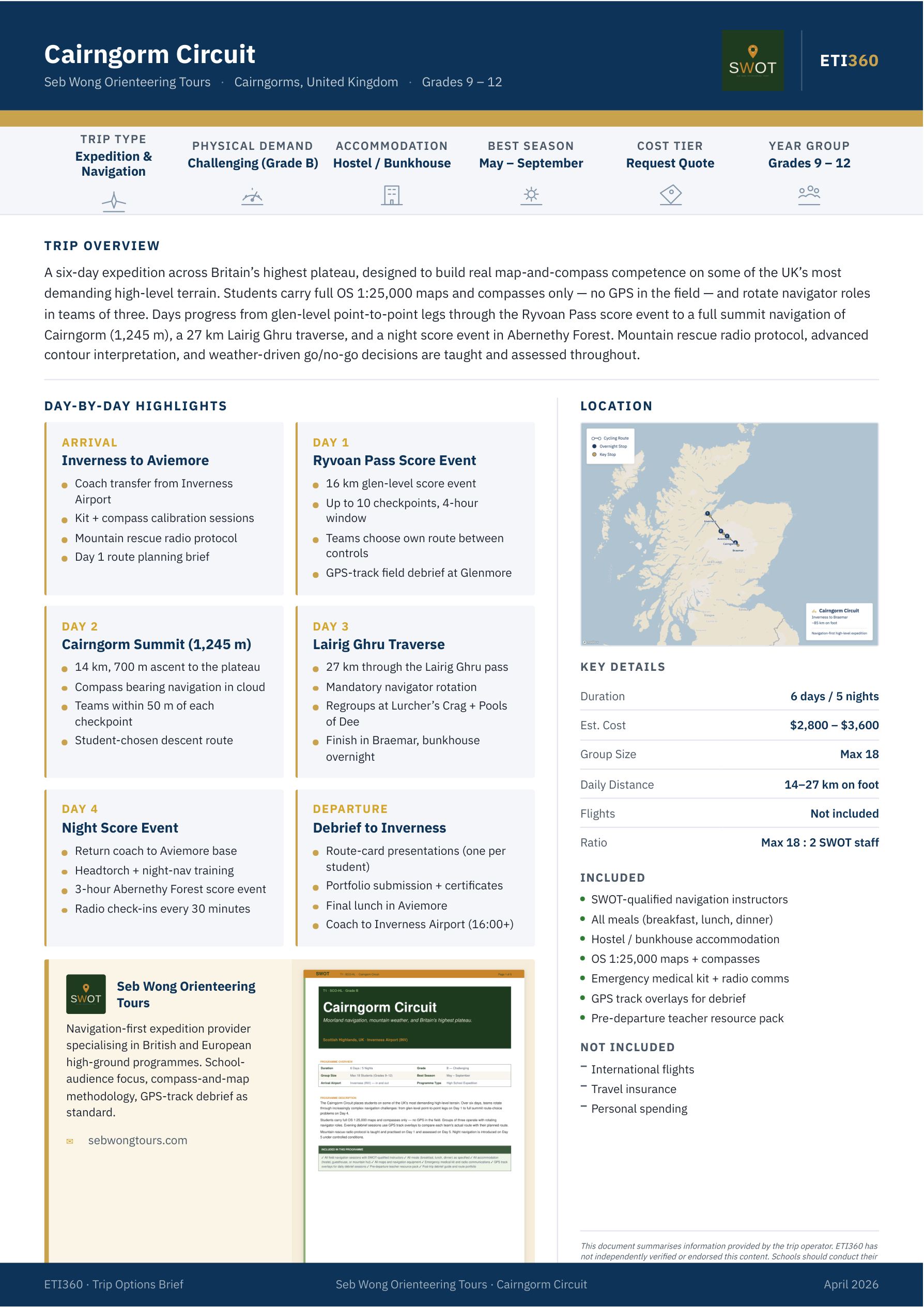
Trip Options Brief
A one-page structured brief produced before the approval meeting. It collapses the provider's submission into comparable evidence — trip type, physical demand, accommodation, season, cost tier, year group, included and excluded elements, and a day-by-day operational summary.
The committee reads it in evidence form rather than narrative form. A provider's glossy proposal is good marketing; a Trip Options Brief is what a governance body actually signs against.
Primary reader Risk committee · Head of school · Trip approval meeting
- This document decides
- Whether the provider matches the school's governance standards
- Whether the destination's operational profile fits the programme
- Whether the trip passes baseline selection before deeper work begins
Stage 02 · Audit
Does the provider meet the standard the school holds itself to?
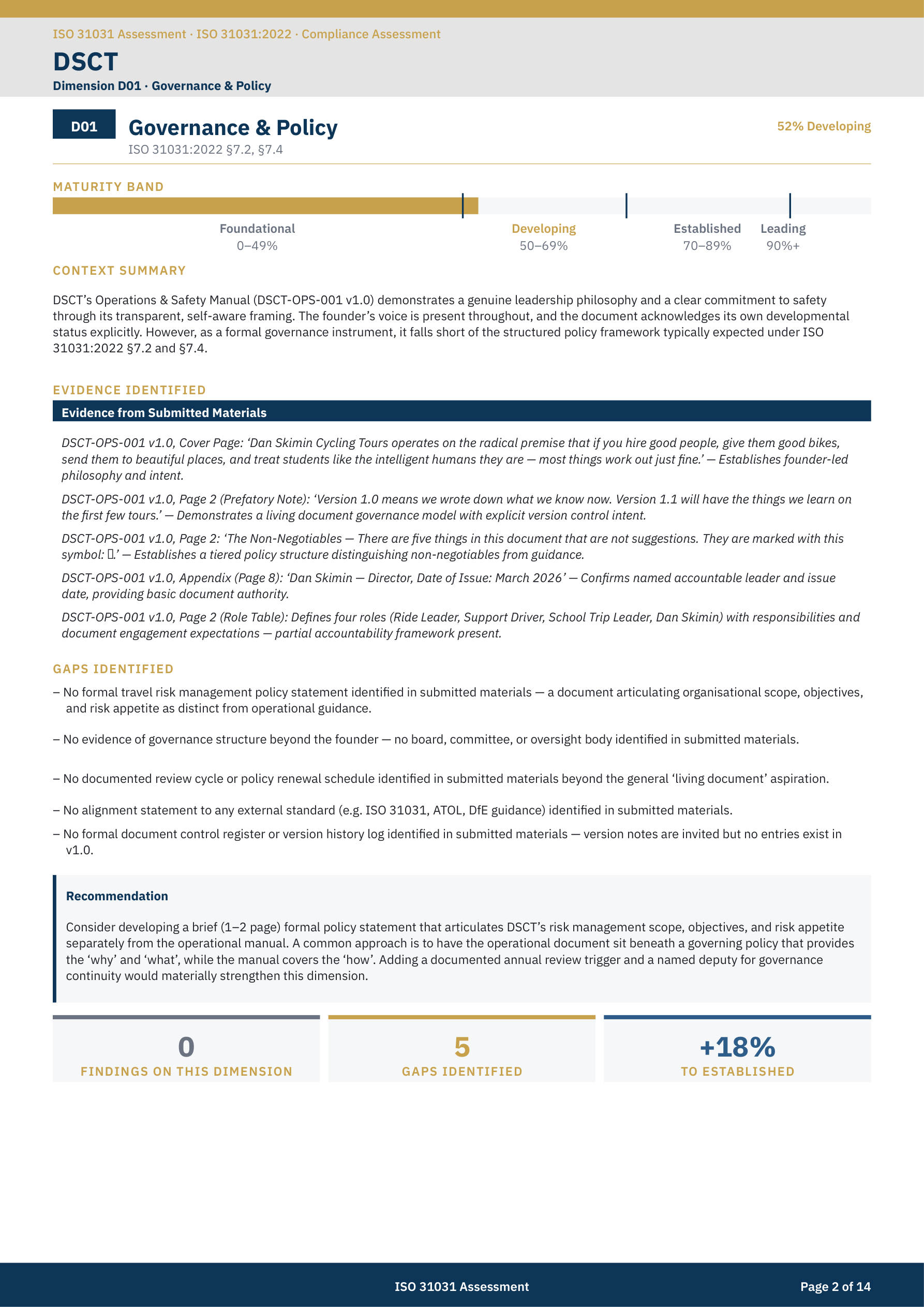
ISO 31031 Audit
A structured maturity assessment across ISO 31031's ten dimensions — governance, risk management, provider selection, communication, monitoring, and the rest. Each dimension is scored Foundational, Developing, Established, or Leading, with evidence cited and gaps itemised.
The audit does not produce a pass/fail. It produces a defensible record. When a committee is asked why they approved a trip, the ISO 31031 Audit is what they point to — findings by dimension, evidence underneath each finding, and recommendations that travel with the trip into the next stage of the cycle.
Primary reader Risk committee · Insurance carrier · Accrediting body
- This document decides
- Where the provider sits on ISO 31031's four-band maturity scale
- What evidence has been submitted and what is missing
- What must be addressed before the trip proceeds, and what can be addressed after
Stage 03 · Lock
Is this the itinerary every party is working from?
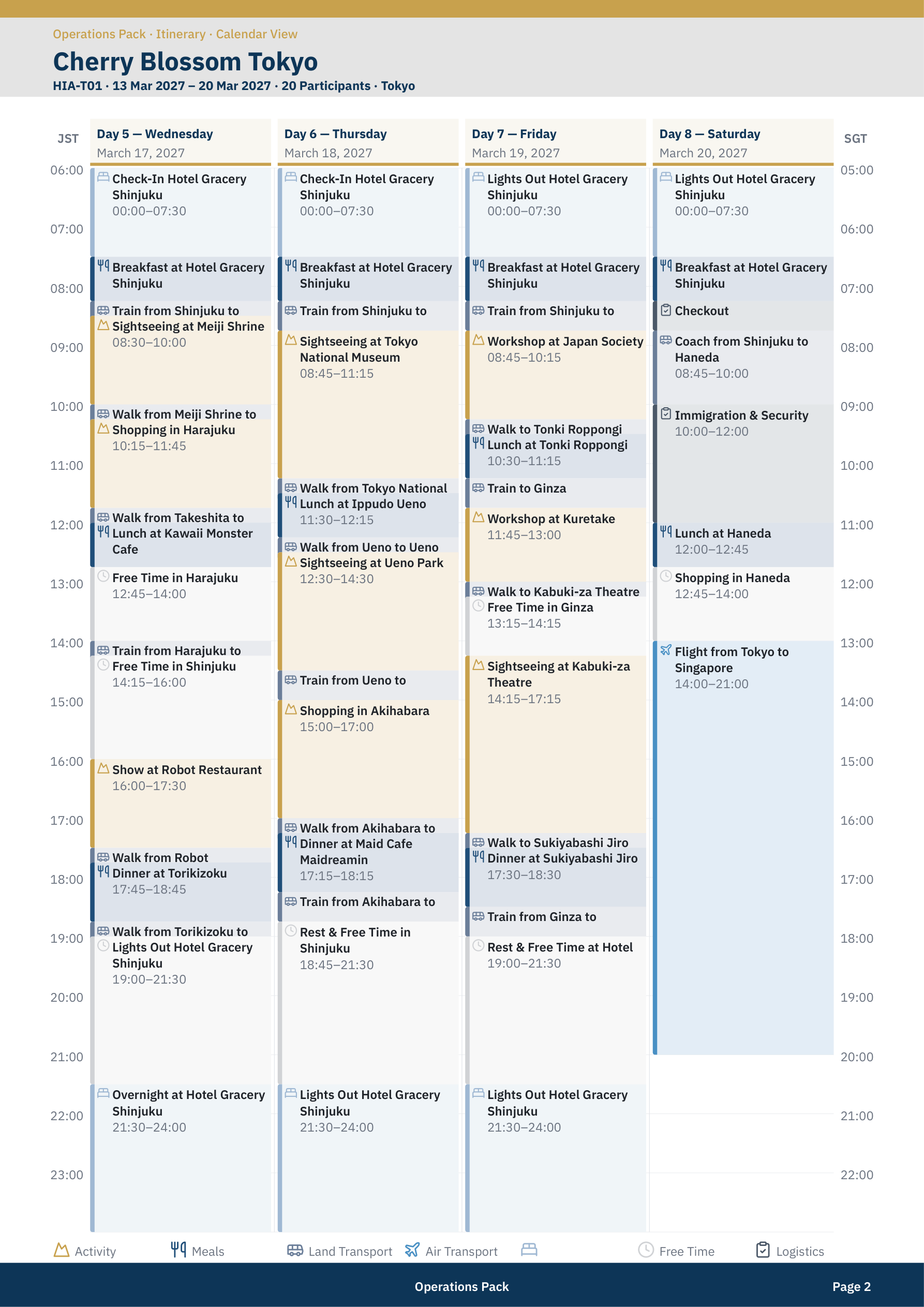
Itinerary Confirmation
A calendar-view confirmation that renders the trip as a four-column hour-block timeline, with meals, activities, accommodation, and logistics visible at a glance in the local time zone plus the school's home time zone.
Trip governance drifts without a single source of truth. Pre-departure emails multiply; providers update one party but not another; parents hold an old version. The Itinerary Confirmation is the artifact every downstream decision references — emergency documentation, parent letters, duty-manager scripts, post-trip review. If it isn't agreed, nothing downstream is.
Primary reader Trip leader · Provider operations · Parents · Duty manager
- This document decides
- What happens on each day, down to the hour
- What transport and accommodation are locked in
- Where drift from the original plan has occurred (and been agreed)
Stage 07 · Run · Location
Where are students at every point during the trip?
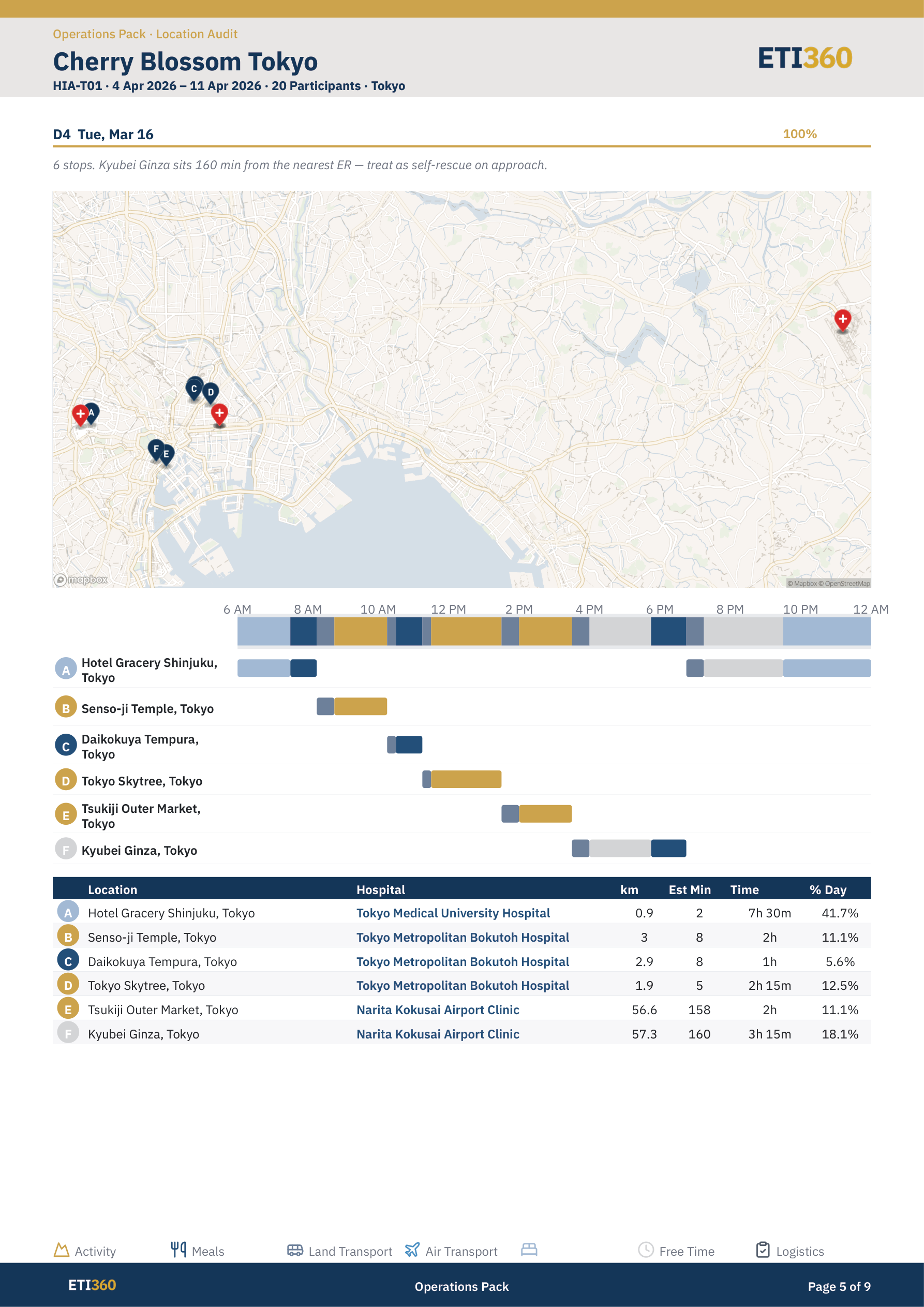
Location Audit
A day-by-day location timeline, each day showing a map of stops, a stacked time-bar of what happens where, and a distance-to-hospital table with the expected road time. 100% day coverage is the standard; anything under 100% is a flagged gap with a named responsible contingency.
Emergency response begins with a location. A trip that cannot tell a duty manager where its students are at 14:15 on day 2 cannot tell an ambulance service the same thing. The Location Audit moves this answer from memory to record.
Primary reader Duty manager · Trip leader · Emergency responder
- This document decides
- The percentage of the trip covered by a known, mapped location
- The nearest hospital for each location and the estimated road time to it
- Gaps in coverage that need a contingency plan before departure
Stage 07 · Run · Route
What does the stated route actually involve?
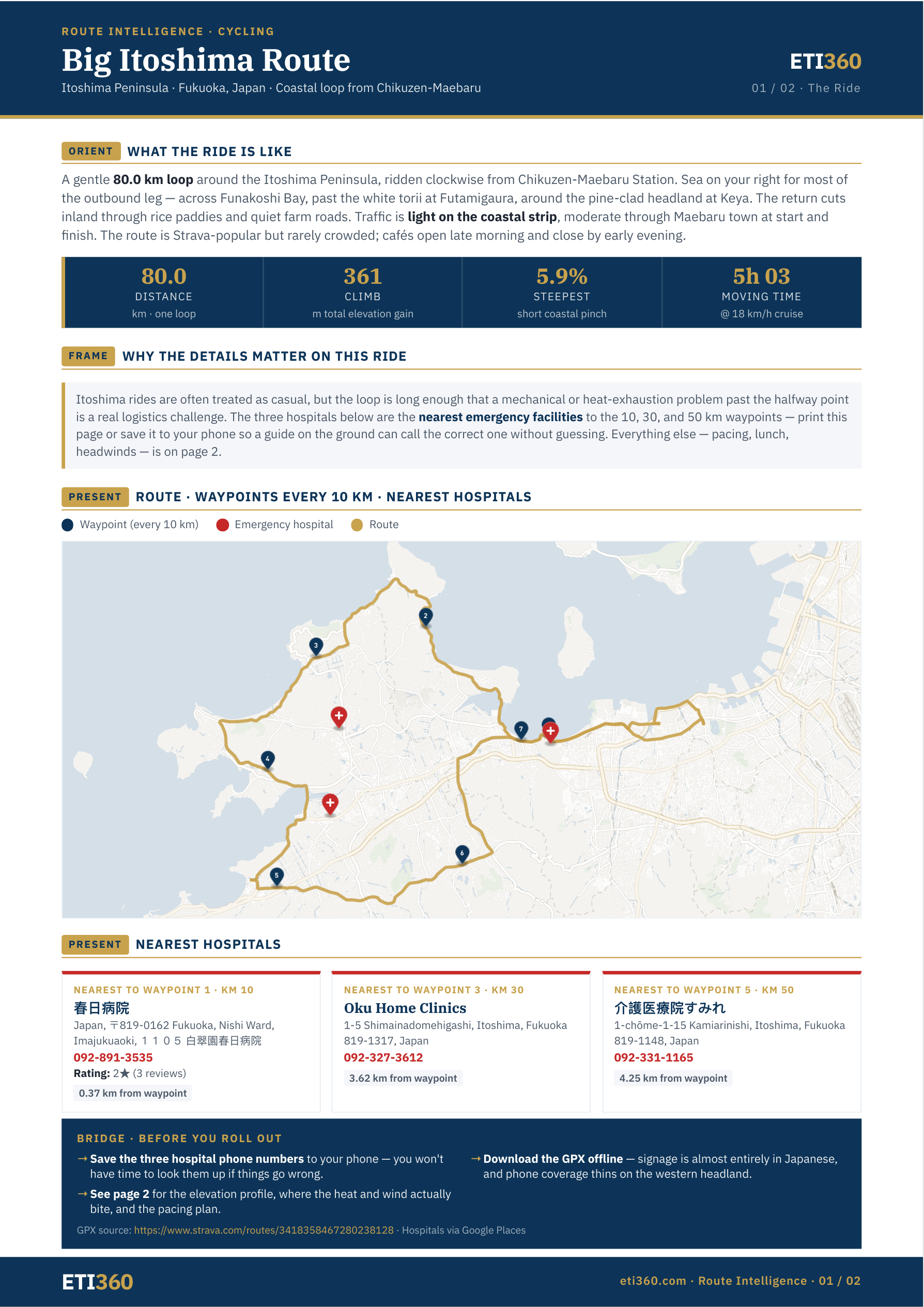
Route Audit
A two-page intelligence brief per route: a stats page with distance, climb, steepest grade, moving time, a waypoint map overlaid with nearest hospitals and phone numbers, plus a “how the ride actually feels” page with an elevation profile, waypoint register (coordinates), direction, season, hydration, lunch and navigation notes, and an on-trip checklist.
A route description supplied by a provider is marketing. A Route Audit is the document a trip leader can actually ride with — where emergency hospitals are along the way, where conditions turn, and where the apparent numbers don’t match the real difficulty. The artifact makes route intelligence portable.
Primary reader Trip leader · Ride leader · Duty manager
- This document decides
- Whether the stated distance, climb and moving time match the route's actual difficulty
- Which waypoints sit near emergency facilities and which do not
- Where on the route — terrain, heat, wind, remoteness — the operational risk concentrates
Stage 07 · Run · Weather
What conditions should trip leaders prepare for?
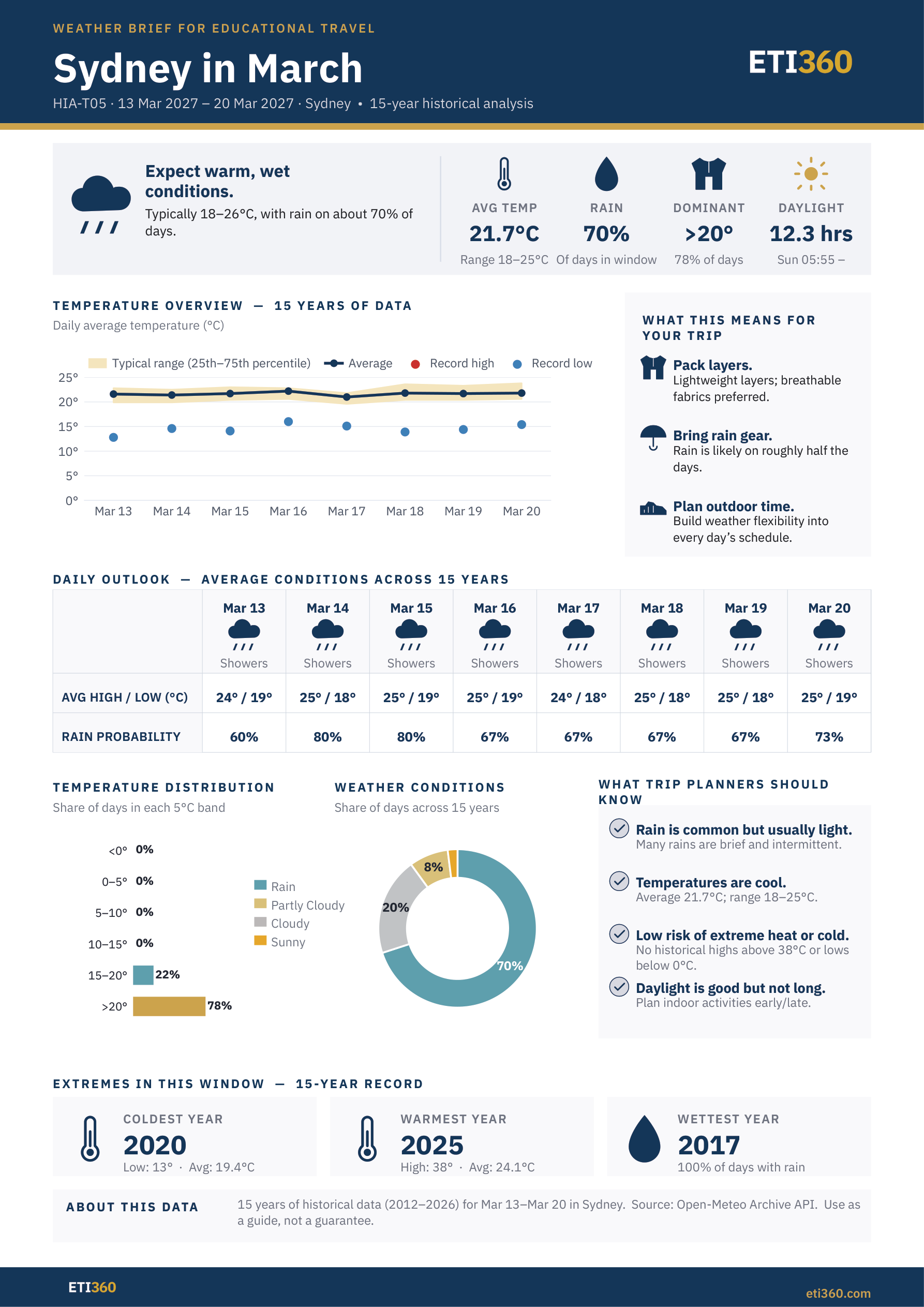
Weather Brief
A single-page climate brief calibrated to the trip's specific window and destination. Fifteen years of historical daily data — temperature range, rainfall probability, dominant conditions — presented with the implication for trip planning explicit: pack layers, bring rain gear, plan outdoor time against real daylight.
A forecast is a guess for a particular week. A Weather Brief is a statement about what a trip leader should plan for, built on enough history that the trip can design around it rather than react to it.
Primary reader Trip leader · Provider operations · Parent pack
- This document decides
- What temperature, rainfall, and daylight to expect, day by day
- Which gear and clothing the participant pack should specify
- What weather-driven go/no-go rules apply to each activity
What the six share
None of these documents are long. None are generic. None are written for an abstract regulator. Each one is built around a named reader, a specific decision, and a time horizon short enough that the document must be usable without re-reading it end to end.
That is the governance cycle's quiet promise: that by the time a committee approves, or a trip leader acts, or a duty manager escalates, the evidence the moment requires has already been produced — in a form the moment can actually use.