
Horizon Ridge School of Cleveland is taking twenty tenth graders to Costa Rica for nine days over spring break. ETI360 brought together the school's itinerary, the host operator's and the properties' arrangements, and the school's own procedures, checked the passport rule against Costa Rica's own entry requirements and the health guidance against the CDC, timed every road transfer and traced the boat leg along the canal, and listed the emergency departments by travel time from each of the three bases; the school or provider confirms which one the group uses. Each document below is written for the person who uses it, and each opens in full.
Horizon Ridge School of Cleveland is a fictional school; its location is shown for illustrative purposes.
- Trip
- Costa Rica Service and Ecology Journey, Saturday, March 20 to Sunday, March 28, 2027
- Group
- 20 tenth-grade students and four chaperones, one adult for every five students, in the same groups of five all week
- Program
- Poás Volcano National Park; a rainforest field study with the Selva Verde naturalists and the Tirimbina biologists, including river water quality and the bat program; a school-improvement project with the Sarapiquí Conservation Learning Center; the opening nights of the leatherback census at Pacuare Nature Reserve; a canal wildlife transect. Spanish is used every day and assessed.
- Travel
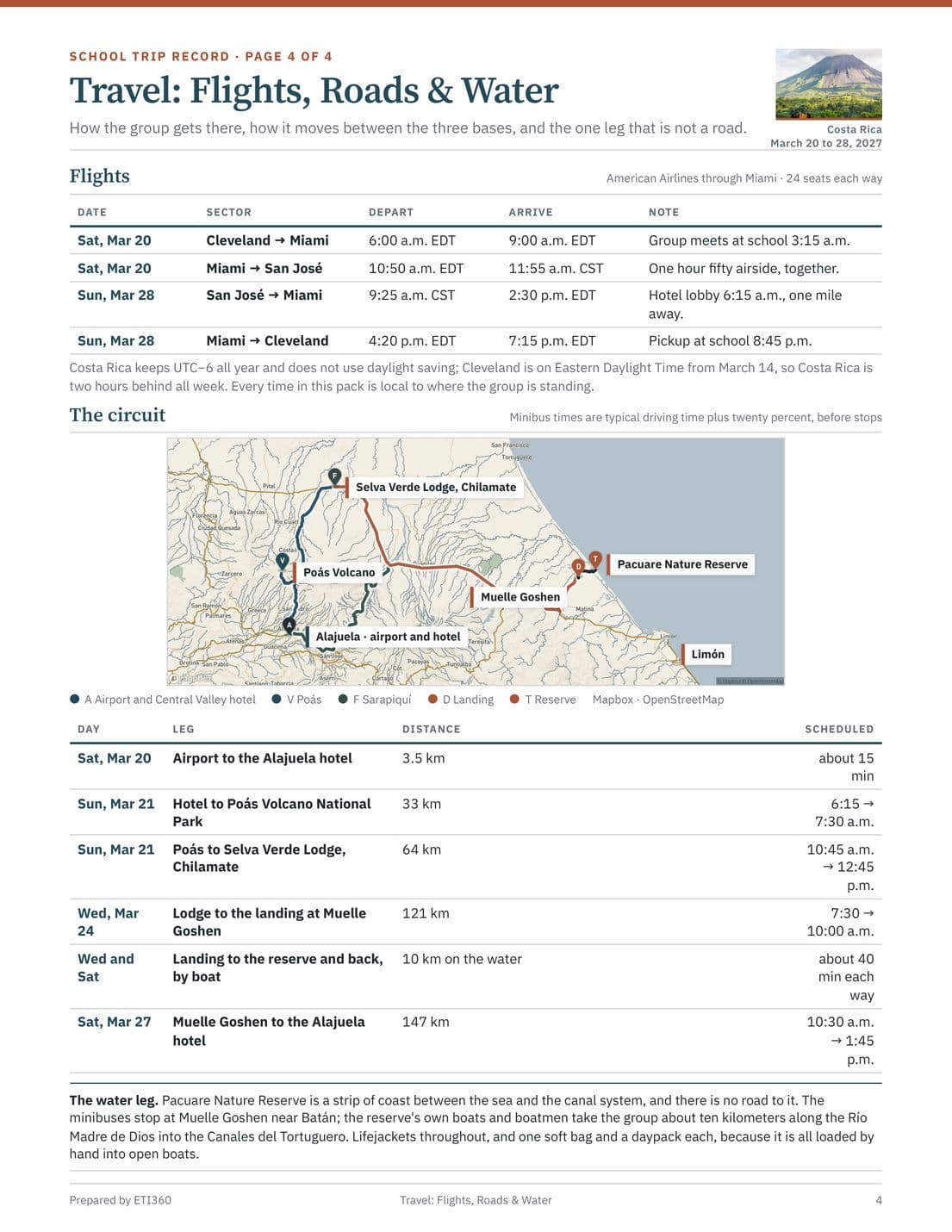
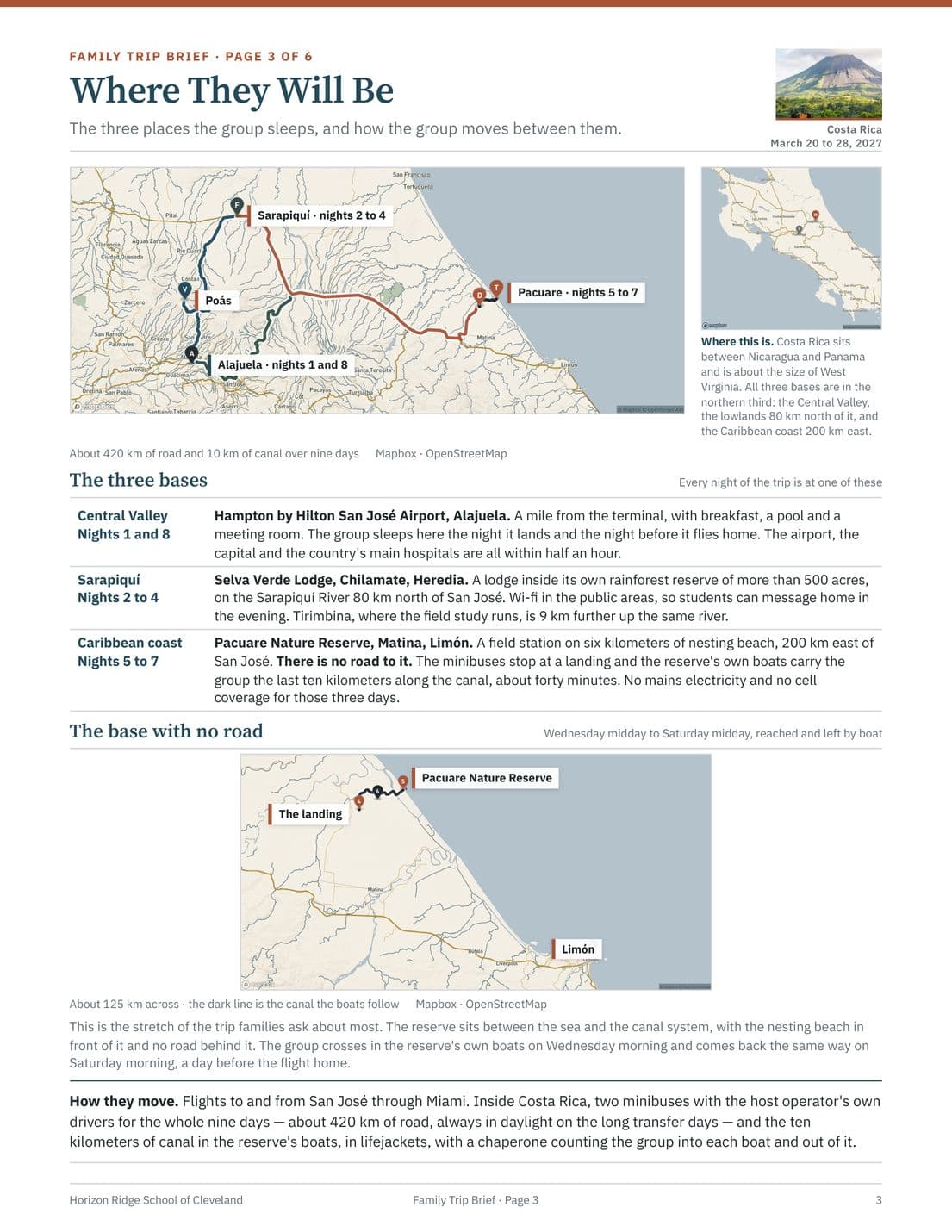
- Flights through Miami, then two minibuses with the host operator's own drivers for nine days. The coastal reserve has no road: the reserve's boats carry the group the last ten kilometers, about forty minutes each way
- Lodging
- Eight nights at three bases: an airport hotel in Alajuela on arrival and before the flight home, three nights at a rainforest lodge in Sarapiquí, and three at a coastal reserve with no mains electricity and no cell coverage
- School
- Horizon Ridge School of Cleveland, a fictional school
Decision by decision
Each decision the school makes about the trip, and the documents that support it. Every document is written for the person who uses it, and every one opens in full. Under each document, Look inside shows three of its pages as the school receives them; select a page to open the US Letter edition at that page.
ETI360 builds every document to two paper sizes. The US Letter edition (8.5 × 11 inches) is the standard in the United States; the A4 edition (210 × 297 mm) is the standard in most other countries.
Approving the trip
The record the office files, and the Trip Risk Working File for the school to review, complete, and approve.
School
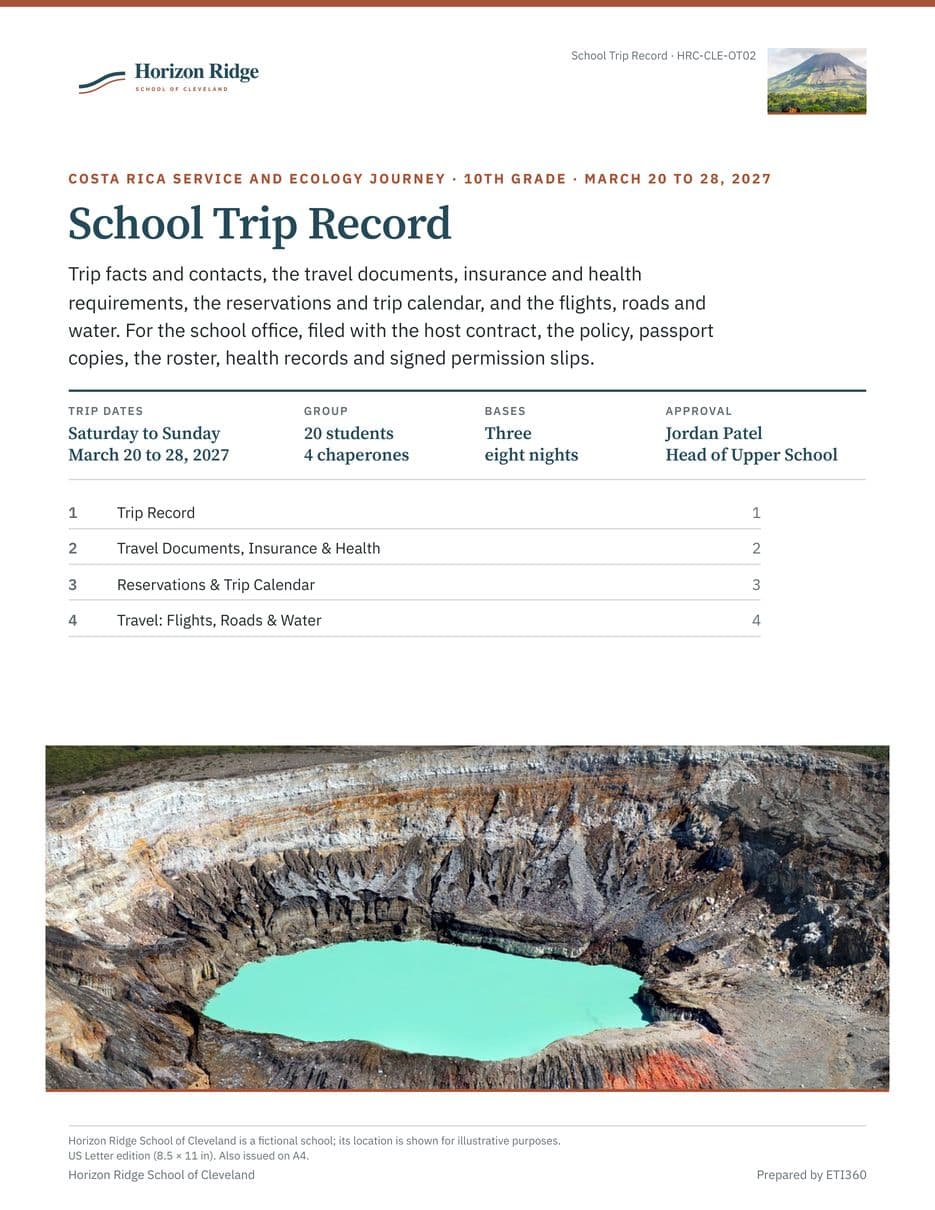
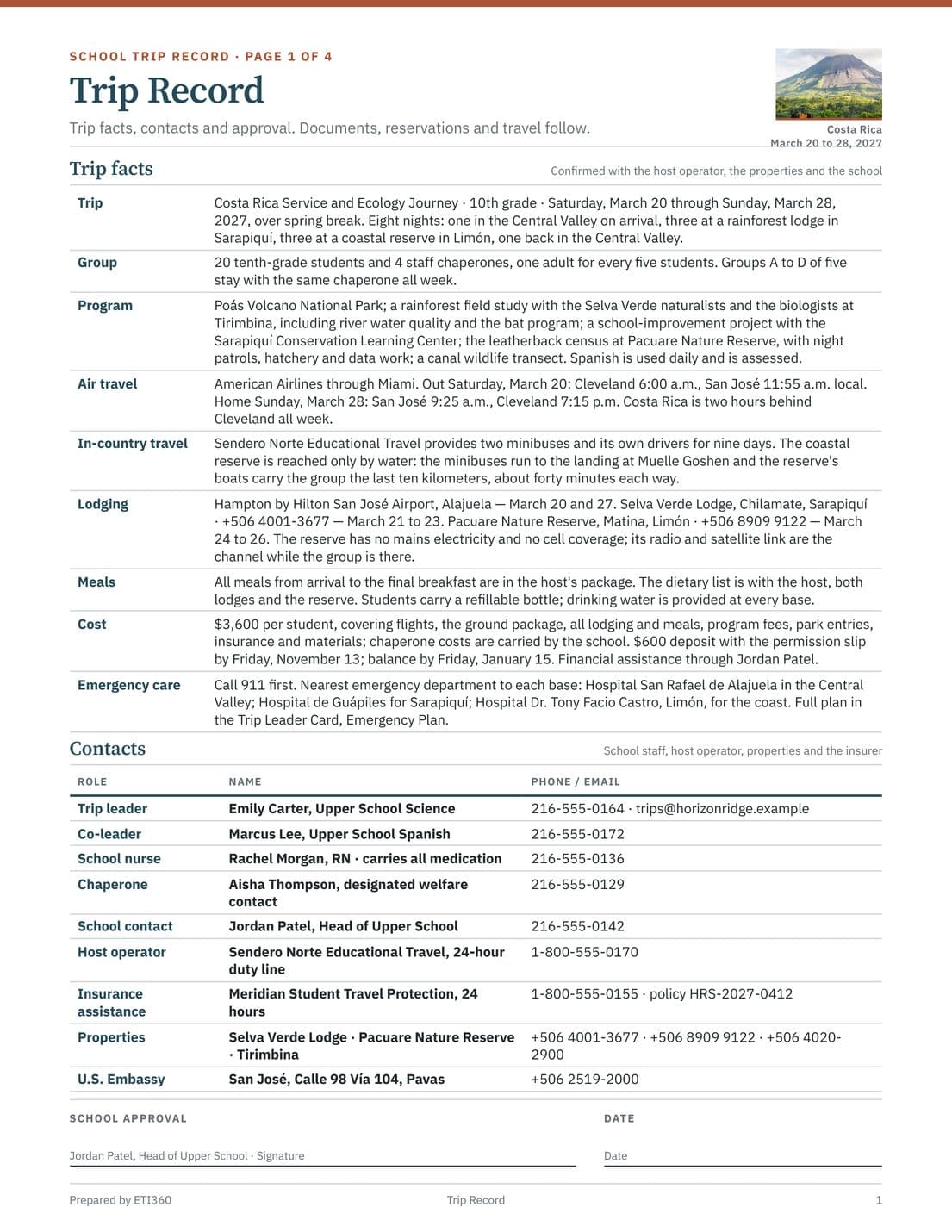
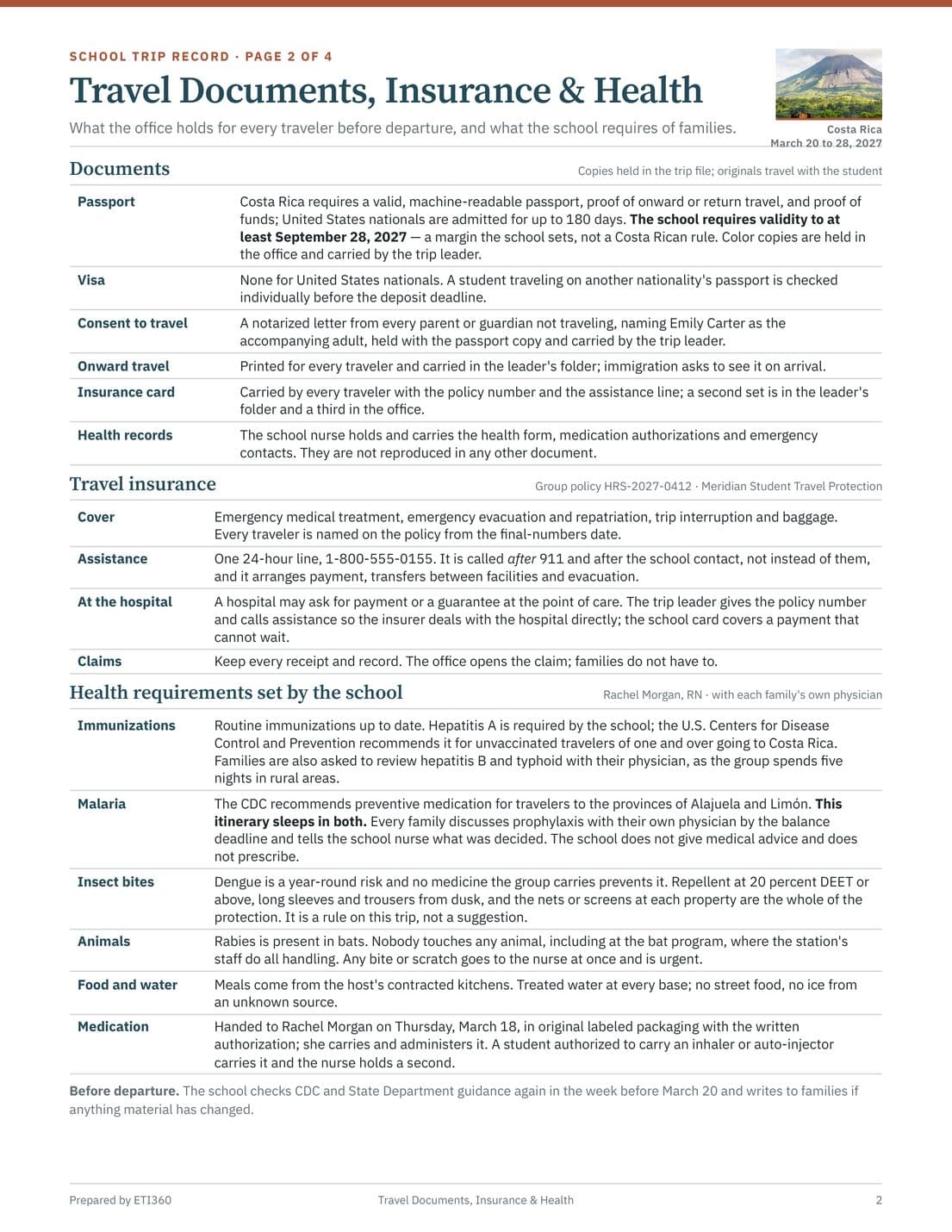
School Trip Record
Trip facts and contacts, the travel documents, insurance, and health requirements, the reservations and trip calendar, and the flights, roads, and water. Filed with the host contract, the policy, passport copies, the roster, health records, and signed permission slips.
Look inside
School
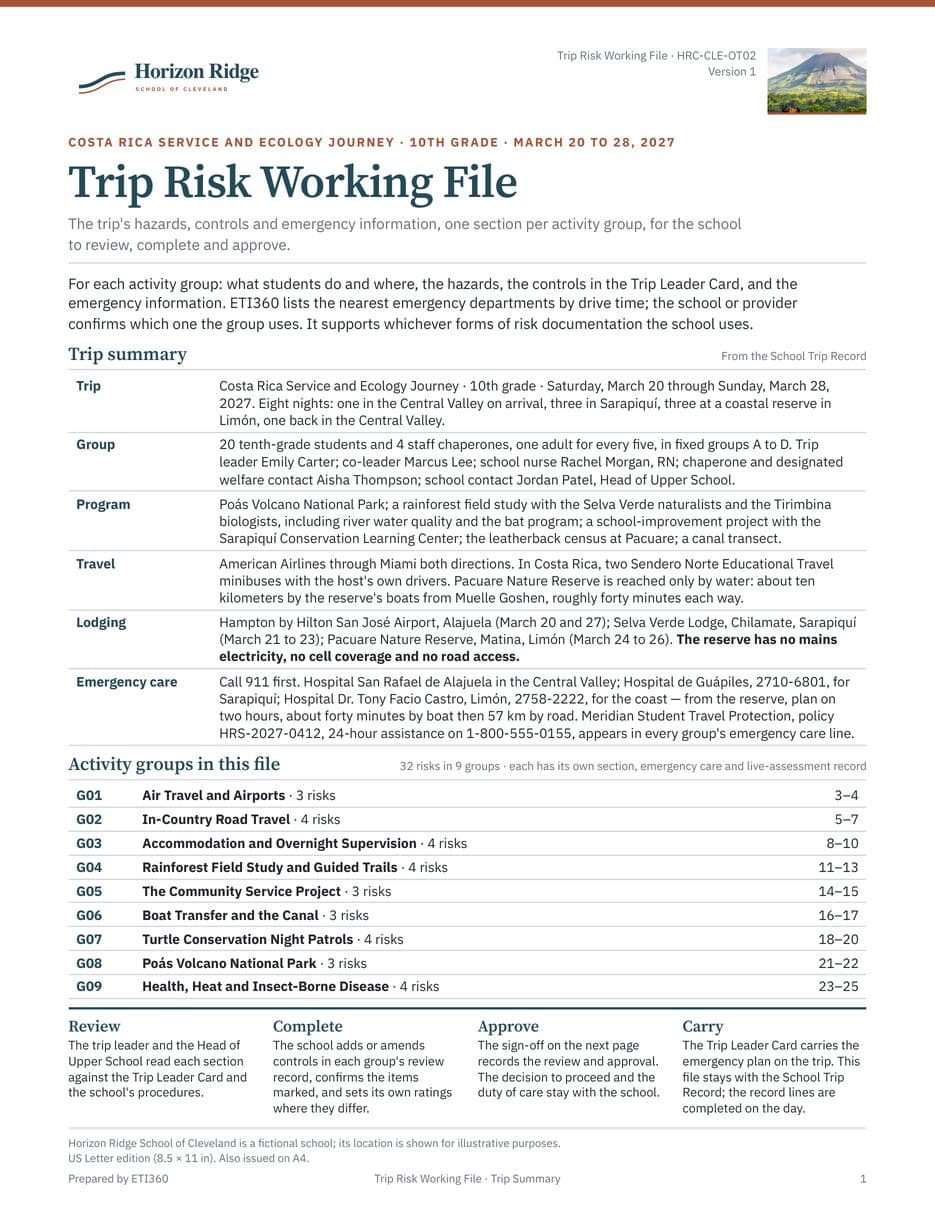
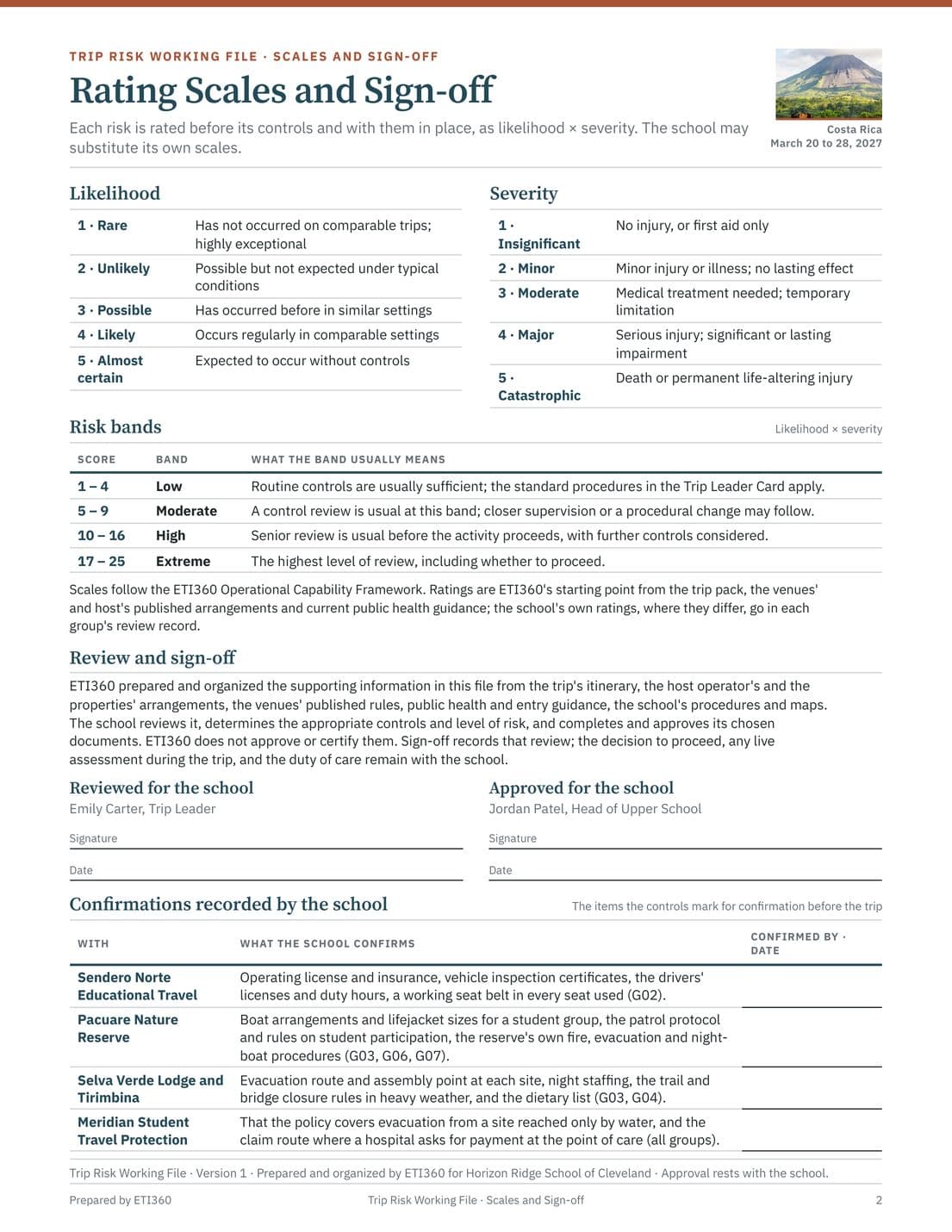
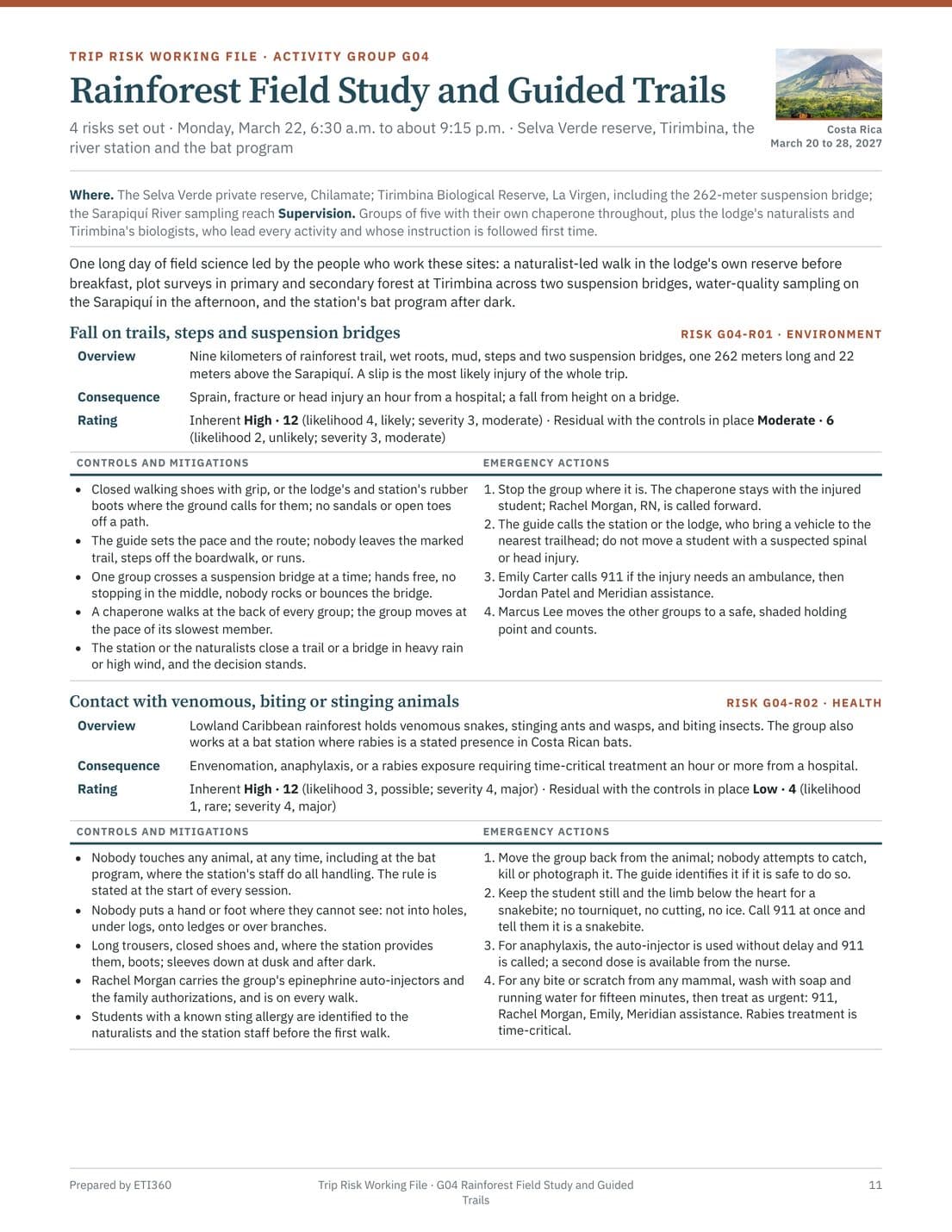
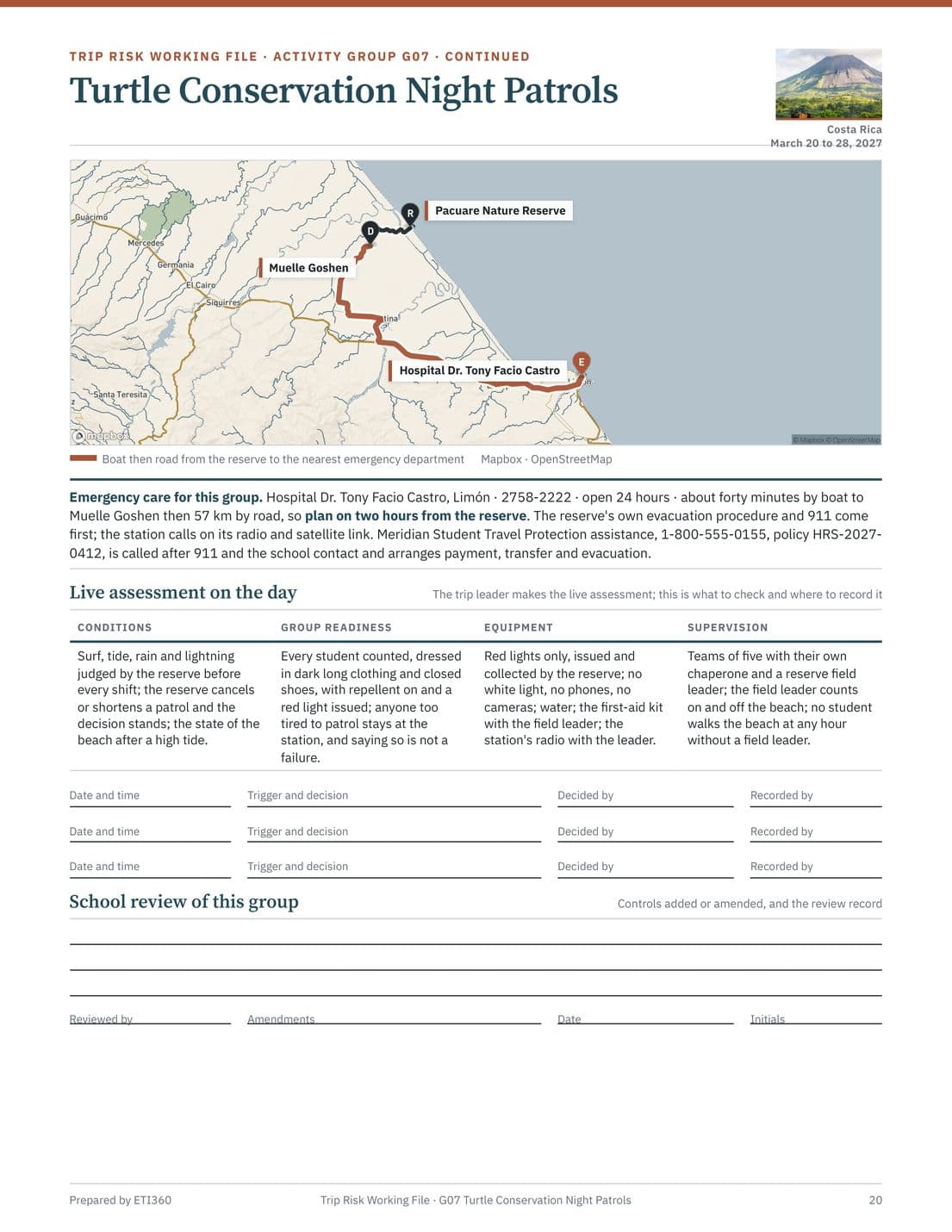
Trip Risk Working File
Hazards, controls, and emergency actions organized one section per activity group, from the flights and the host's road travel to the boat crossing and the night patrols, with the live-assessment prompts for the day. The school completes it, amends it, and approves it.
Look inside
Telling families
The letter home, where the group sleeps each night, the passport and health requirements, and the forms that come back with the deposit.
Families
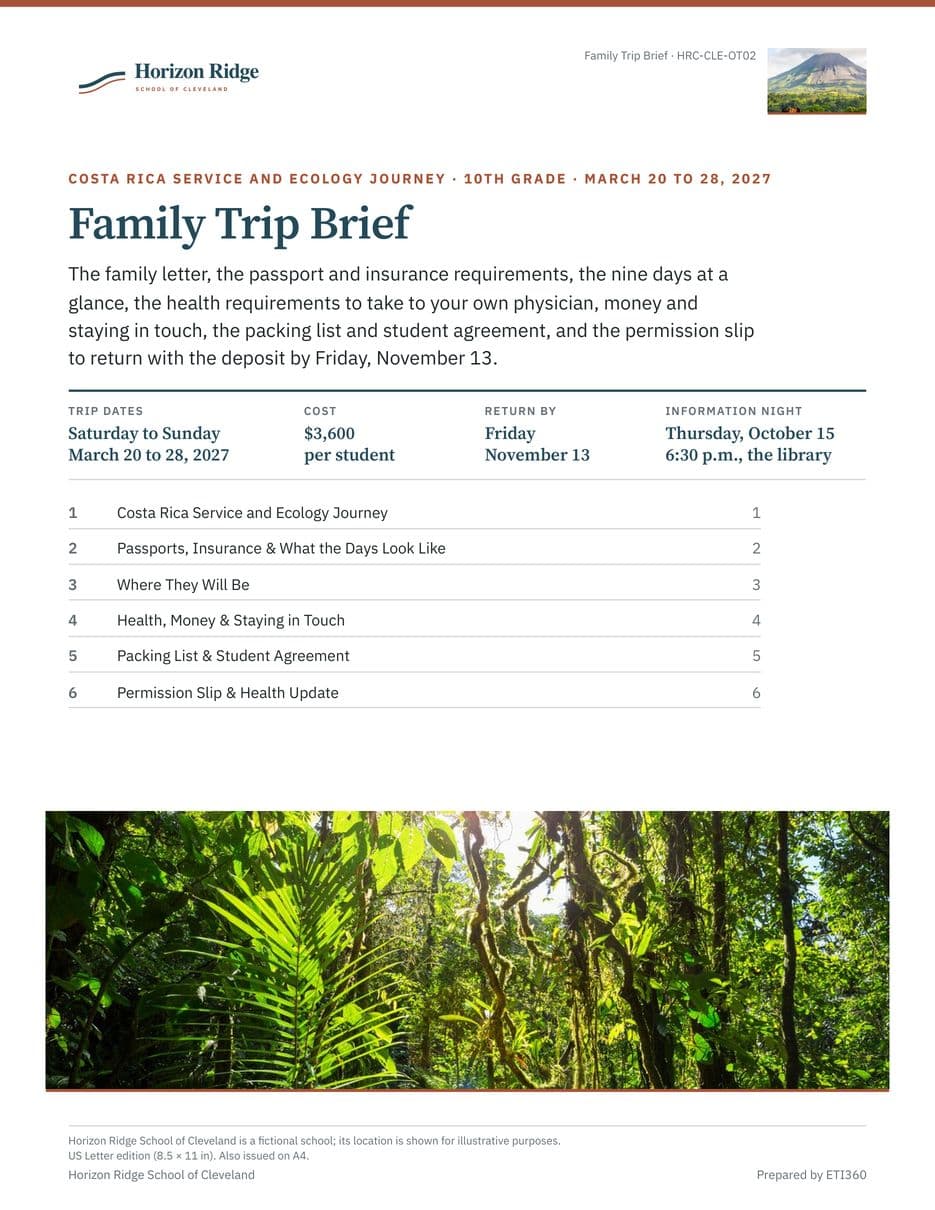
Family Trip Brief
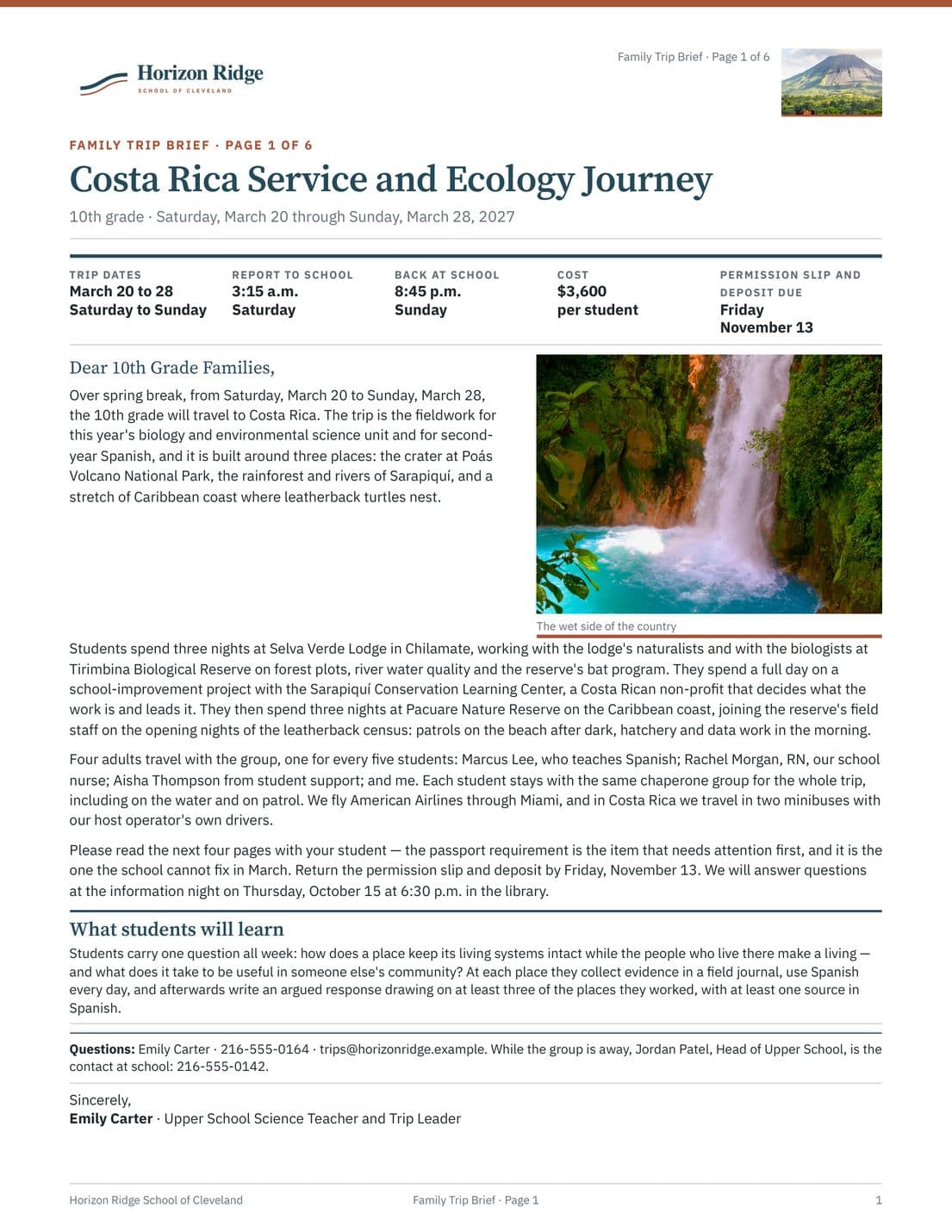
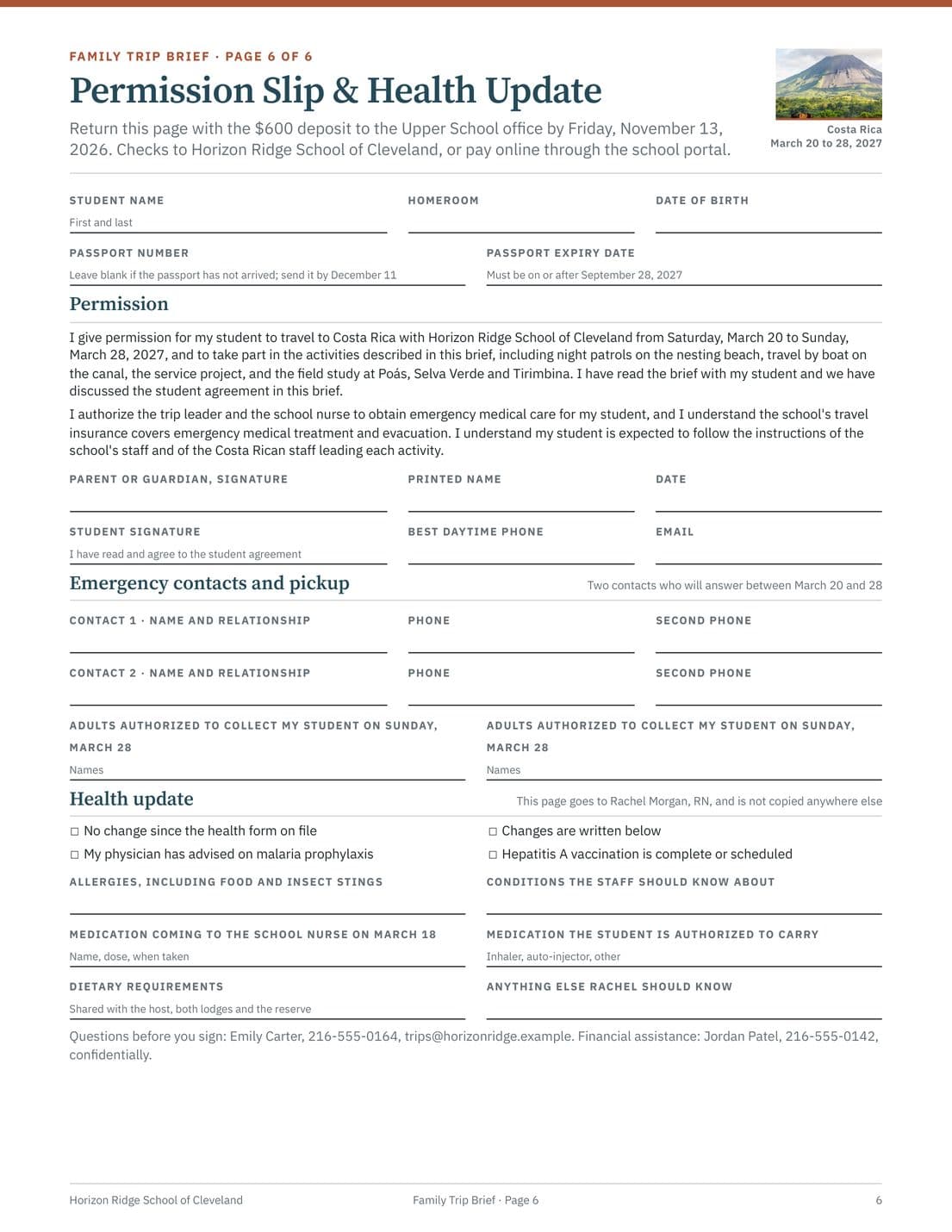
The letter home, the passport and insurance requirements, the nine days at a glance, where the group sleeps each night, the health requirements for families to take to their own physician, money and staying in touch, the packing list and student agreement, and the permission slip and health update that come back with the deposit.
Look inside
Preparing the leader and chaperones
The airport days, day plans timed to the minibuses and the boats, the procedures, and the emergency departments by travel time from each base.
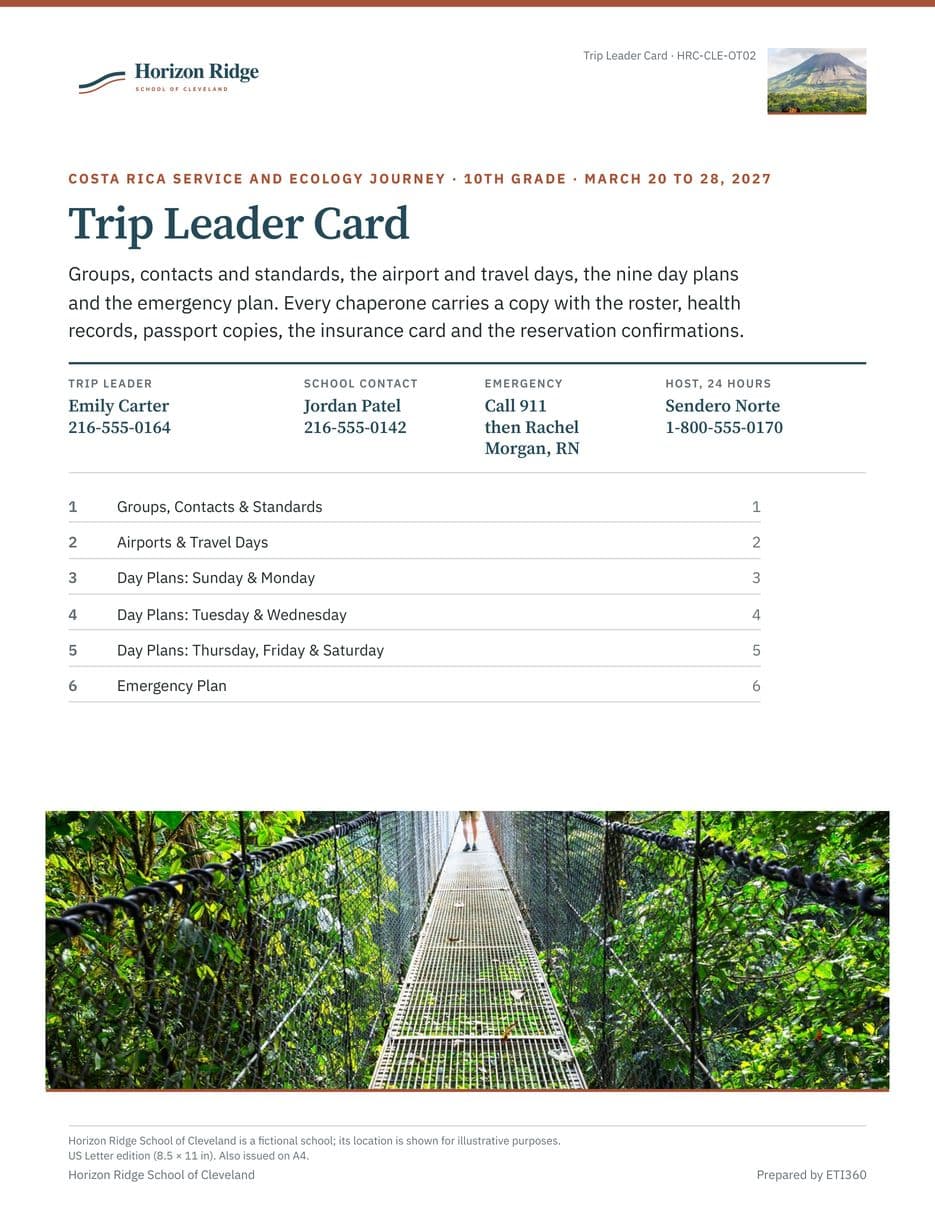
Trip leader
Trip Leader Card
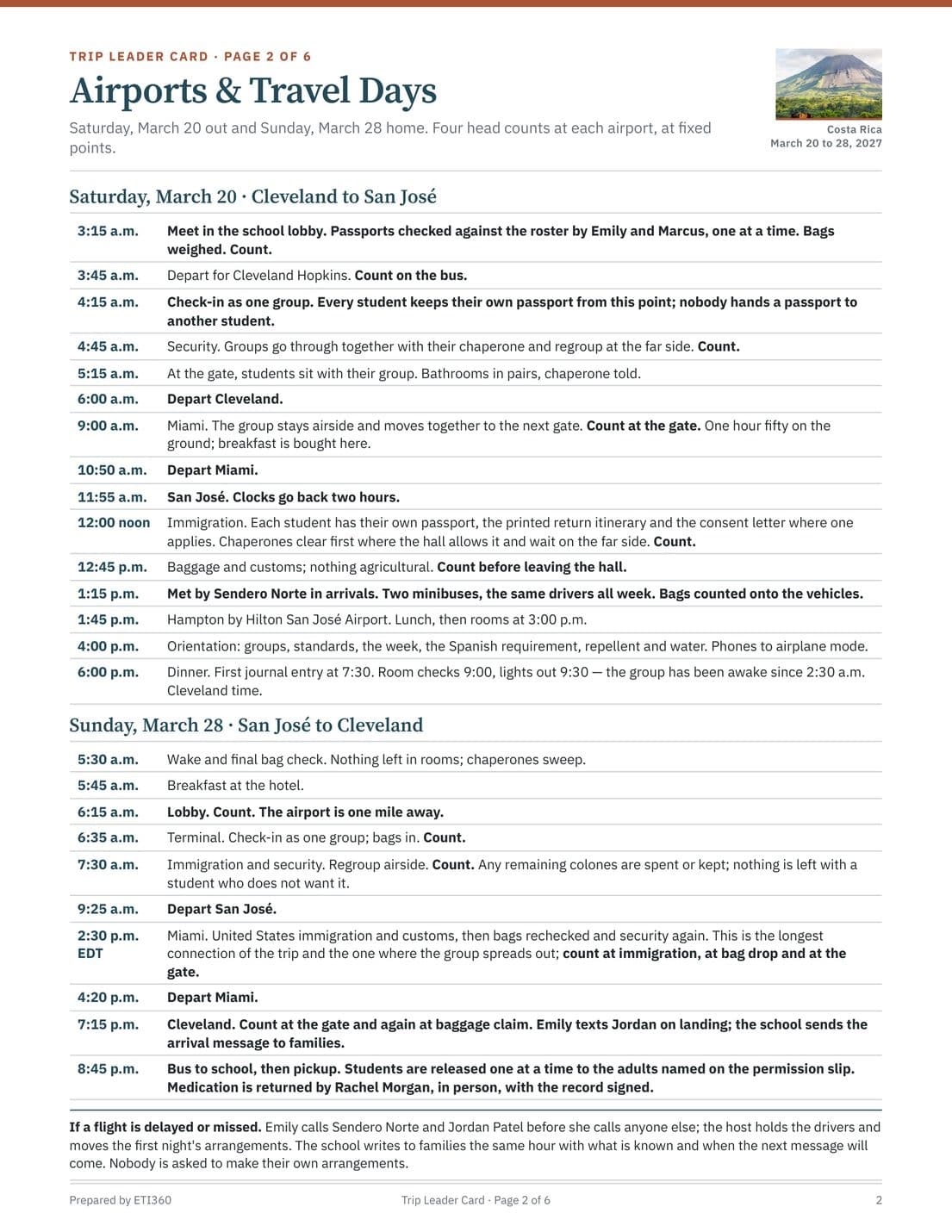
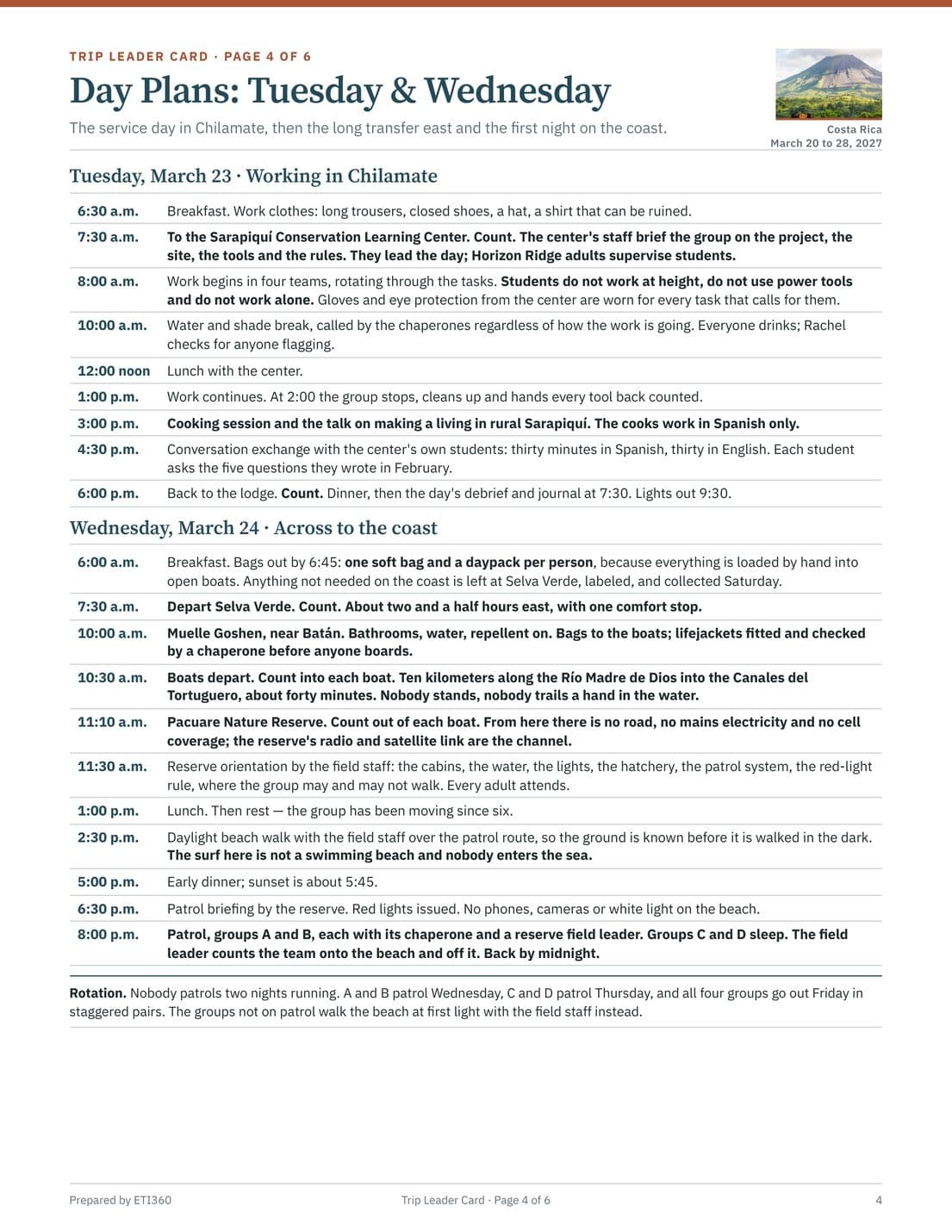
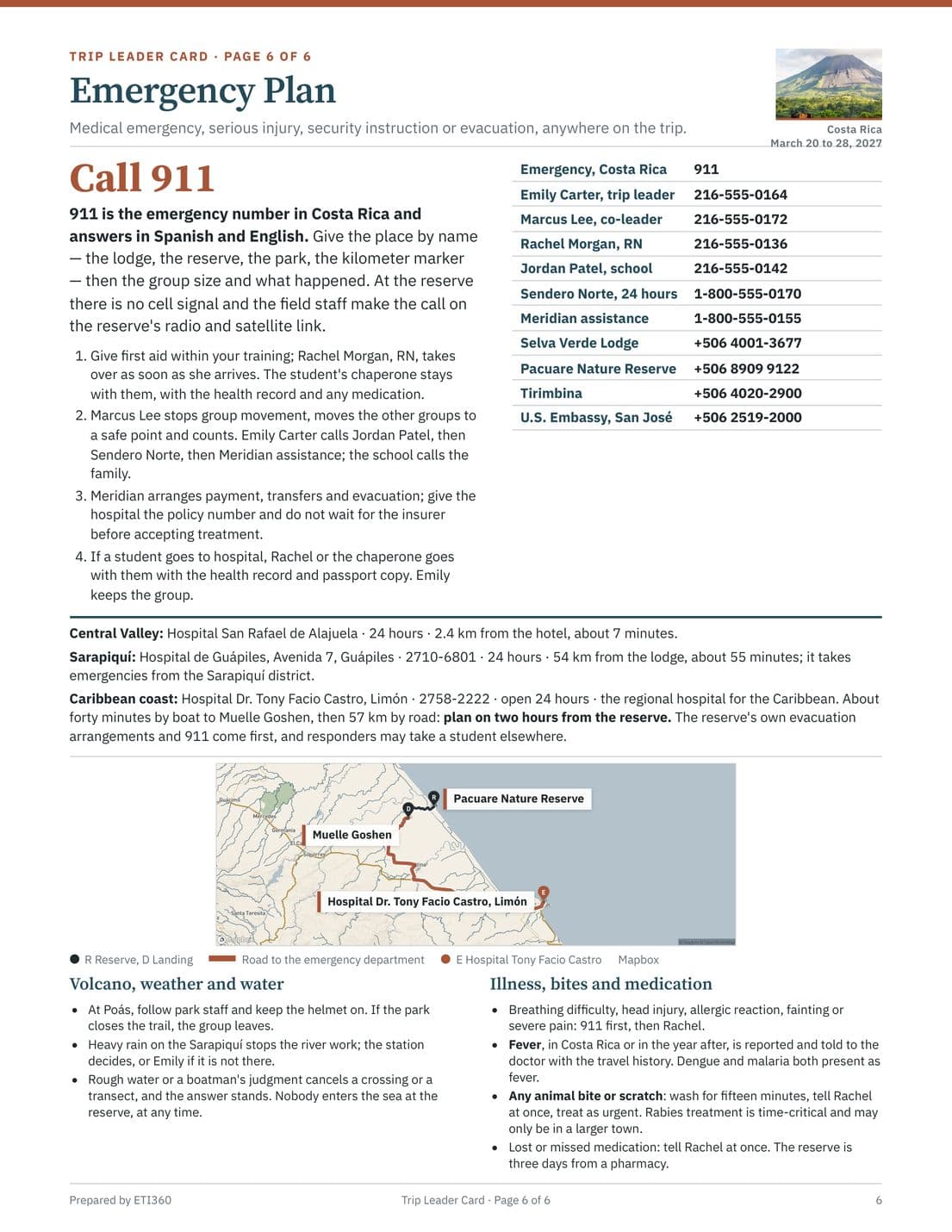
Groups, contacts, and standards, the airport and travel days in both directions, day plans for all nine days, and the emergency plan: the emergency departments by travel time from each of the three bases.
Look inside
Chaperones
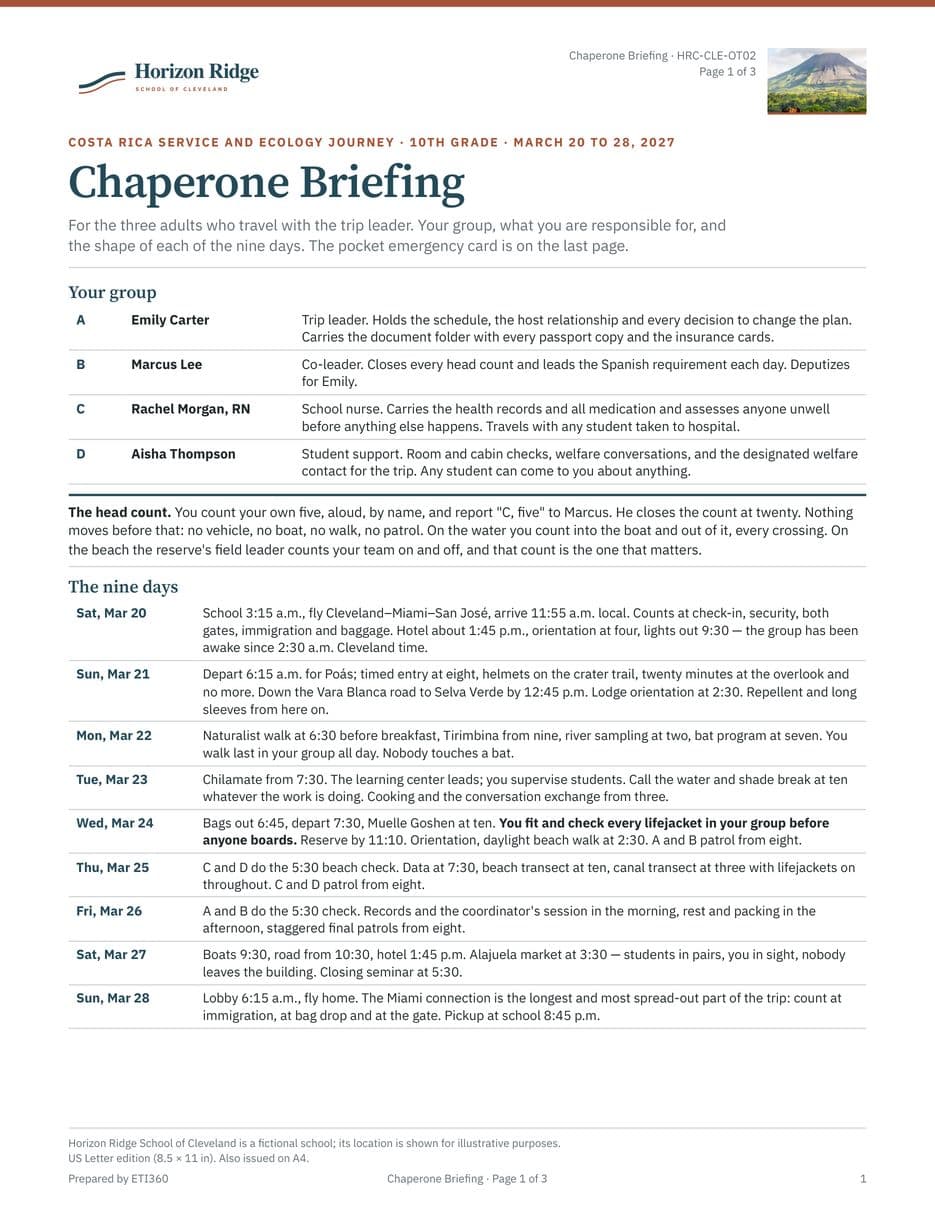
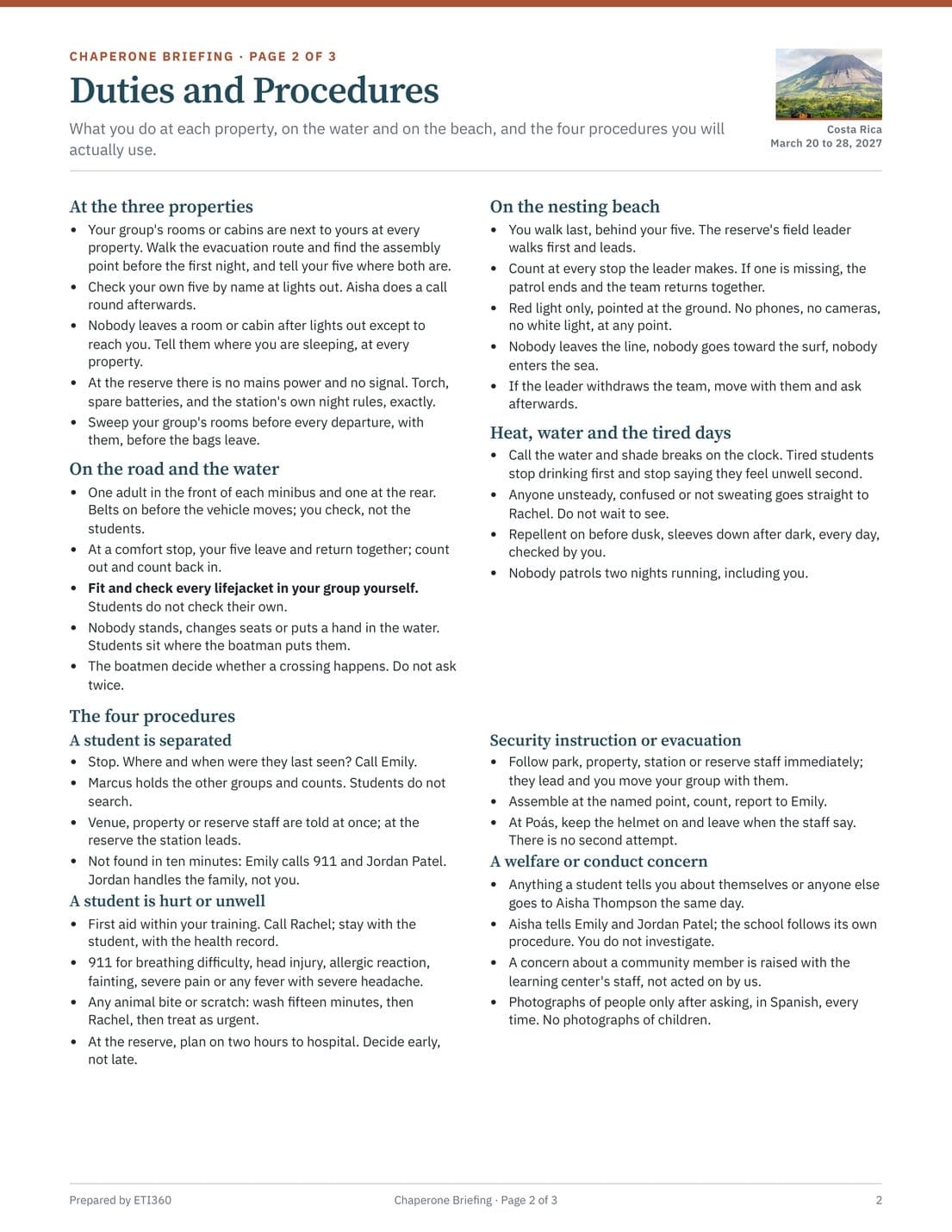
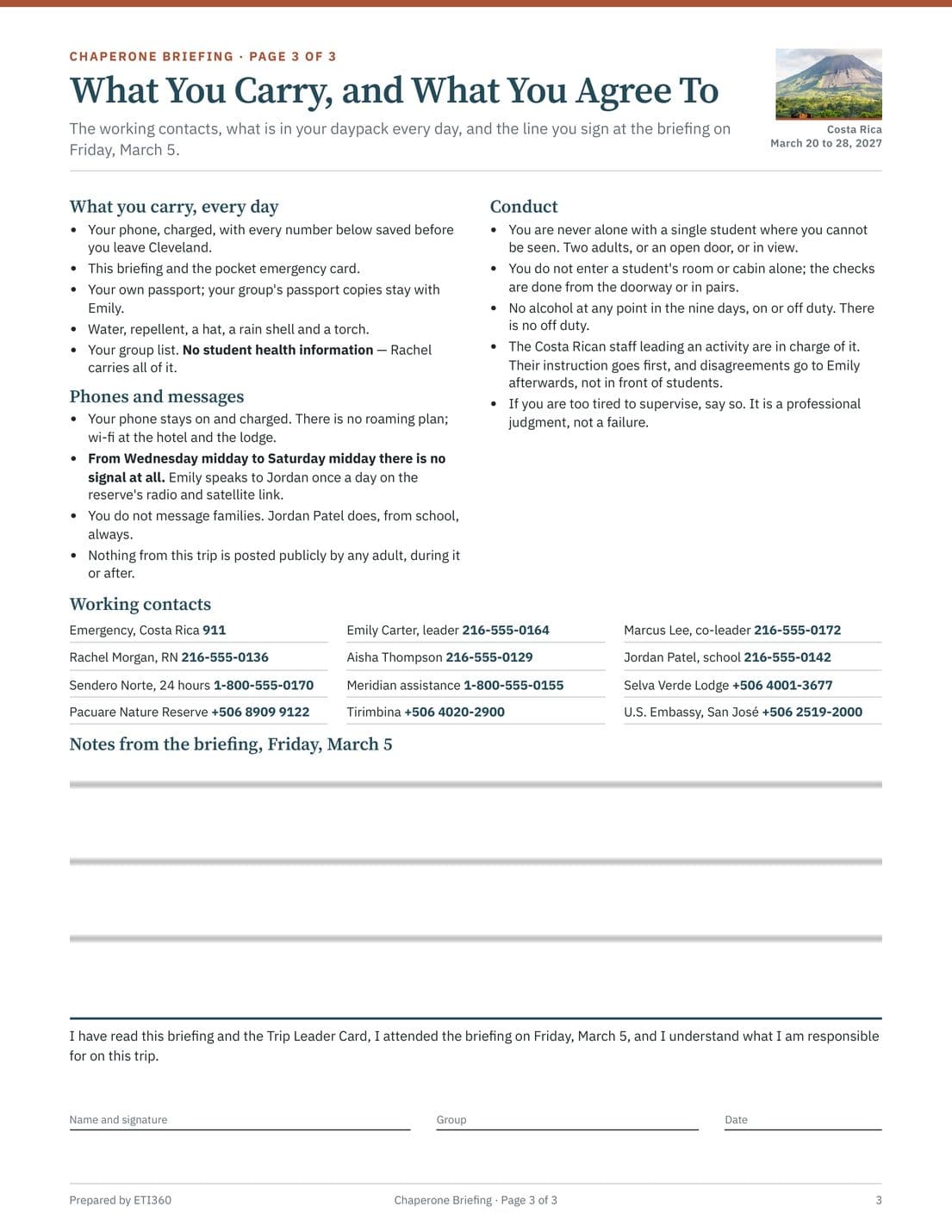
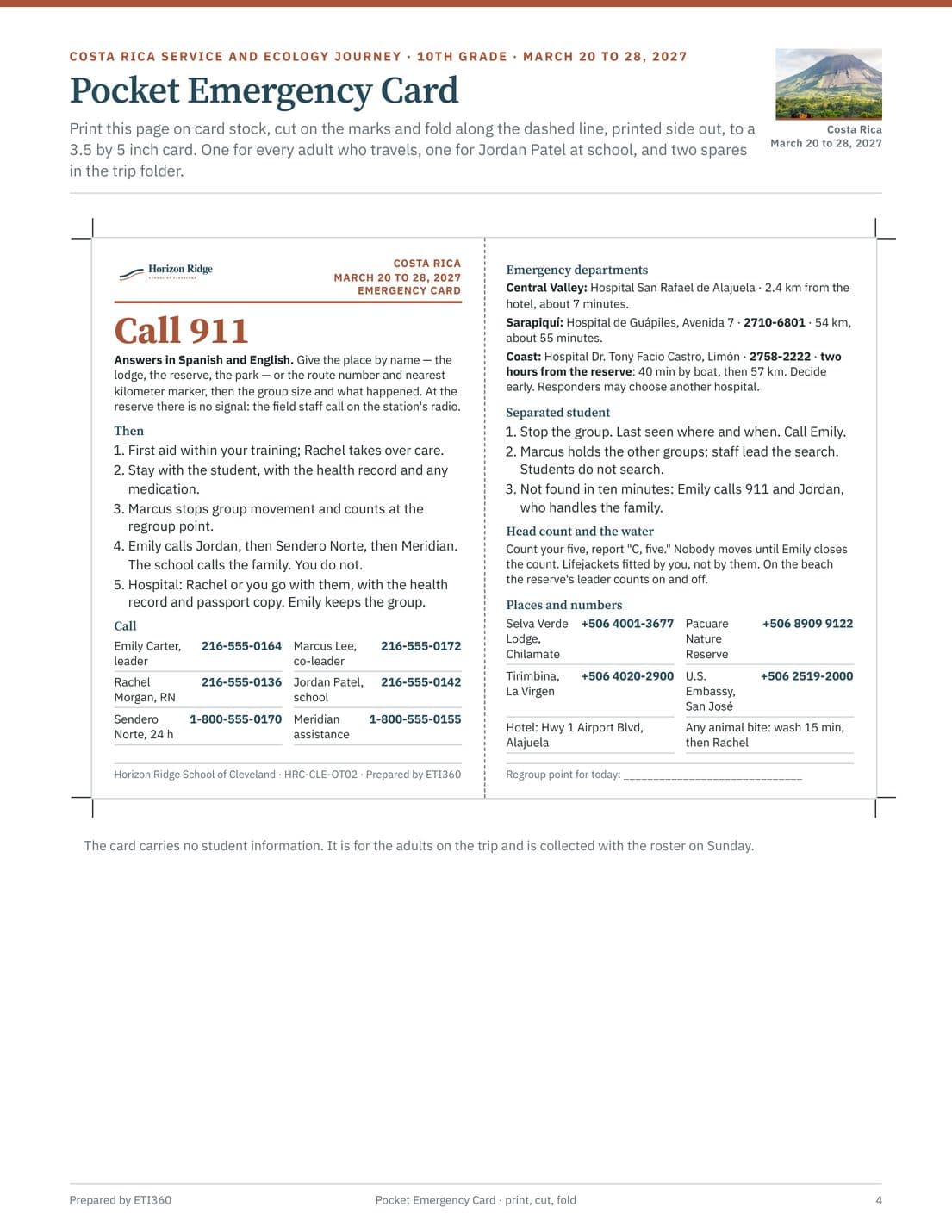
Chaperone Briefing and Pocket Emergency Card
For the adults who each take five students: their group and role, the head count, the nine days in brief, property, boat, and beach duties, and the four procedures, with a card to print, cut, and fold that carries the emergency sequence and every working number.
Look inside
Connecting the trip to learning
One inquiry question, carried from the classroom to six places and back.
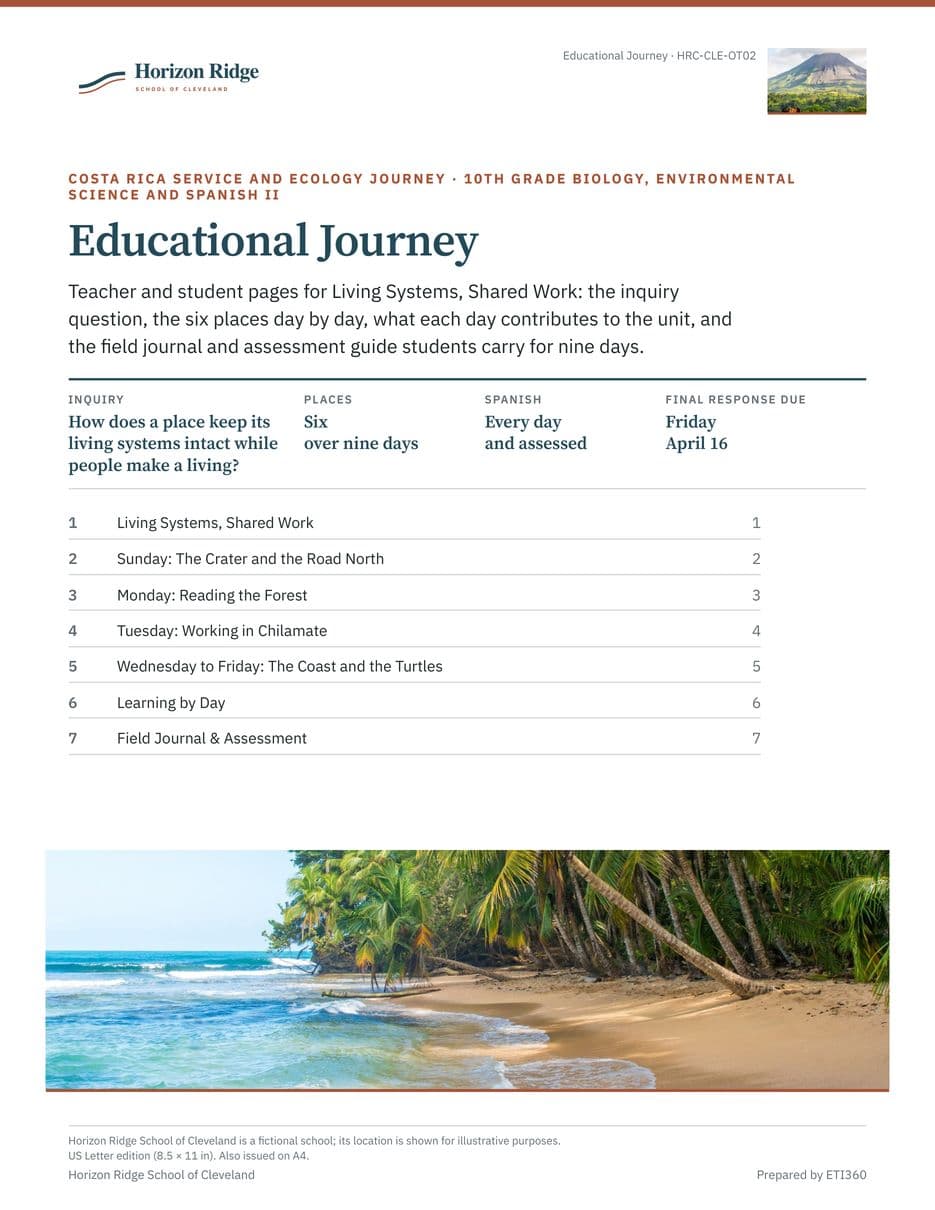
Teachers
Educational Journey
One inquiry question, the six places day by day with a map for each day, what each day contributes to the biology and environmental science unit and to Spanish, and the field journal and assessment guide.
Look inside
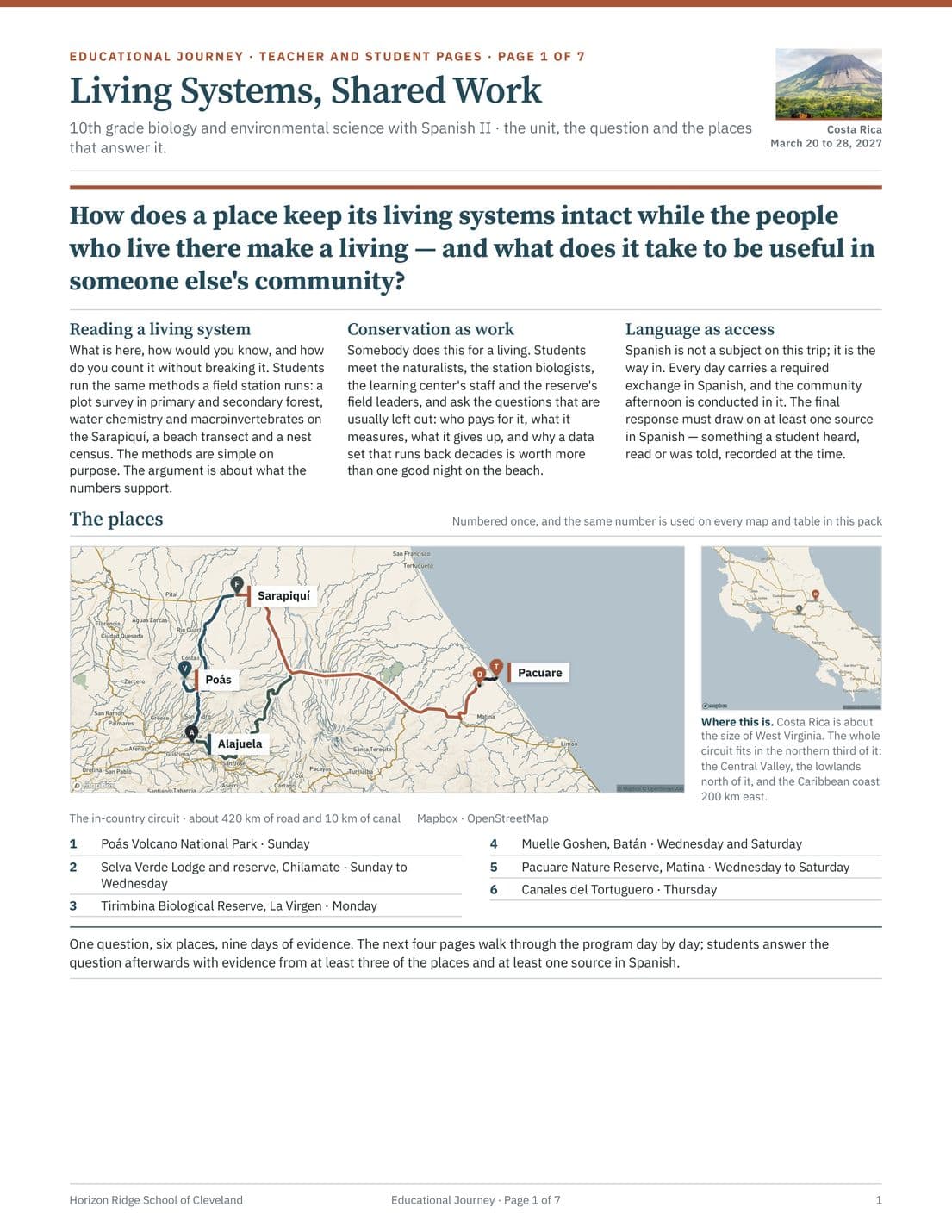
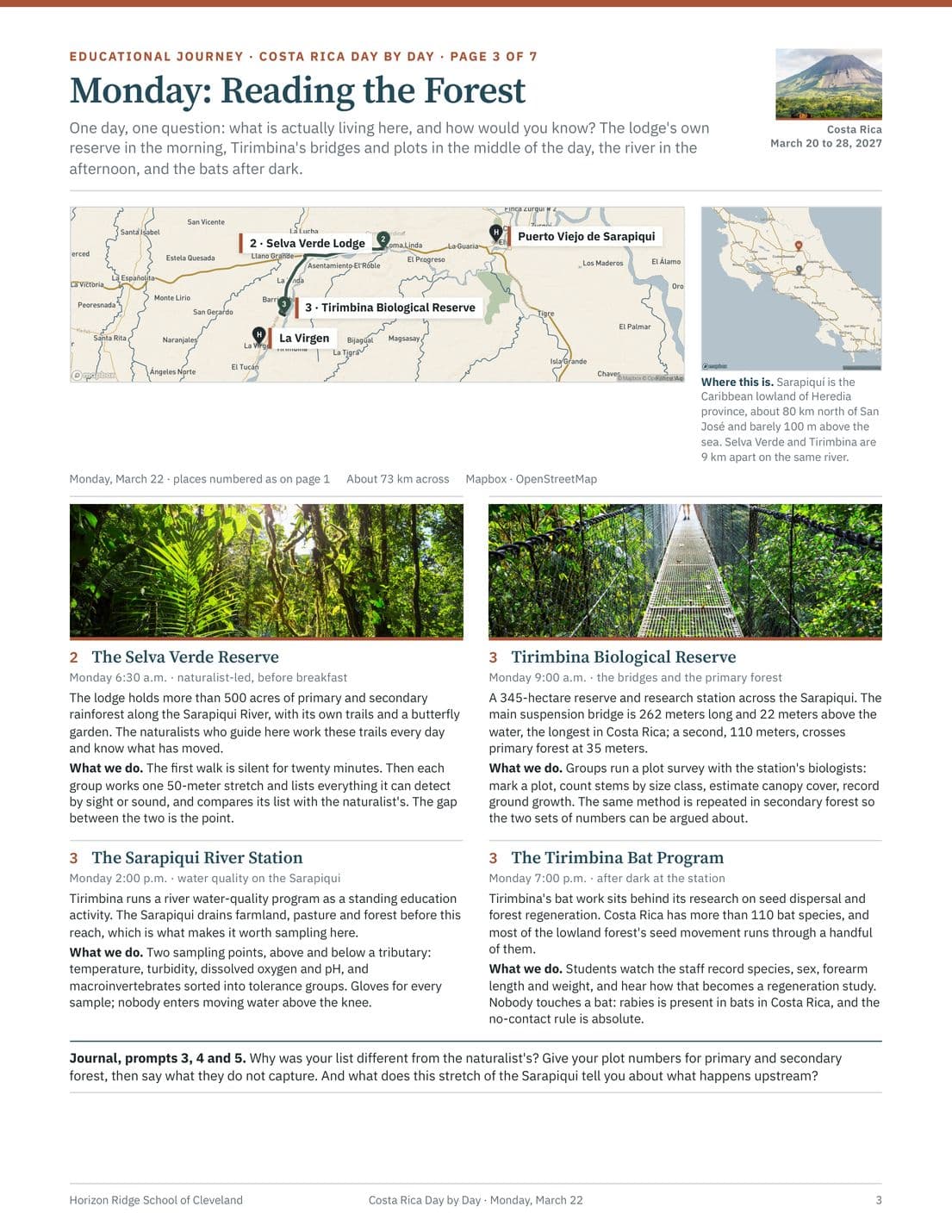
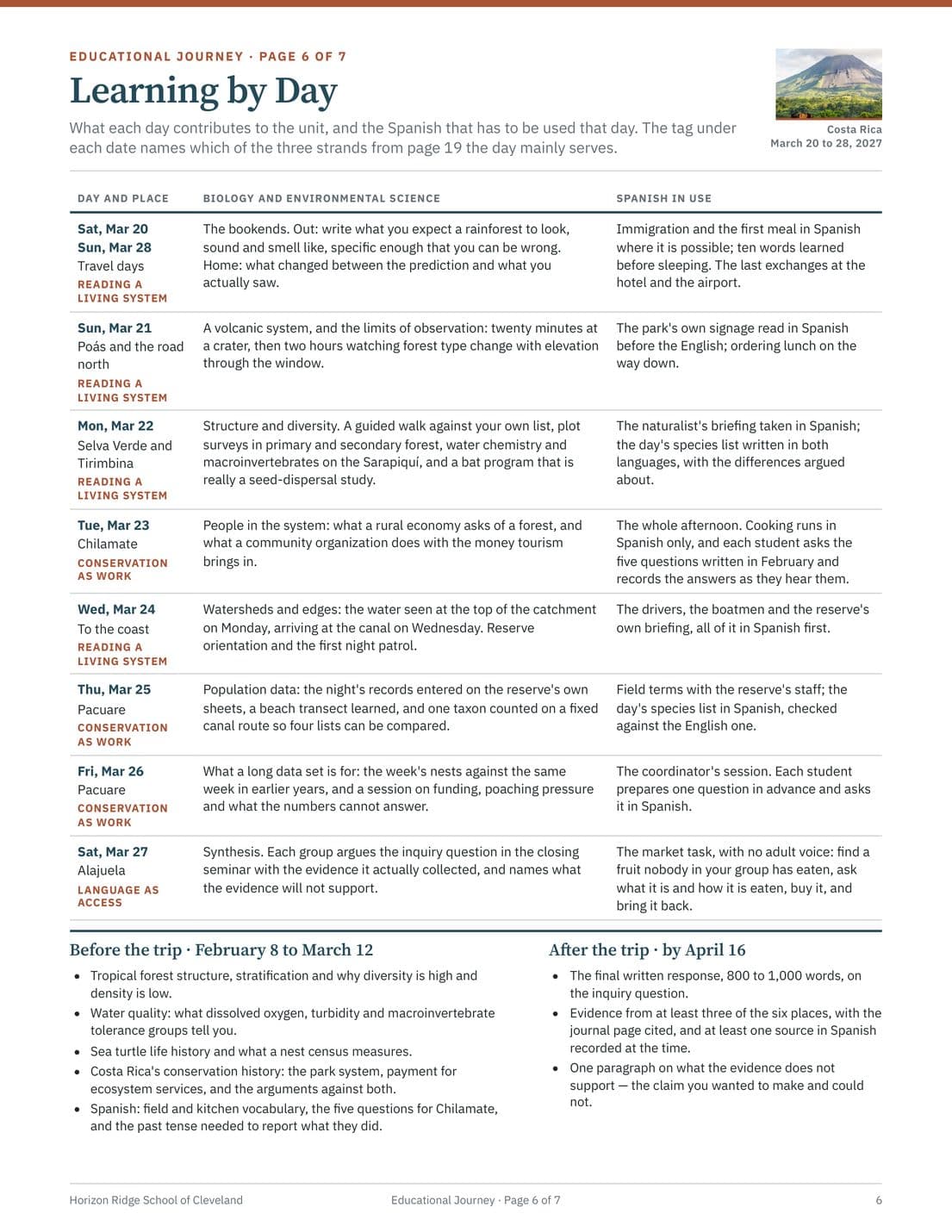
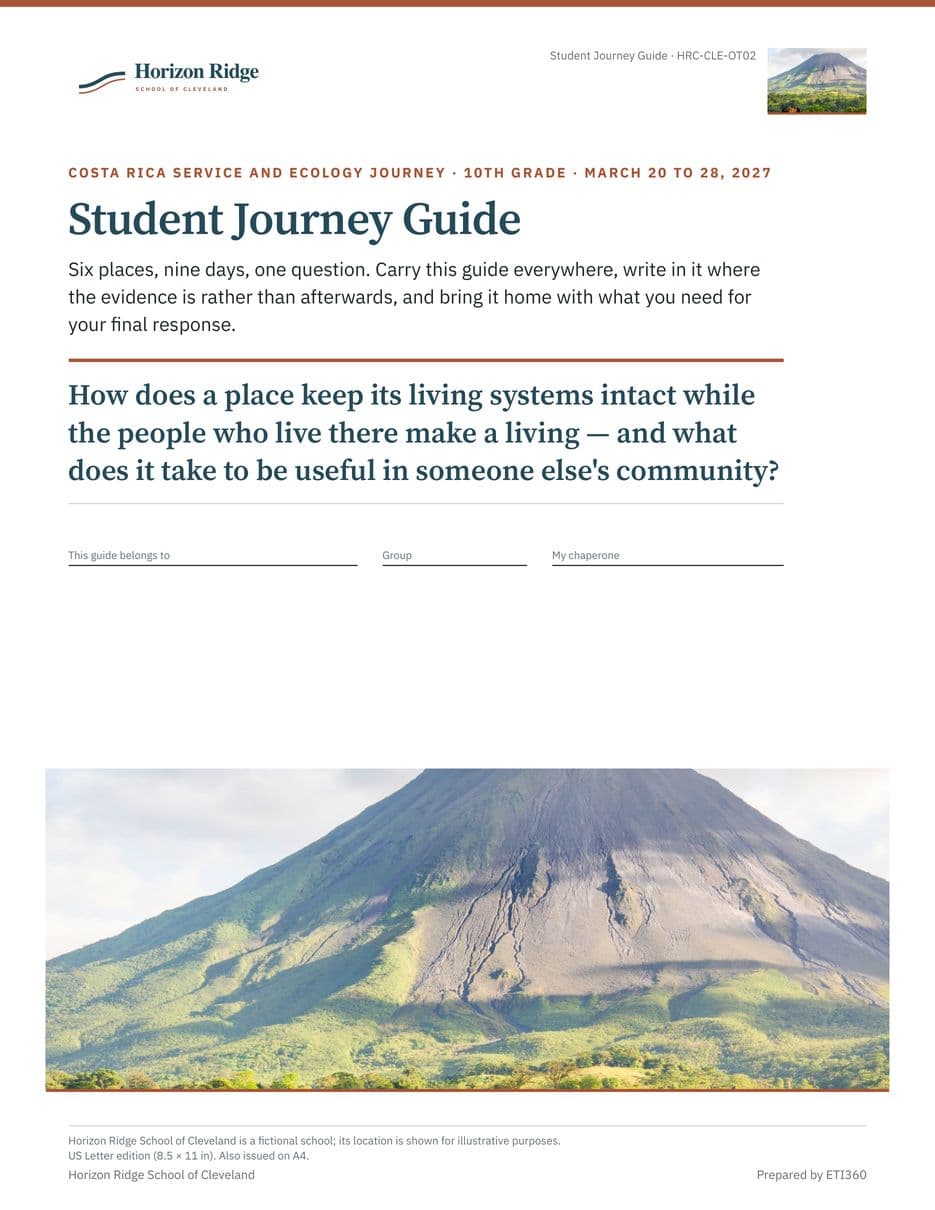
Students
Student Journey Guide
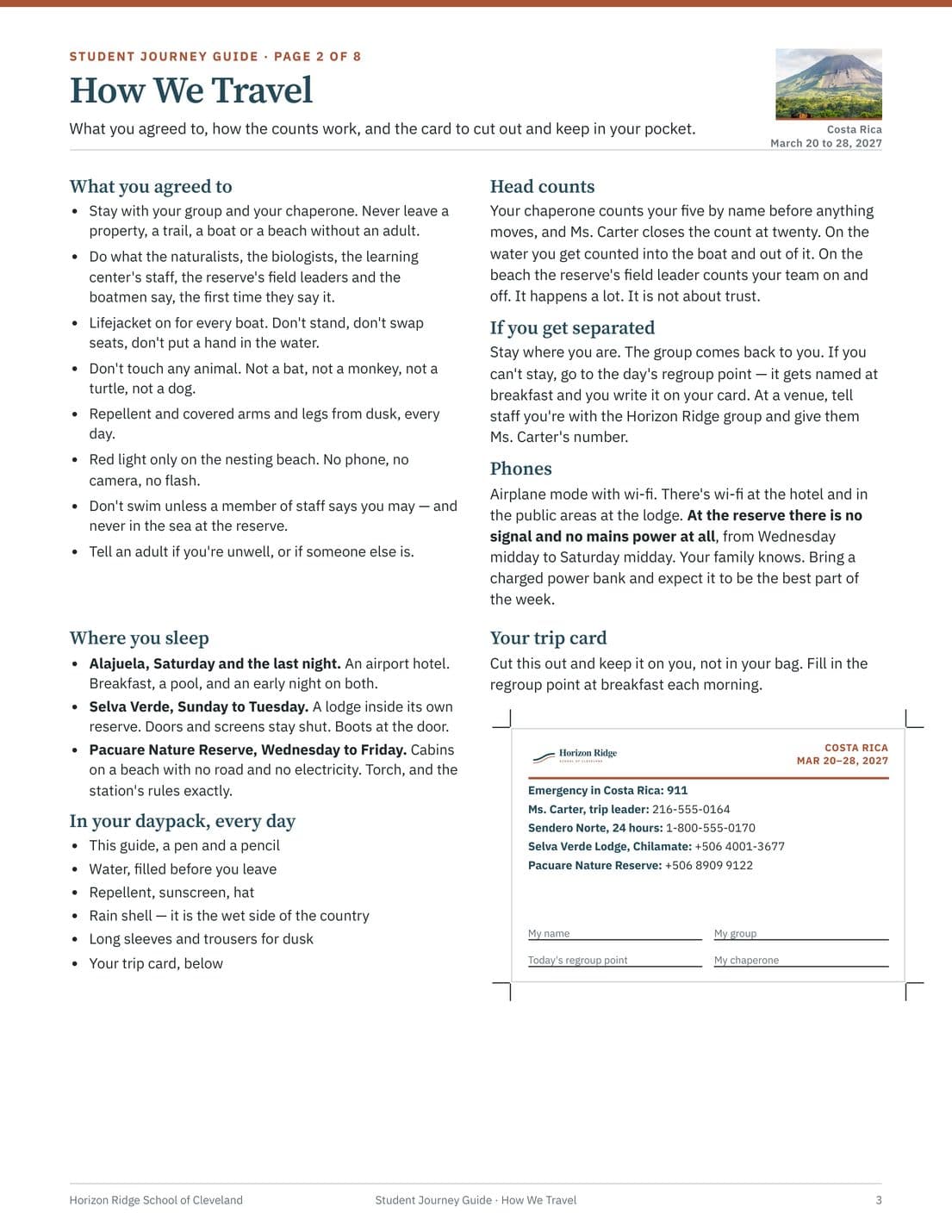
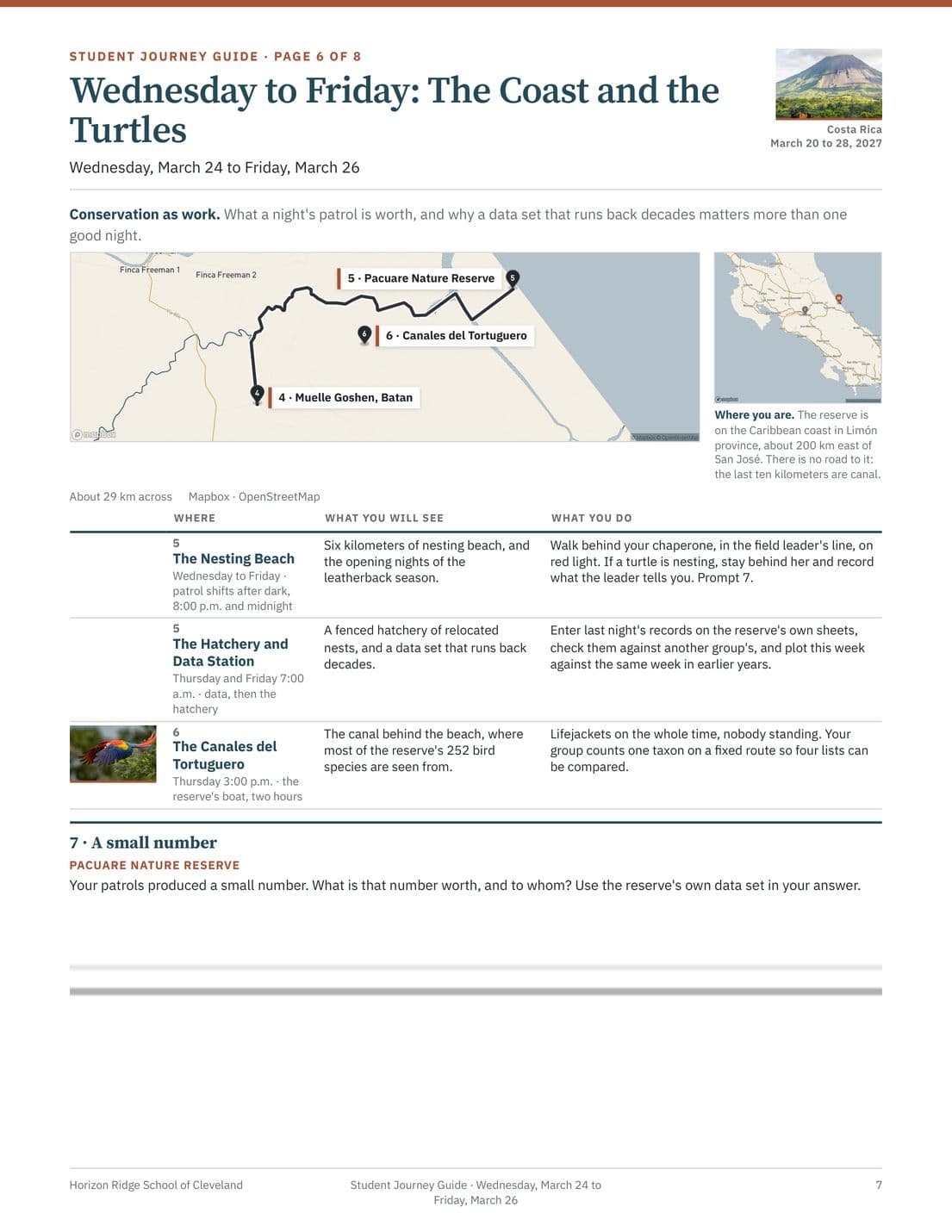
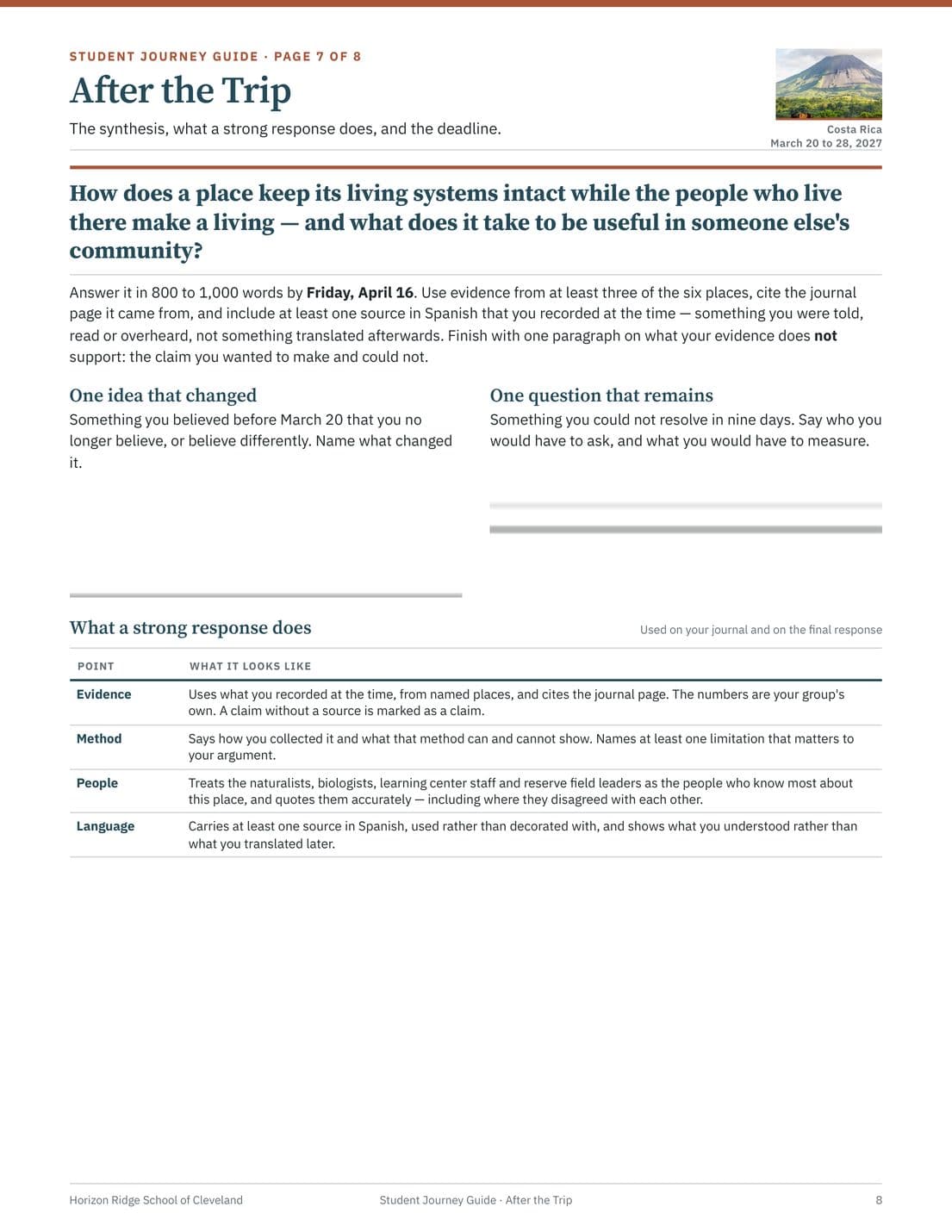
The printed guide students carry for nine days: the question, the days ahead, how the group travels with a cut-out trip card, one page for each part of the trip with the map, the places, and the journal prompts, then the final synthesis and what a strong response does.
Look inside
Improving next year's trip
What students, families, the leaders, and the host operator said, set out for the school's review.
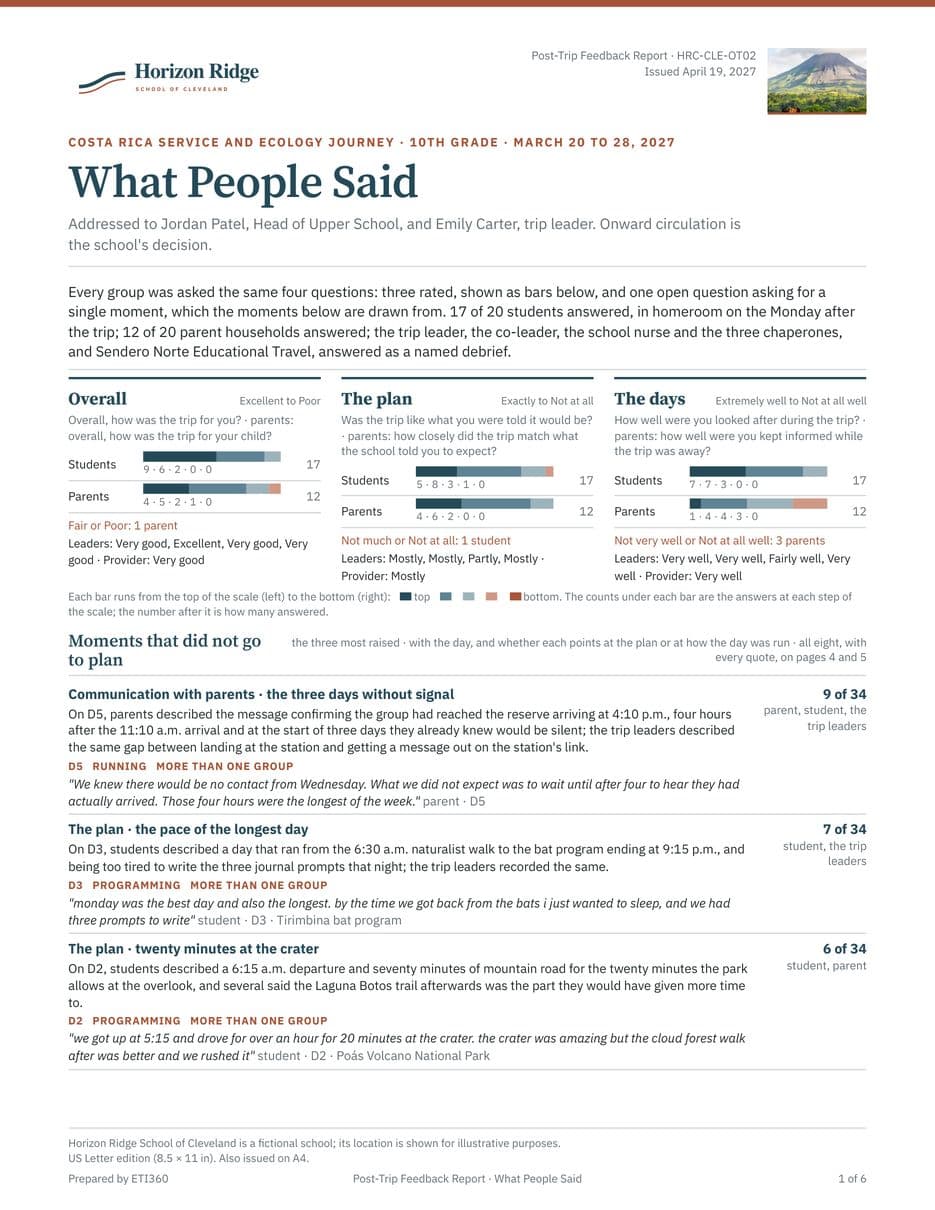
After the trip
Post-Trip Feedback Report
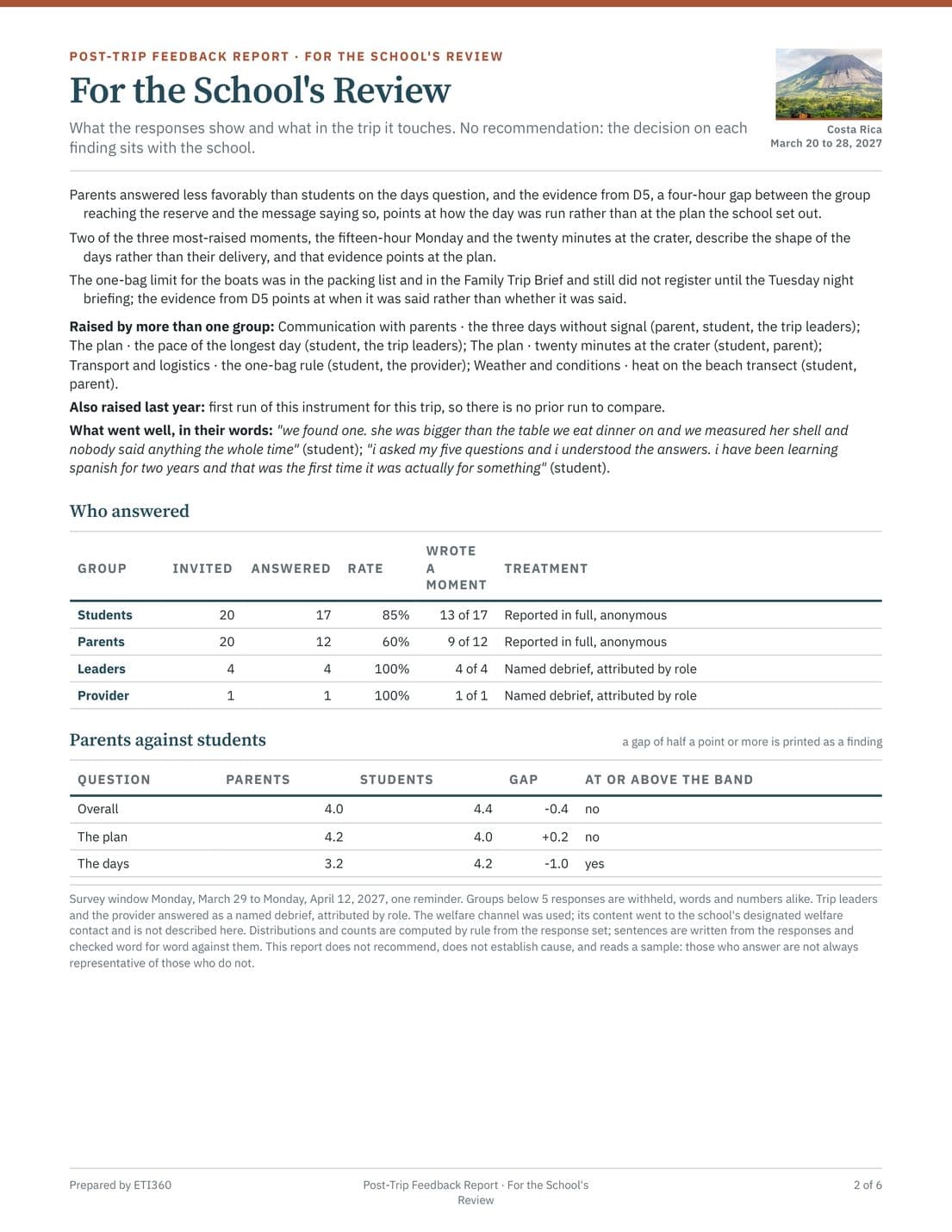
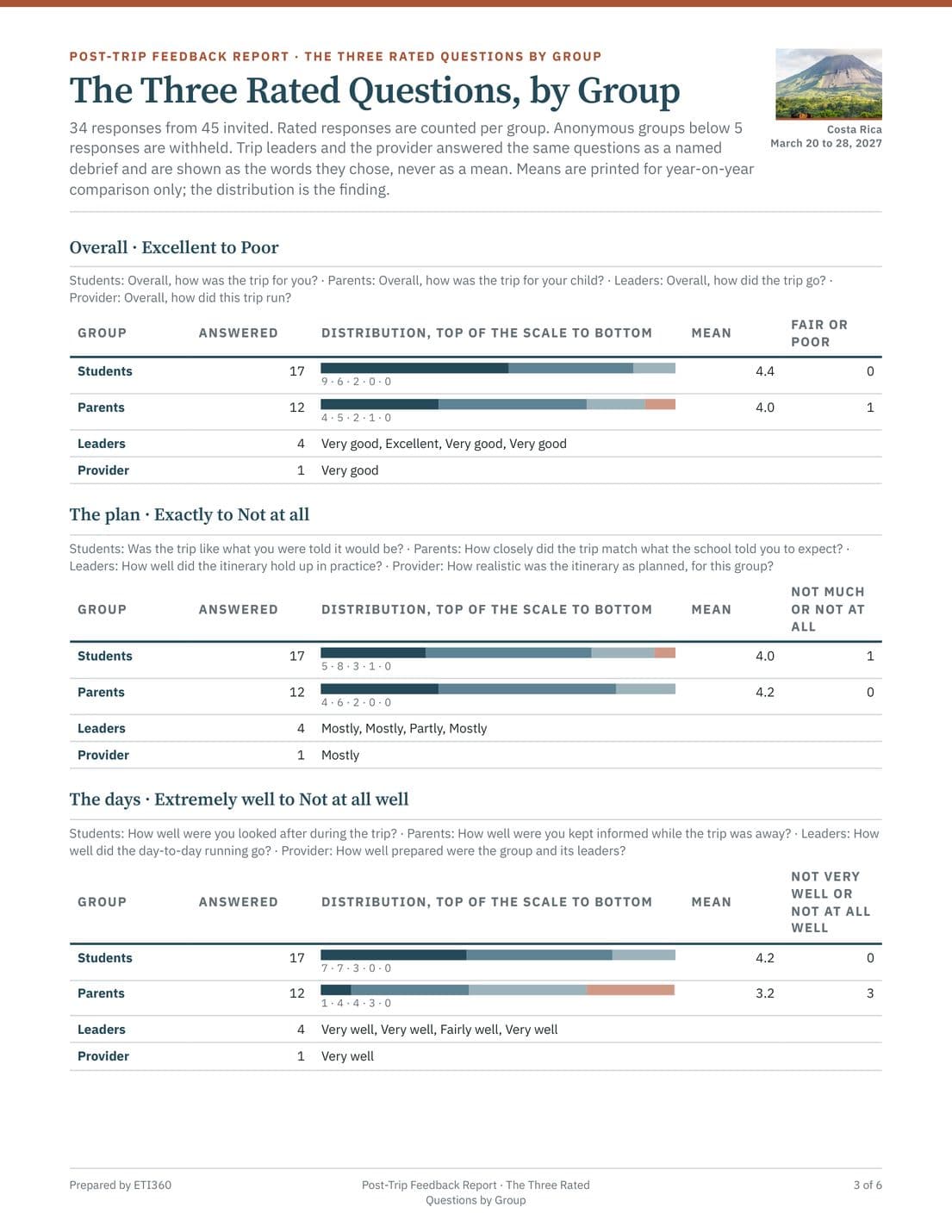
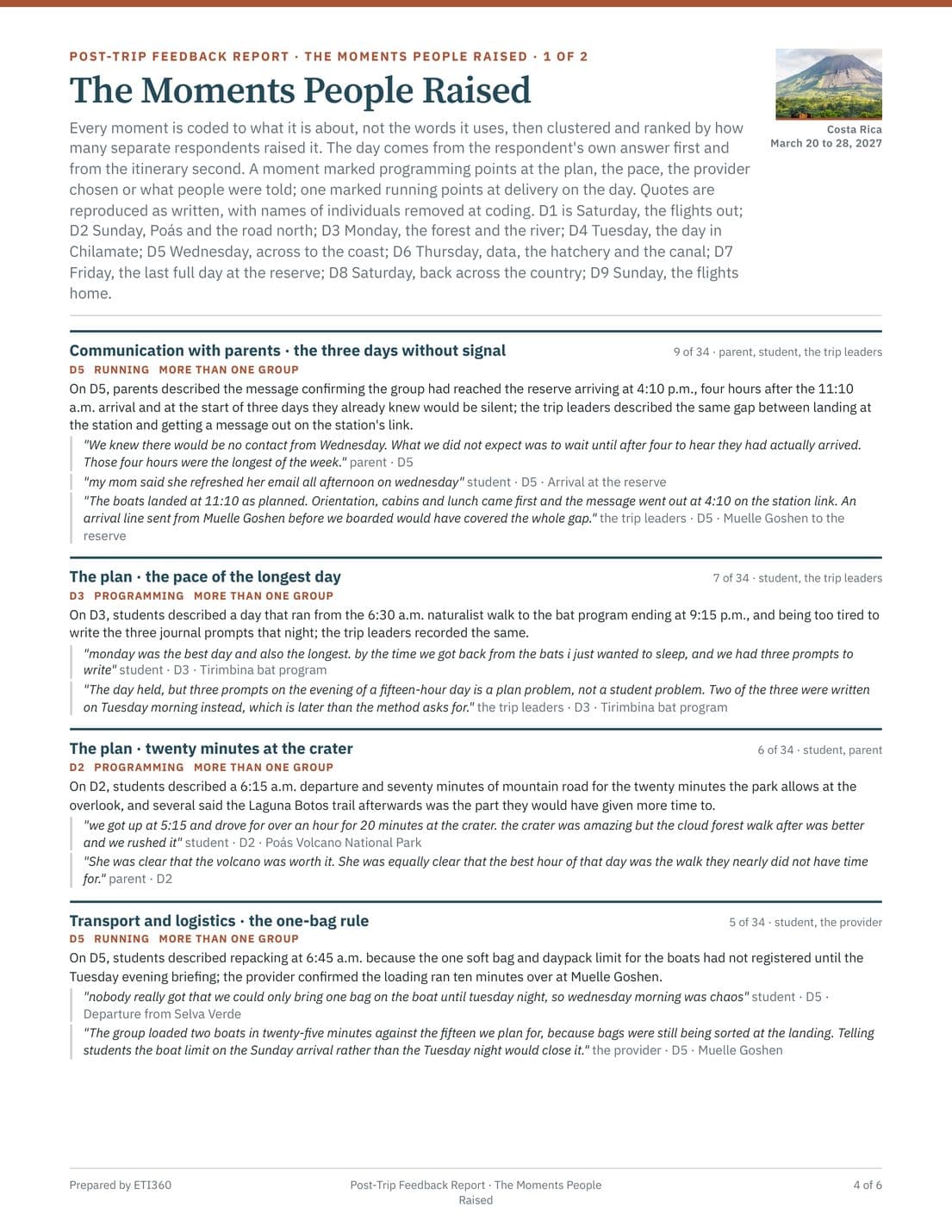
Four questions asked of students, parents, the leaders, and the host operator after the trip: what each group said, the moments that did not go to plan with the day they belong to, and what in the trip each one touches. It states; it does not recommend.
Look inside
Who decides
The school and any provider it works with retain responsibility for decisions, supervision, live assessments, and final approval.
The Trip Risk Working File is written for the school to review, complete, and approve. Its ratings are a starting point, its review lines are for the school’s own controls, and the trip leader makes the live assessment on the day.
Other worked trips
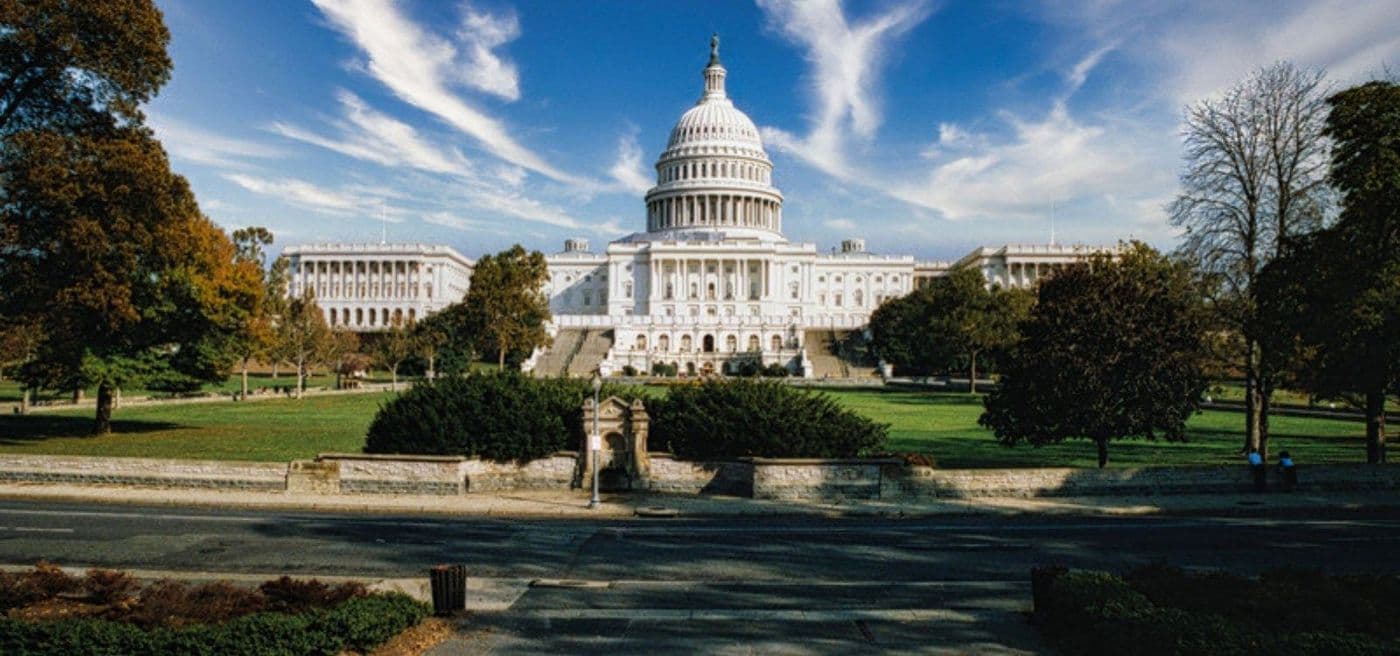 City · Washington, DCWashington, DCHorizon Ridge School of ClevelandSee the documents →
 Culture · EuropeItalyHorizon Ridge School of ClevelandSee the documents →
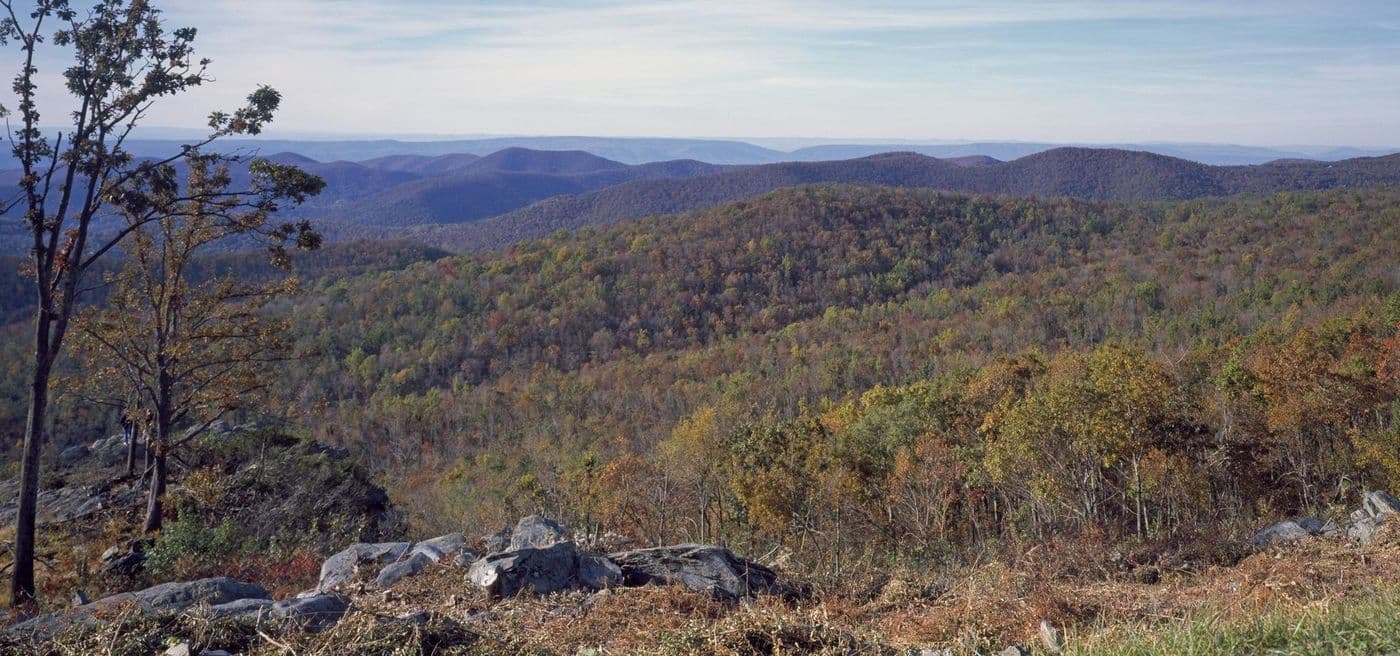 Outdoor · VirginiaShenandoah National ParkHorizon Ridge School of PhiladelphiaSee the documents →
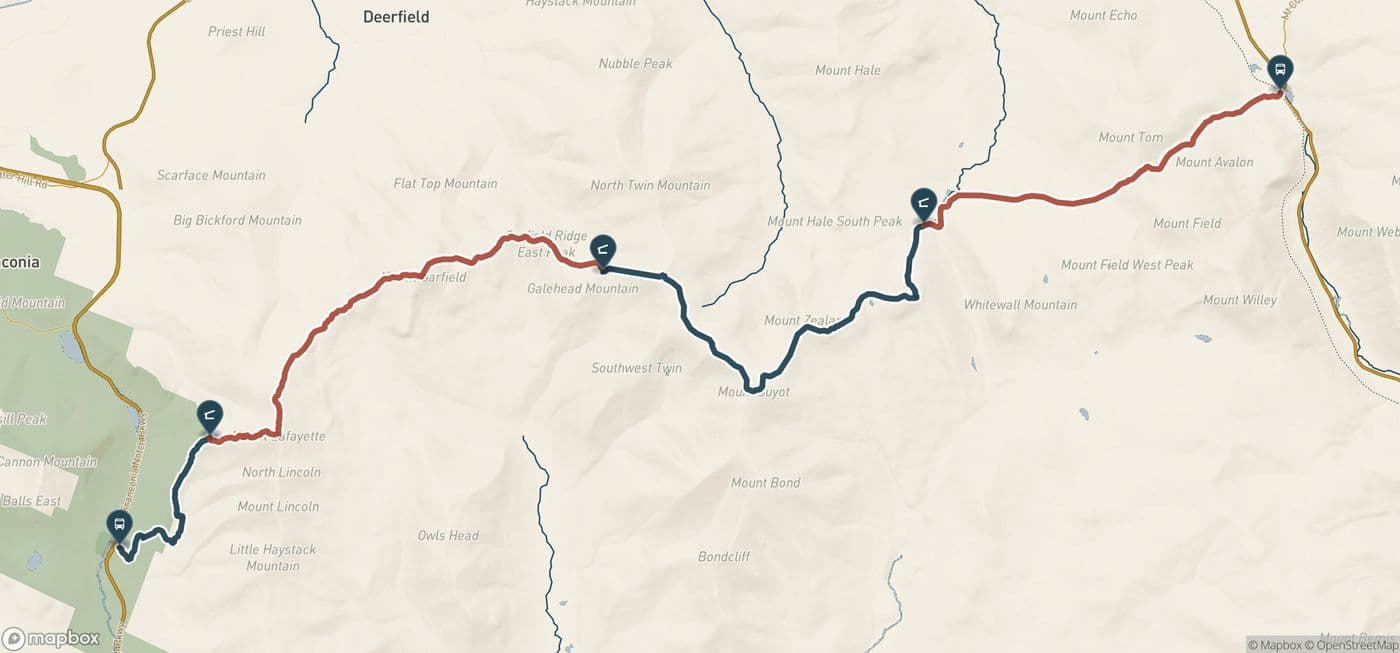 Outdoor · New HampshireWhite MountainsTideline SchoolSee the documents →
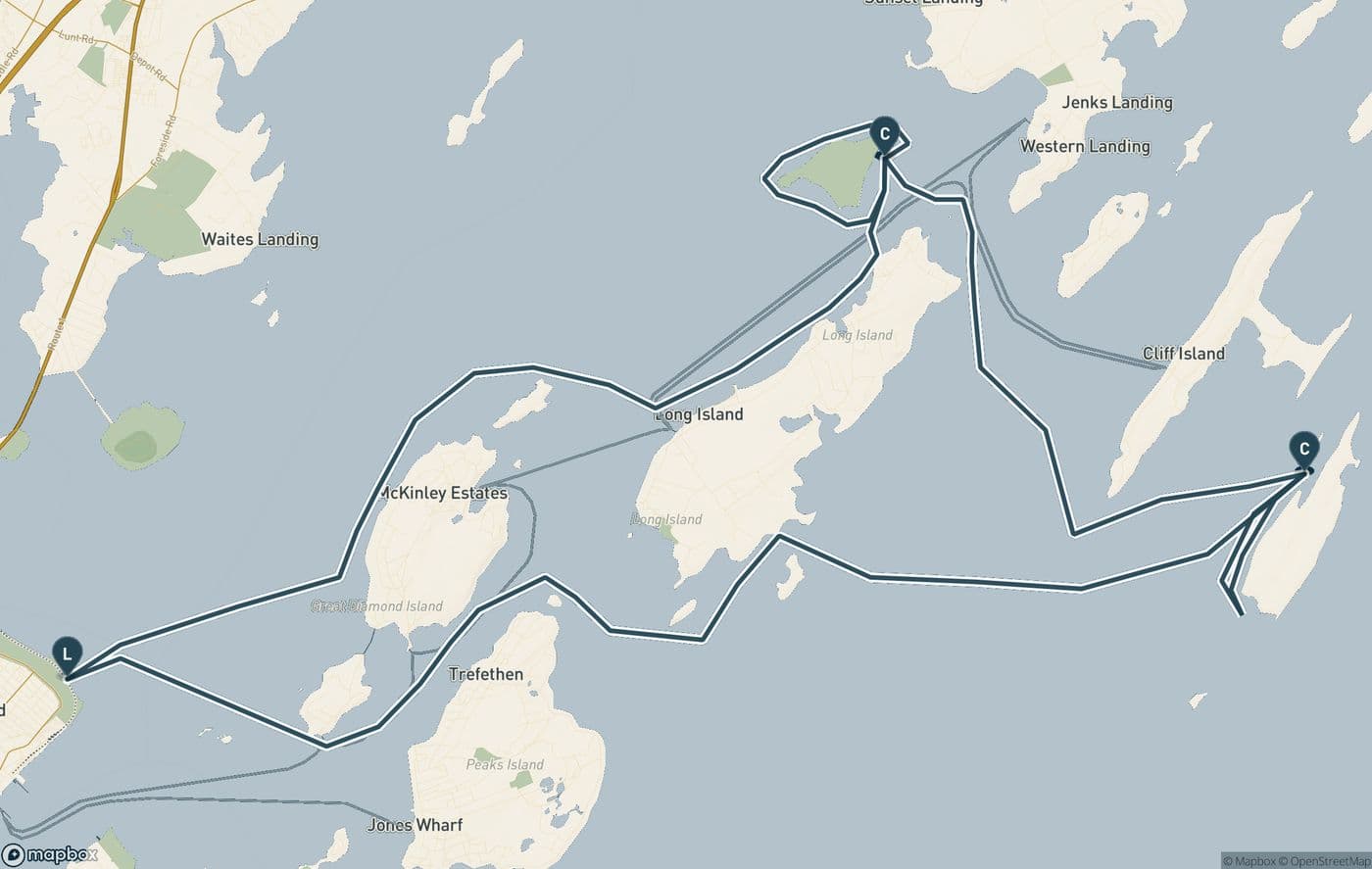 Outdoor · Maine coastCasco BayTideline SchoolSee the documents →The Trip Package →
Horizon Ridge School of Cleveland is a fictional school; its location is shown for illustrative purposes.
Horizon Ridge School of Philadelphia is a fictional school; its location is shown for illustrative purposes.
Tideline School is a fictional school; its location is shown for illustrative purposes.