
Horizon Ridge School of Philadelphia is taking twenty tenth graders to walk the Appalachian Trail through Shenandoah National Park for five days in October. ETI360 brought together the school's itinerary, the coach, lodge, and guiding arrangements, and the school's own procedures, drew each walking day's route from National Park Service and OpenStreetMap trail data, with the elevation along it, computed the sun times for where the group will be each day, and listed the emergency departments by drive time from each half of the ridge; the school confirms which one the group uses. Each document below is written for the person who uses it, and each opens in full.
Horizon Ridge School of Philadelphia is a fictional school; its location is shown for illustrative purposes.
- Trip
- Shenandoah Appalachian Trail Trek, Monday, October 4 to Friday, October 8, 2027
- Group
- 20 tenth-grade students and four chaperones, one adult for every five students; on the Trail, two walking parties of thirteen, each with a guide and two school adults
- Program
- The outdoor education program and the American studies unit on the Appalachians
- On foot
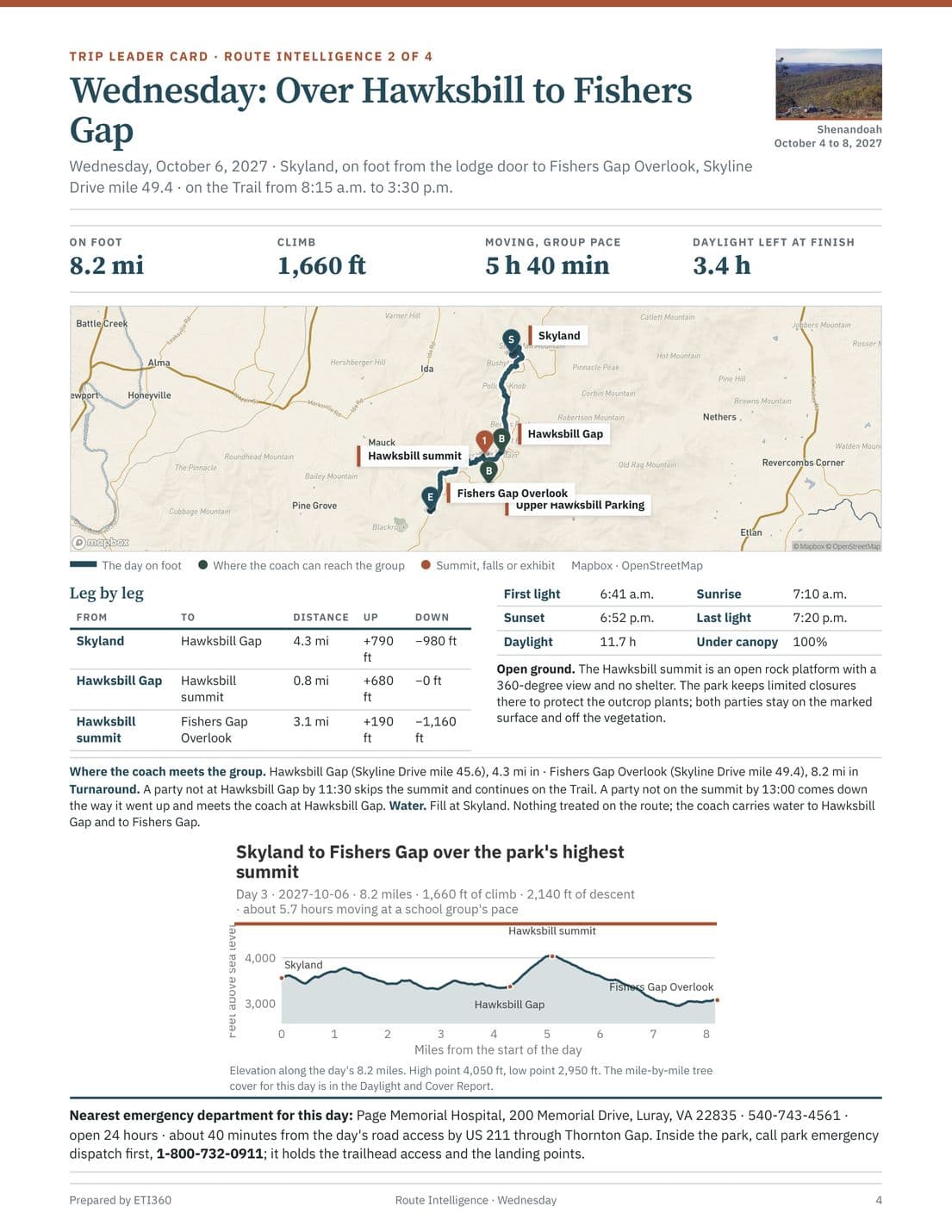
- 23.3 miles over four walking days and 4,744 feet of climb: Stony Man, Hawksbill at 4,051 feet, Dark Hollow Falls, and Rapidan Camp, with an optional rock scramble at Bearfence on Thursday afternoon
- Travel
- One motorcoach: about 215 road miles to the park on Monday and about 230 home on Friday, with the coach on Skyline Drive all week and meeting each walking party at the named road crossings
- Lodging
- Two nights at Skyland and two at Big Meadows Lodge, both inside the national park on Skyline Drive
- School
- Horizon Ridge School of Philadelphia, a fictional school
Decision by decision
Each decision the school makes about the trip, and the documents that support it. Every document is written for the person who uses it, and every one opens in full. Under each document, Look inside shows three of its pages as the school receives them; select a page to open the US Letter edition at that page.
ETI360 builds every document to two paper sizes. The US Letter edition (8.5 × 11 inches) is the standard in the United States; the A4 edition (210 × 297 mm) is the standard in most other countries.
Approving the trip
The record the office files, and the Trip Risk Working File for the school to review, complete, and approve.
School
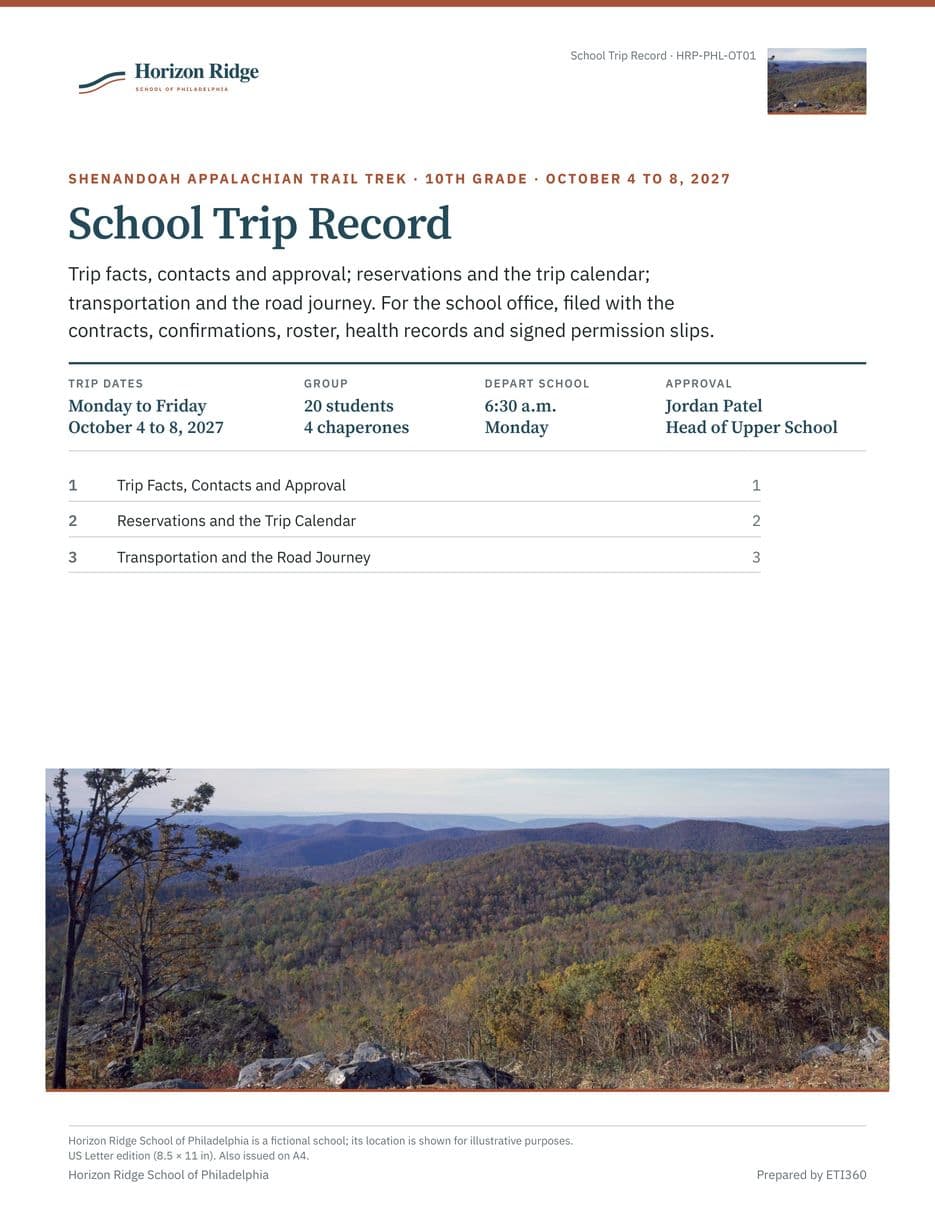
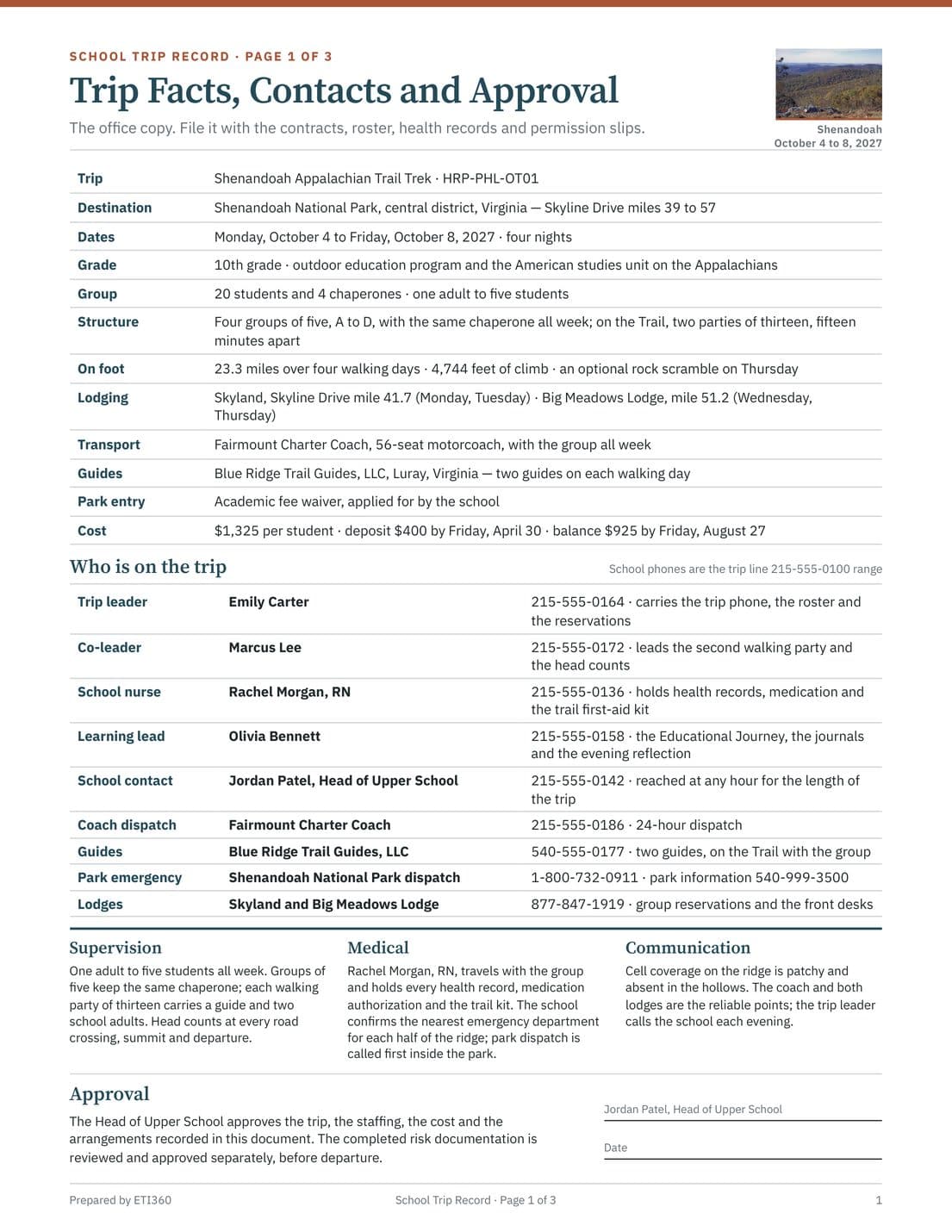
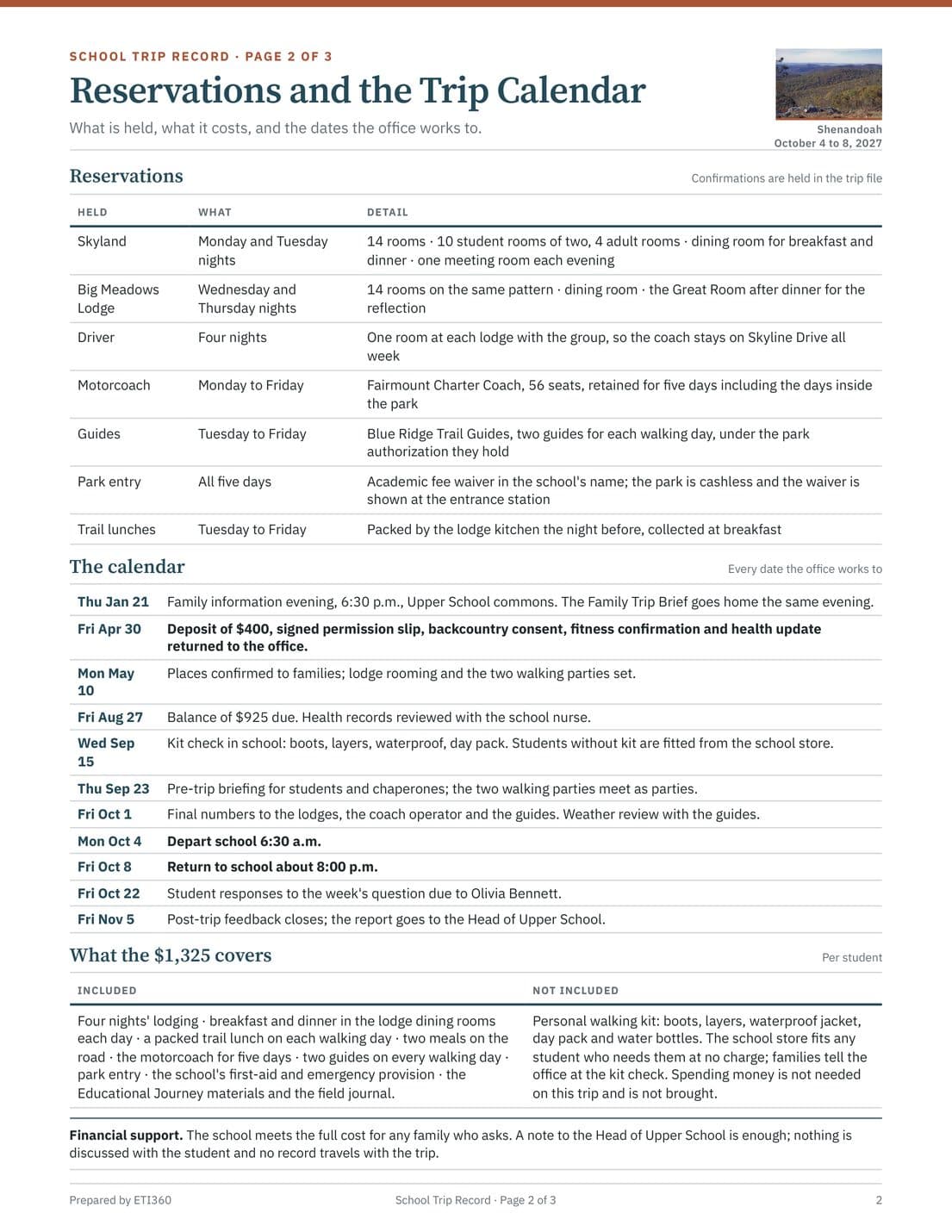
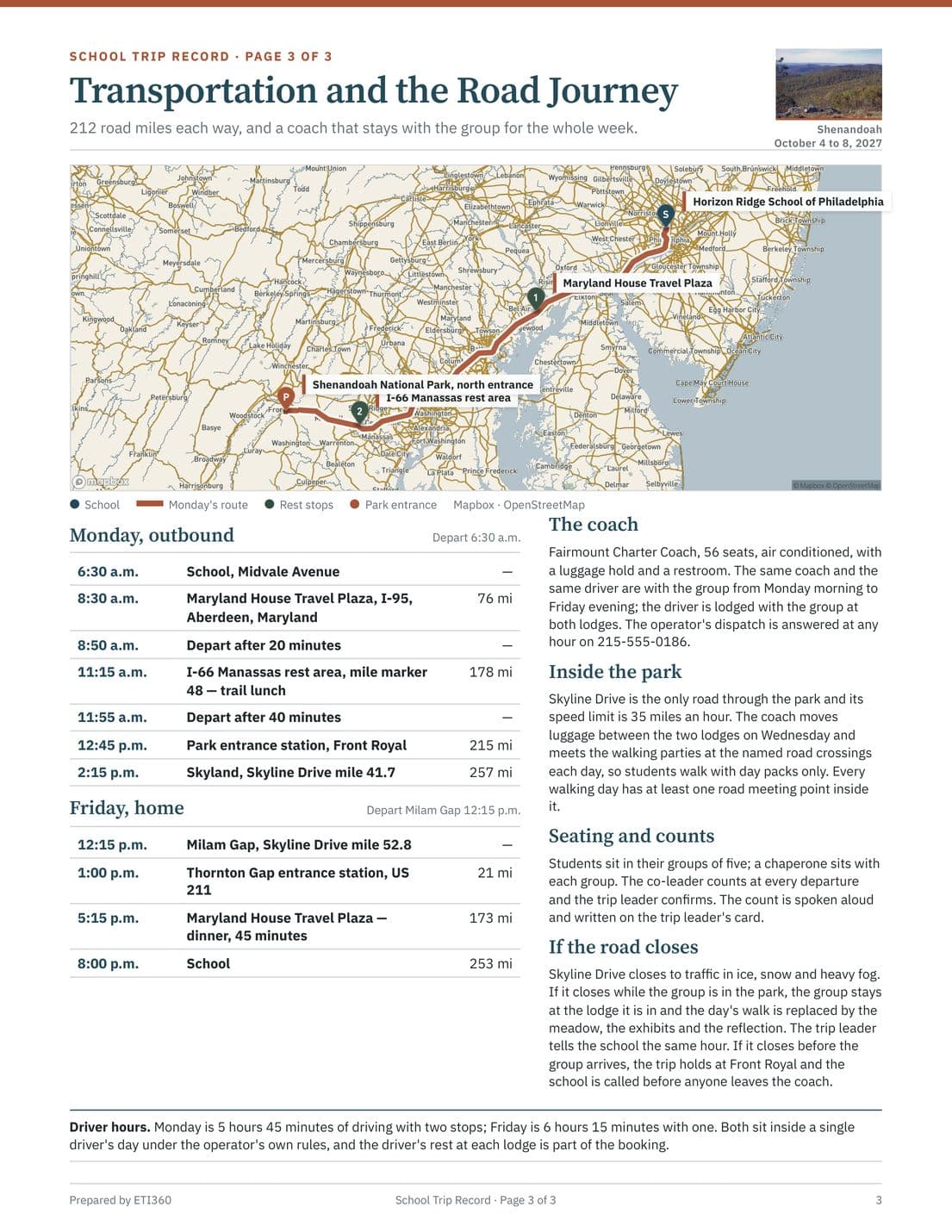
School Trip Record
Trip facts, contacts, and the approval line, then what is held at each lodge, the dates the office works to, and the road journey. Filed with the contracts, confirmations, roster, health records, and signed permission slips.
Look inside
School
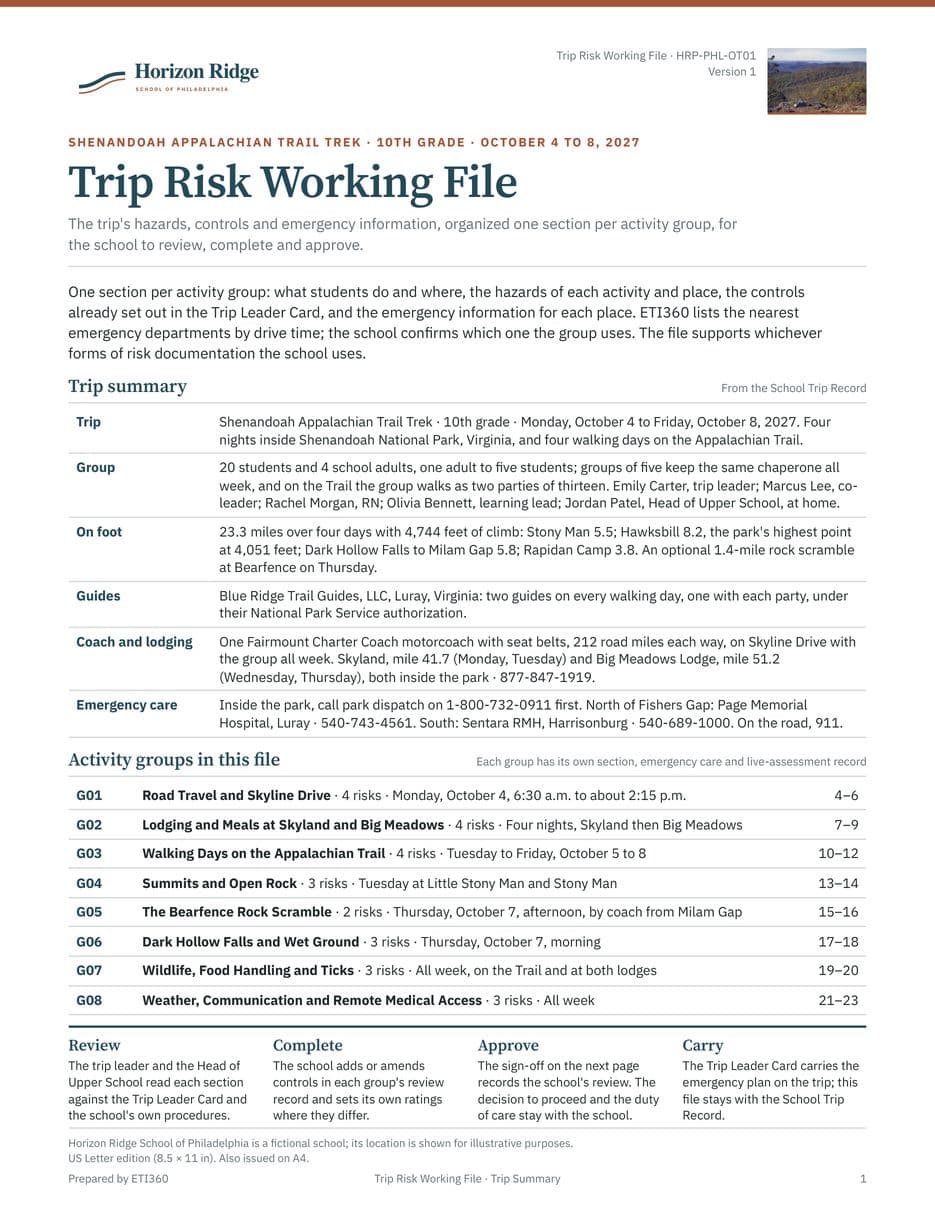
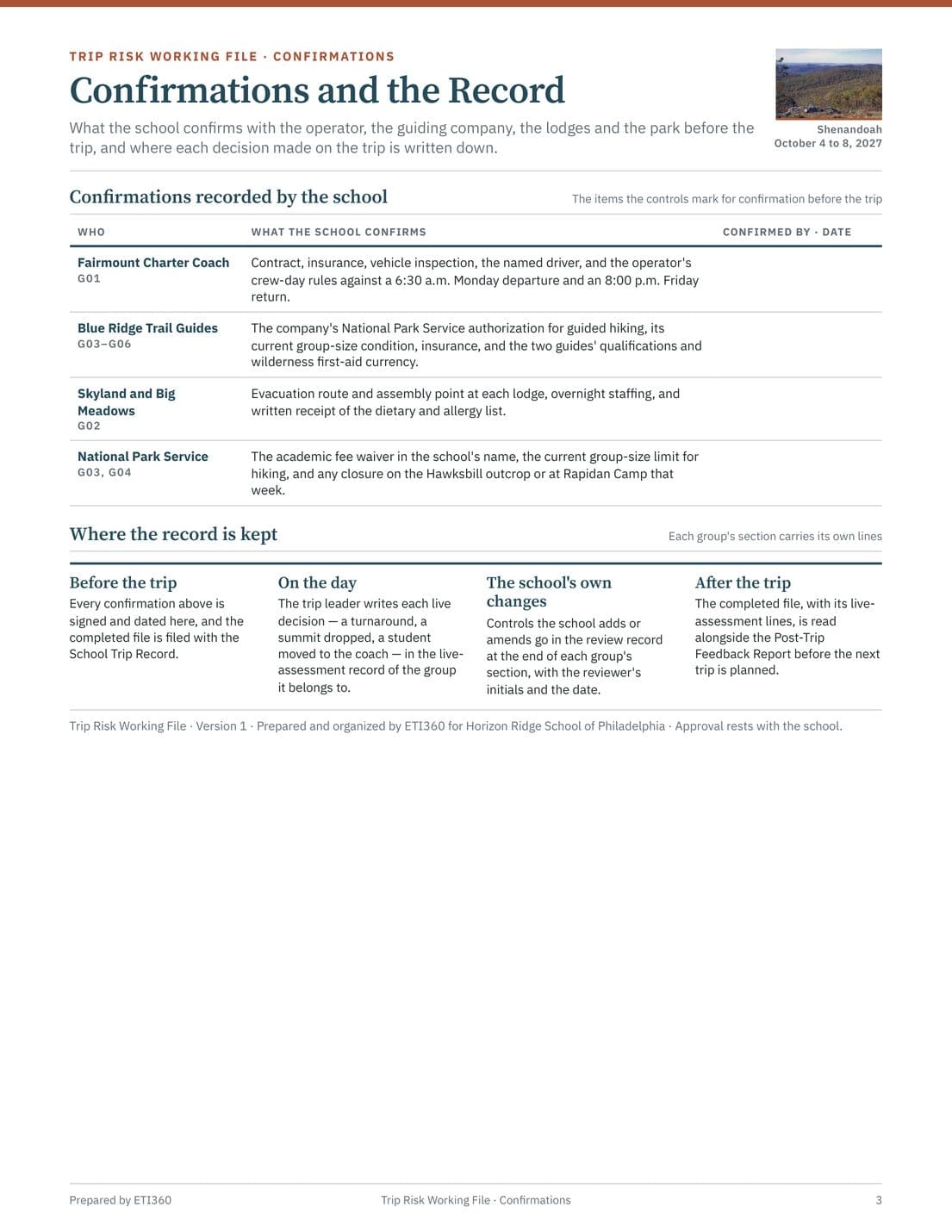
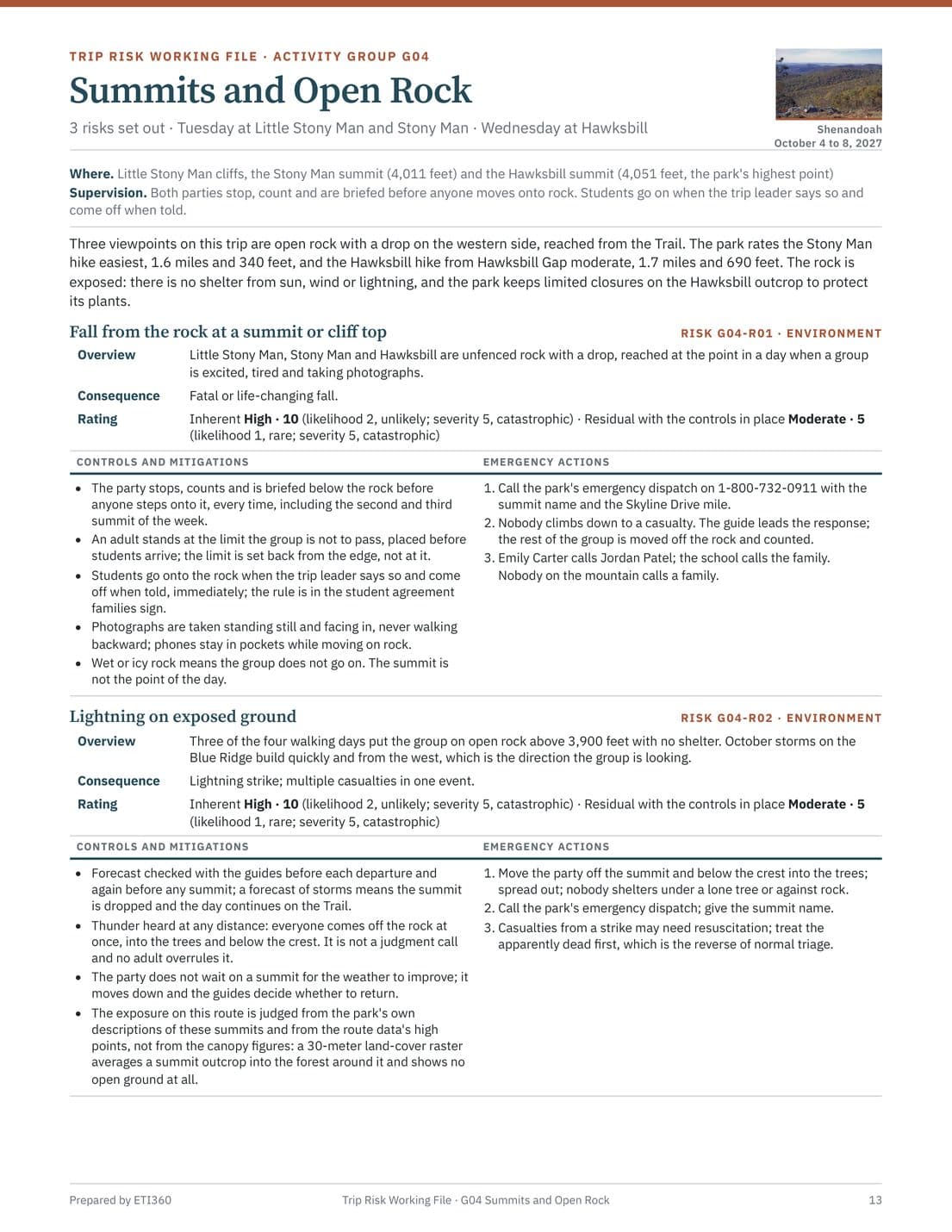
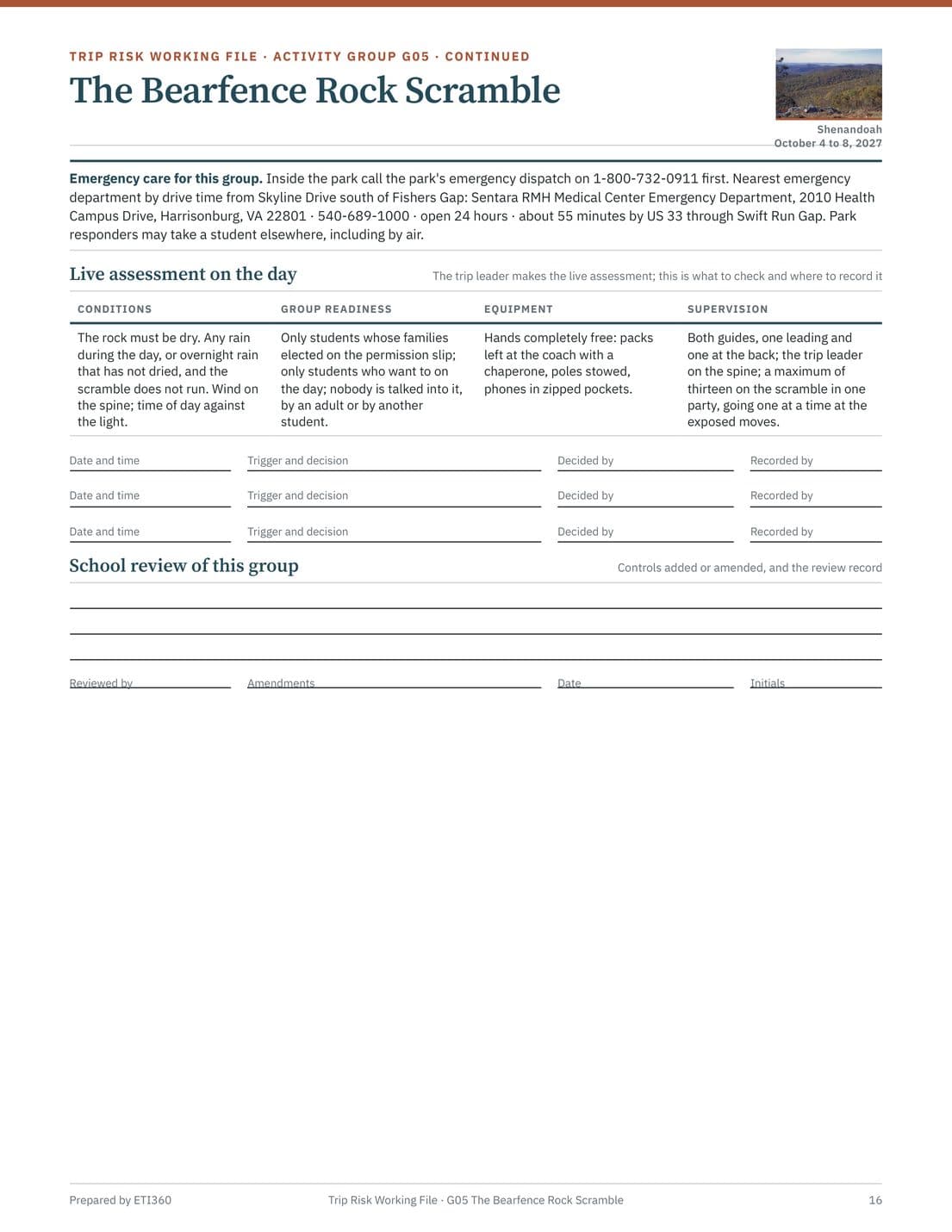
Trip Risk Working File
Hazards, controls, and emergency actions organized one section per activity group, from the road to the open rock and the optional scramble, with the emergency care for each group and the live-assessment prompts for the day. The school completes it, amends it, and approves it.
Look inside
Telling families
The letter home, the week day by day, and the forms that come back with the deposit, including the backcountry consent.
Families
Family Trip Brief
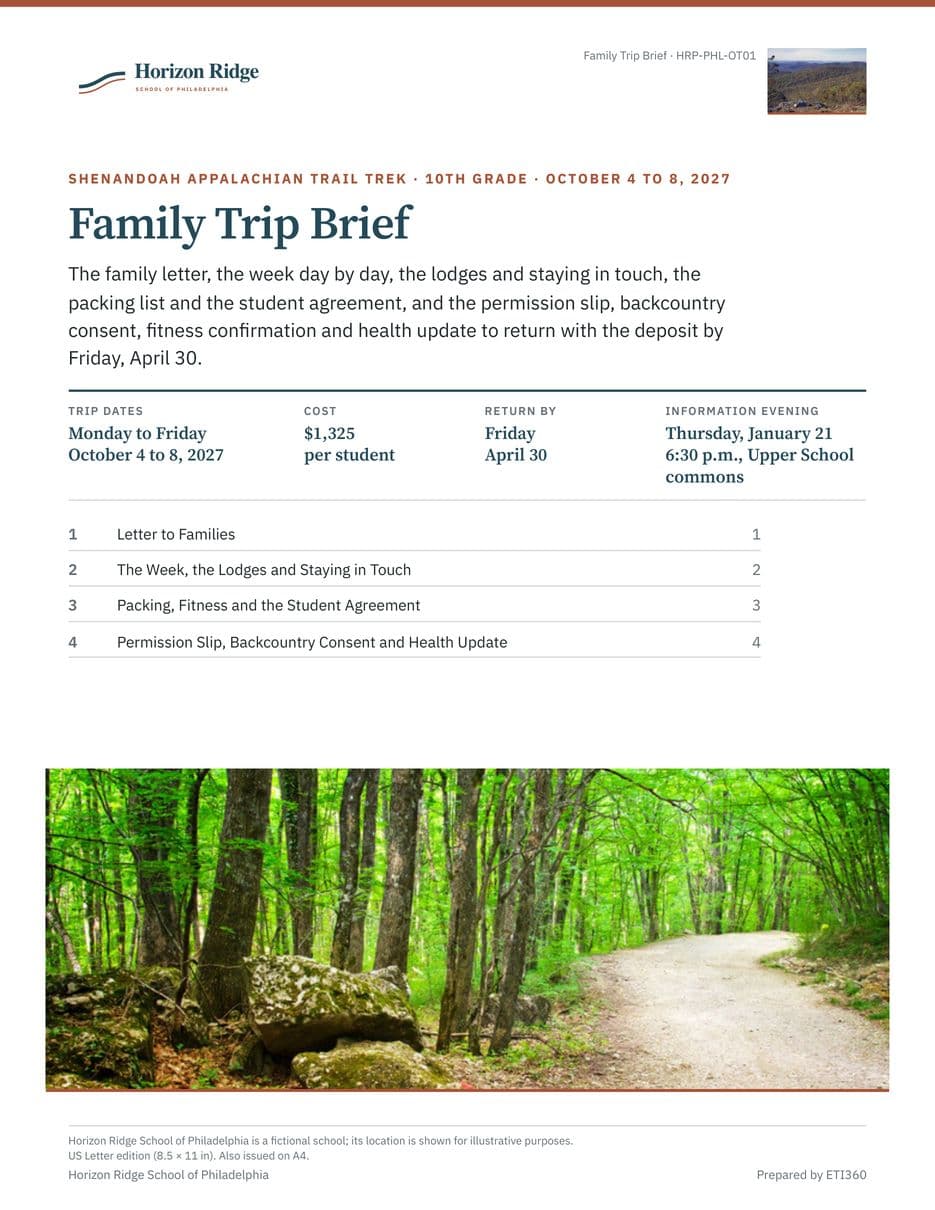
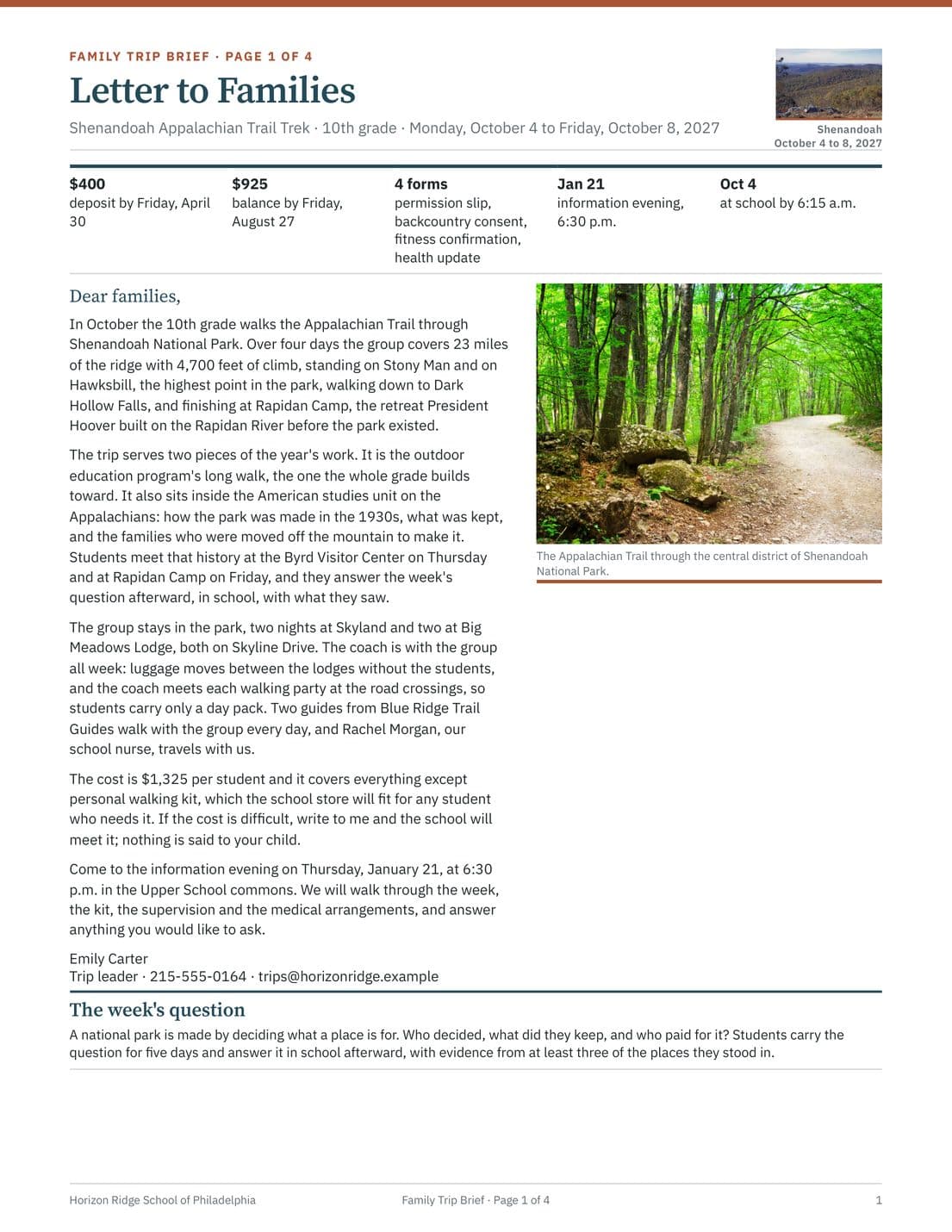
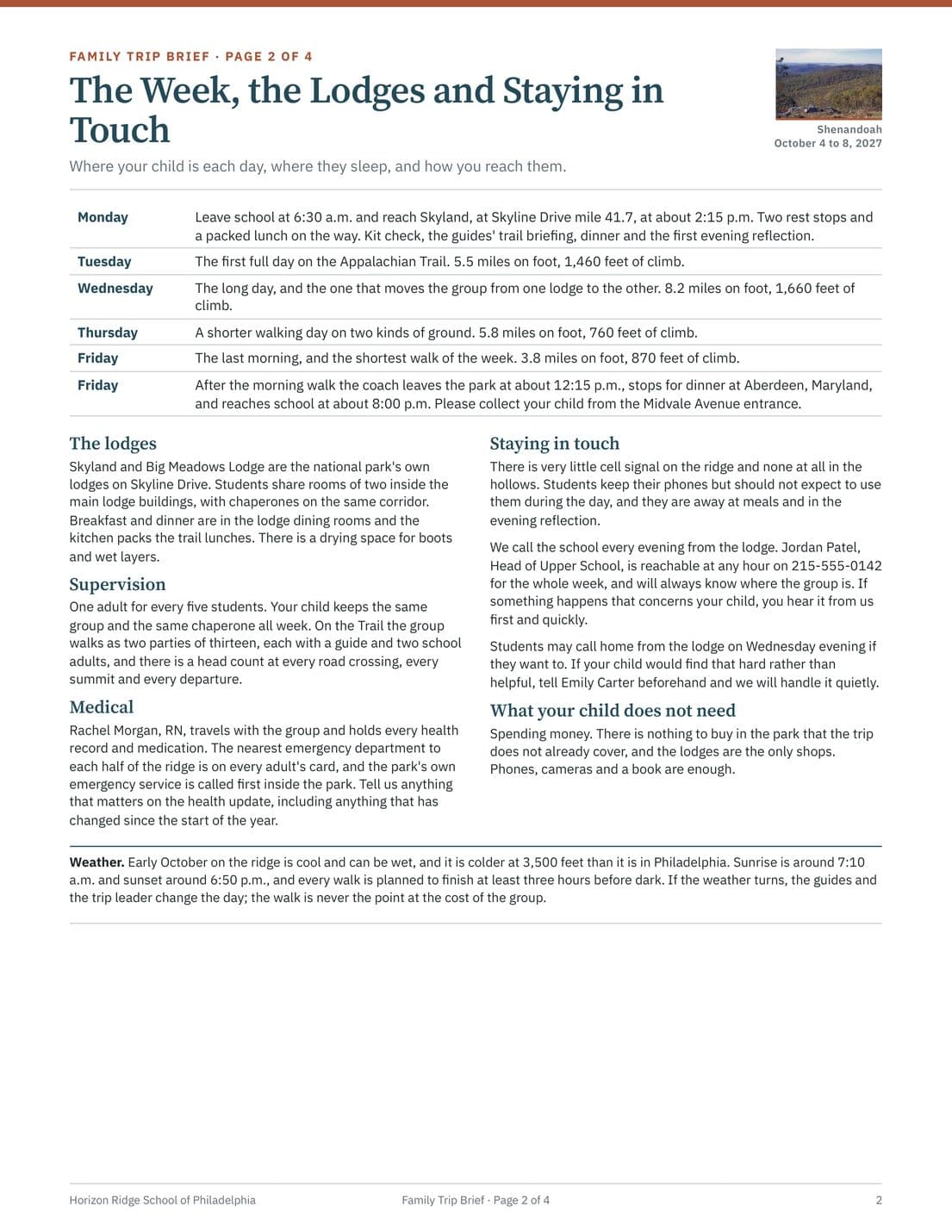
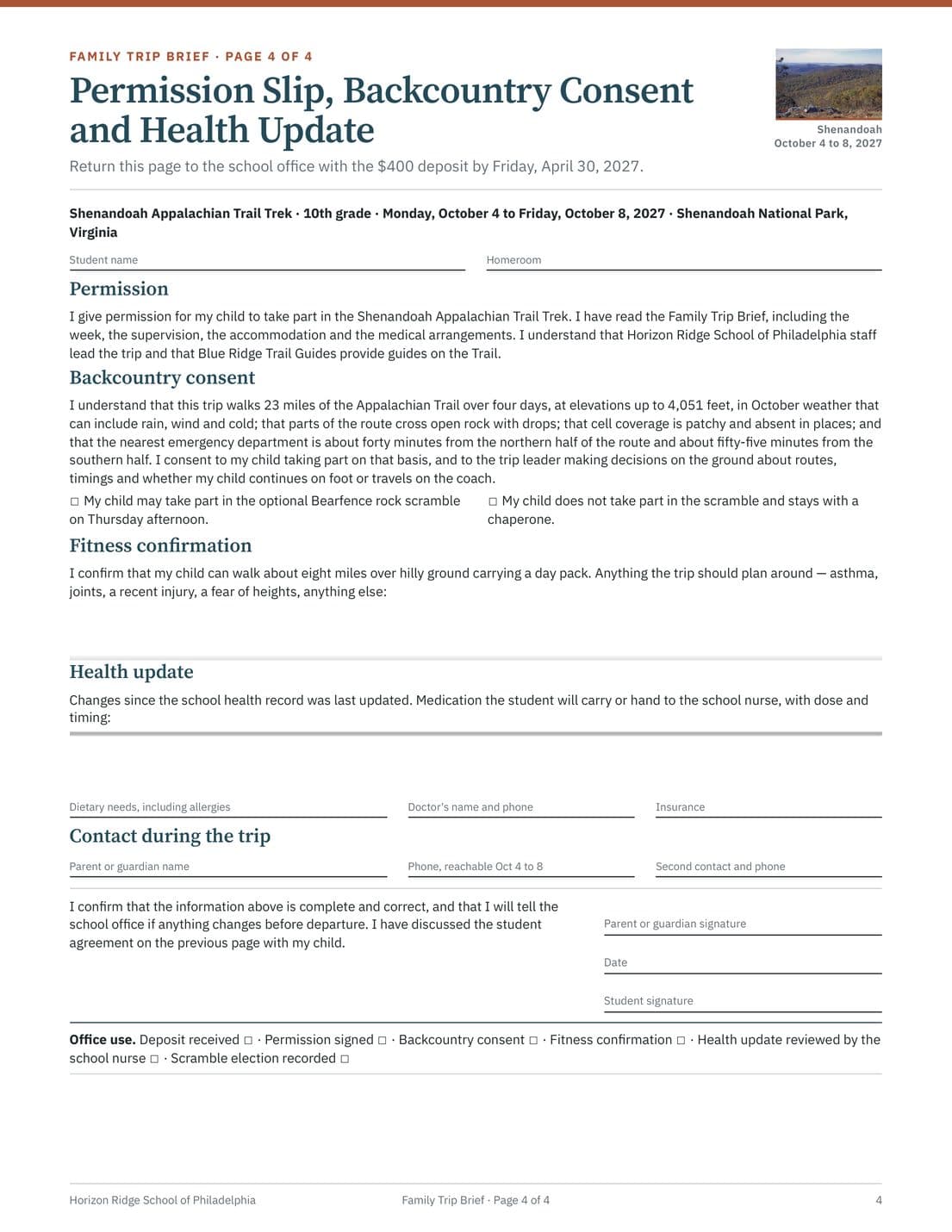
The letter home, the week day by day, the lodges and how families reach the group from a ridge with little signal, the packing list and the student agreement, and the forms that come back to the office.
Look inside
Preparing the leader and chaperones
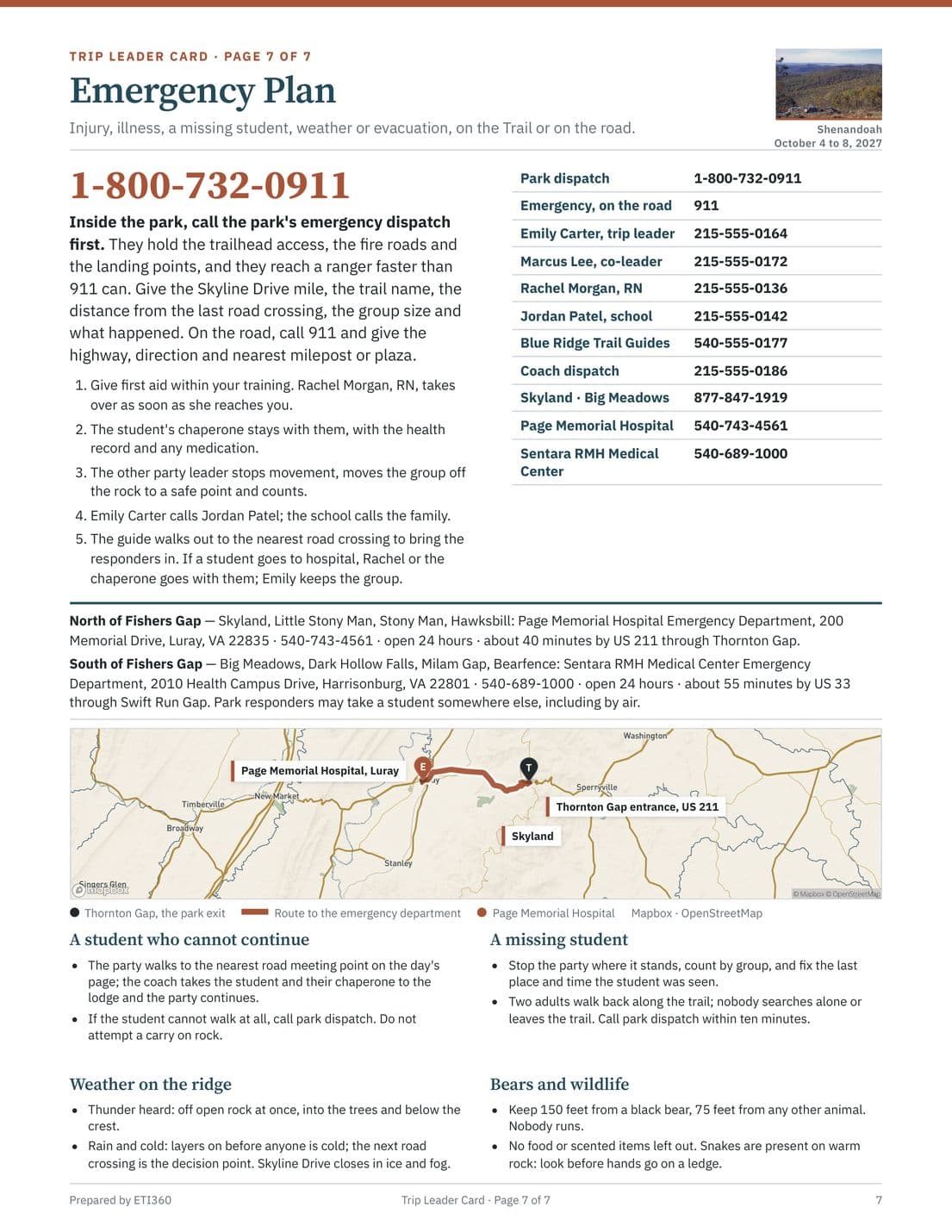
Groups and walking parties, the procedures on the Trail and at the lodges, and the emergency departments by drive time from each half of the ridge.
Trip leader
Trip Leader Card
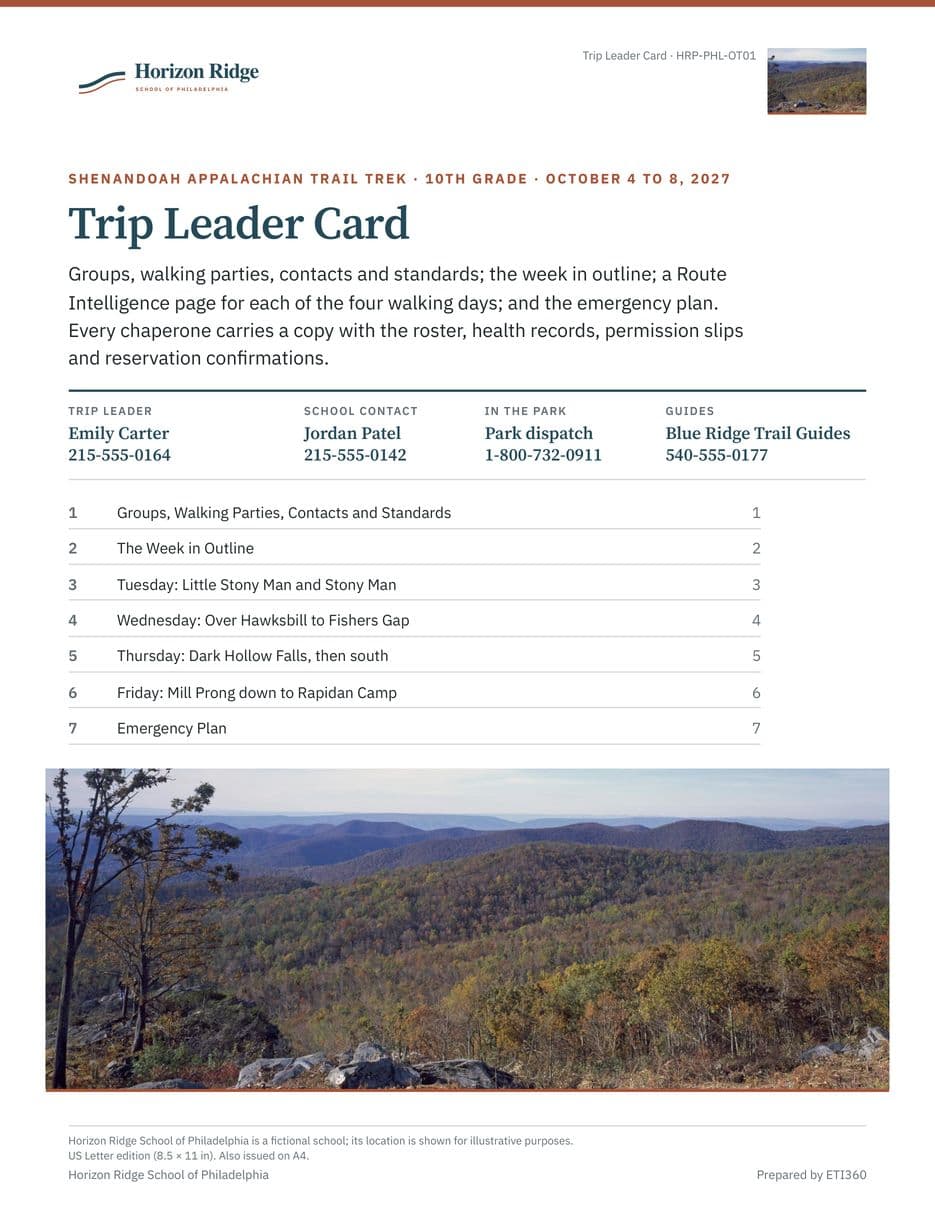
Groups, walking parties, contacts, and standards, the week in outline, a Route Intelligence page for each walking day, and the emergency plan: the emergency departments by drive time from each half of the ridge.
Look inside
Chaperones
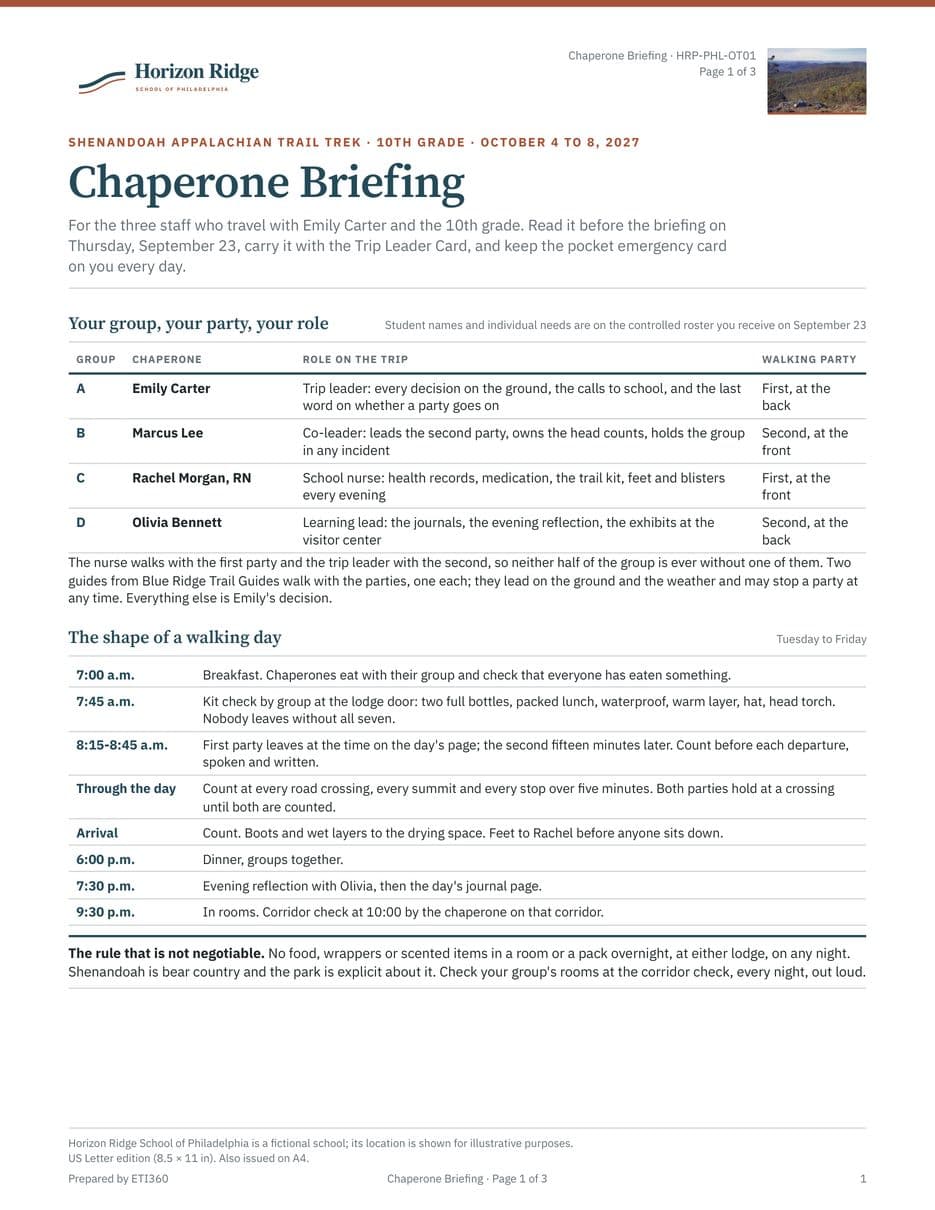
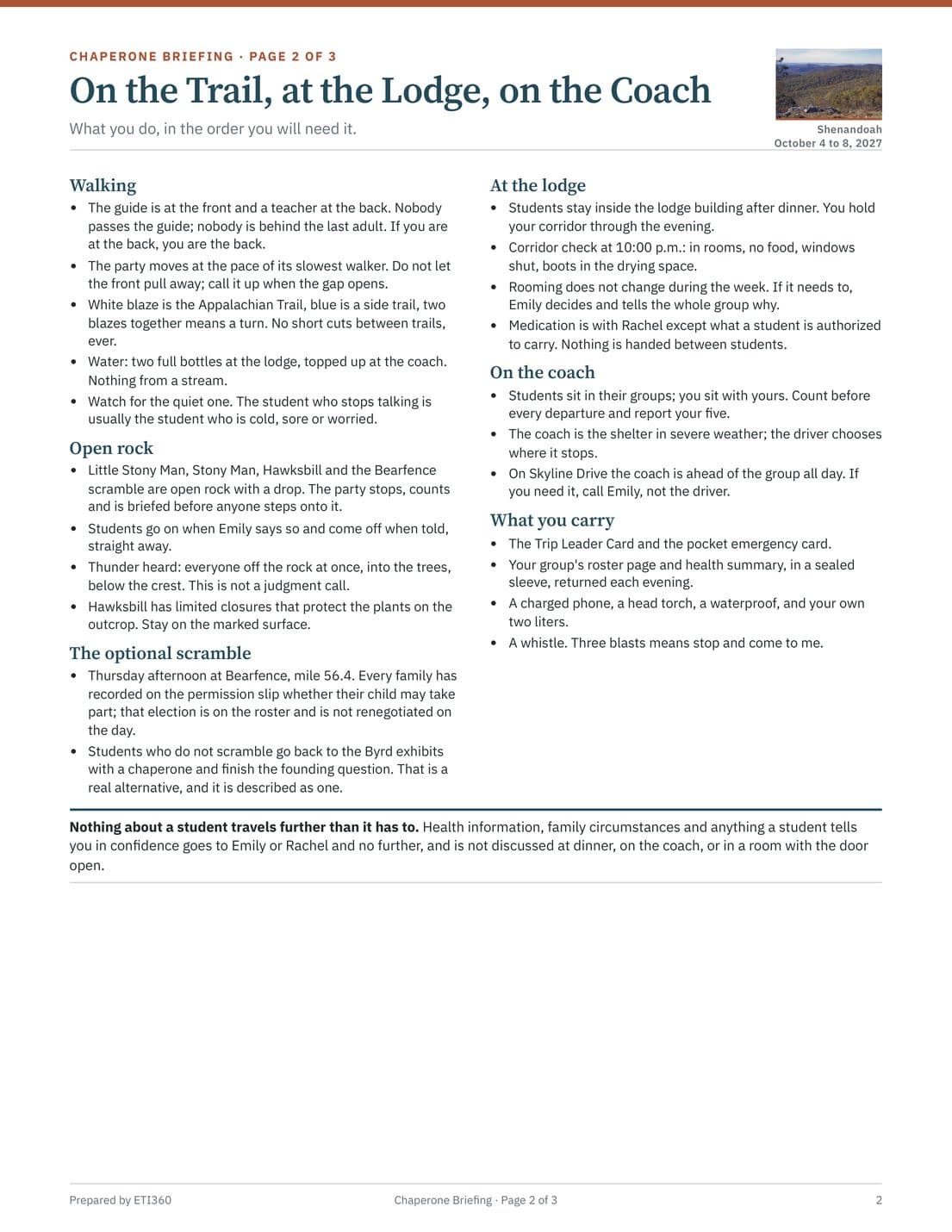
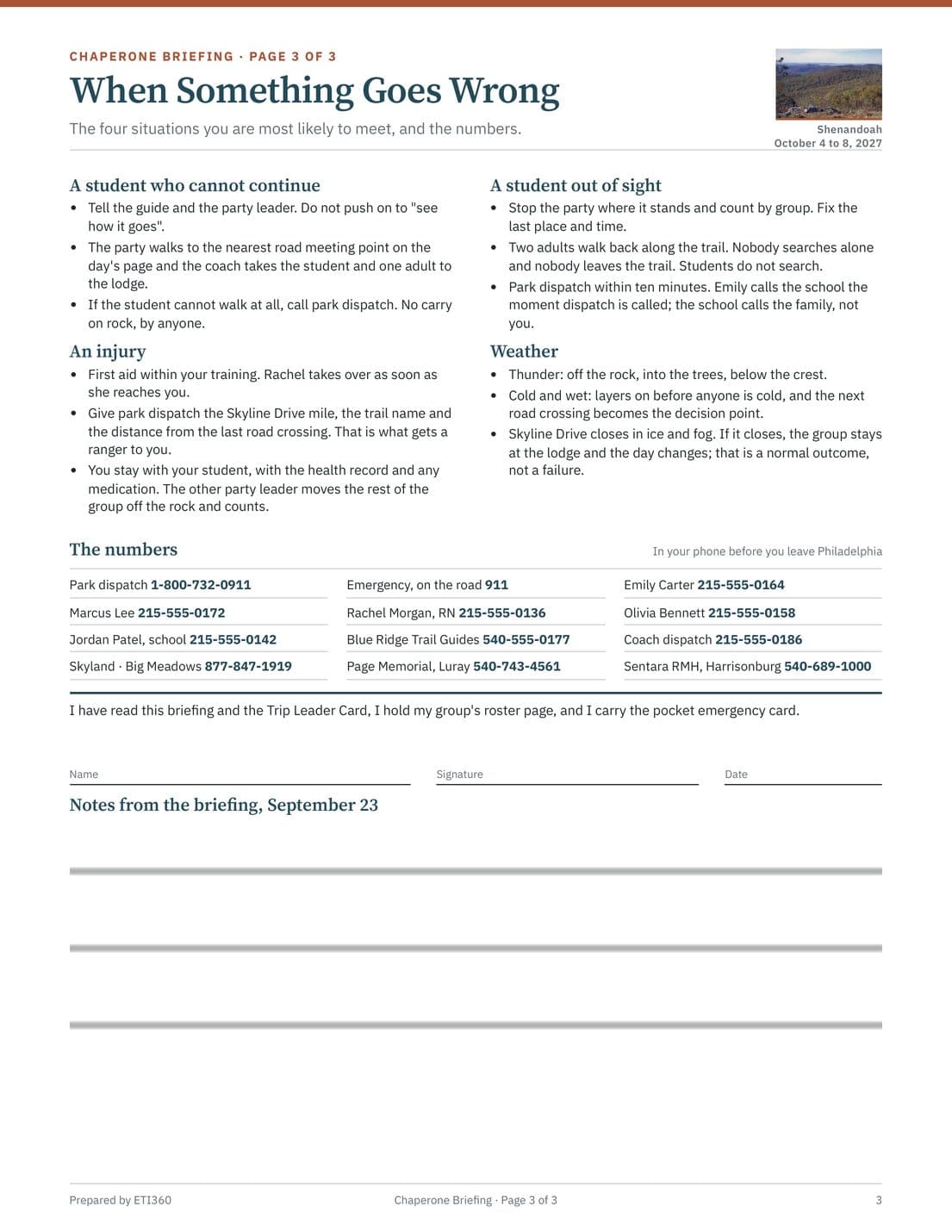
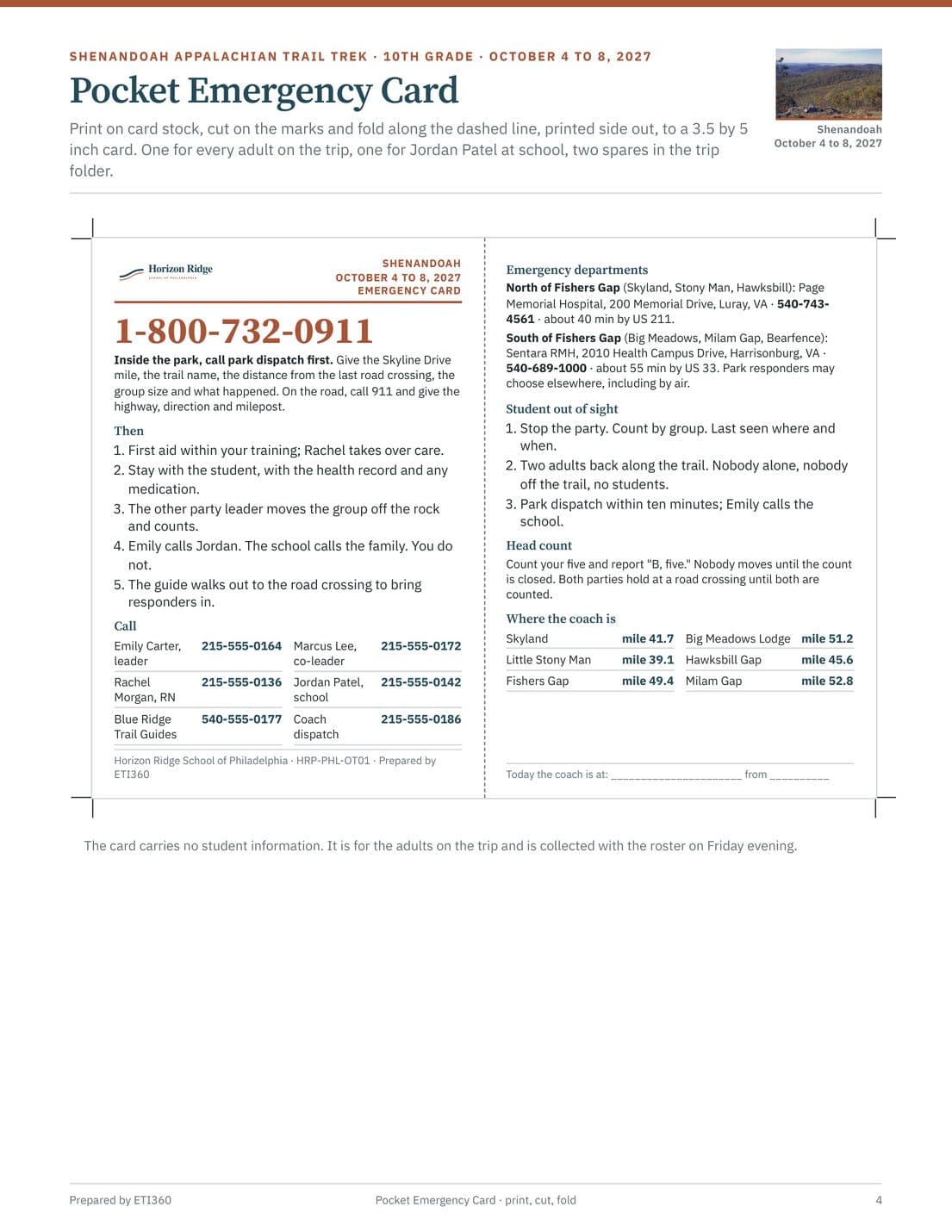
Chaperone Briefing and Pocket Emergency Card
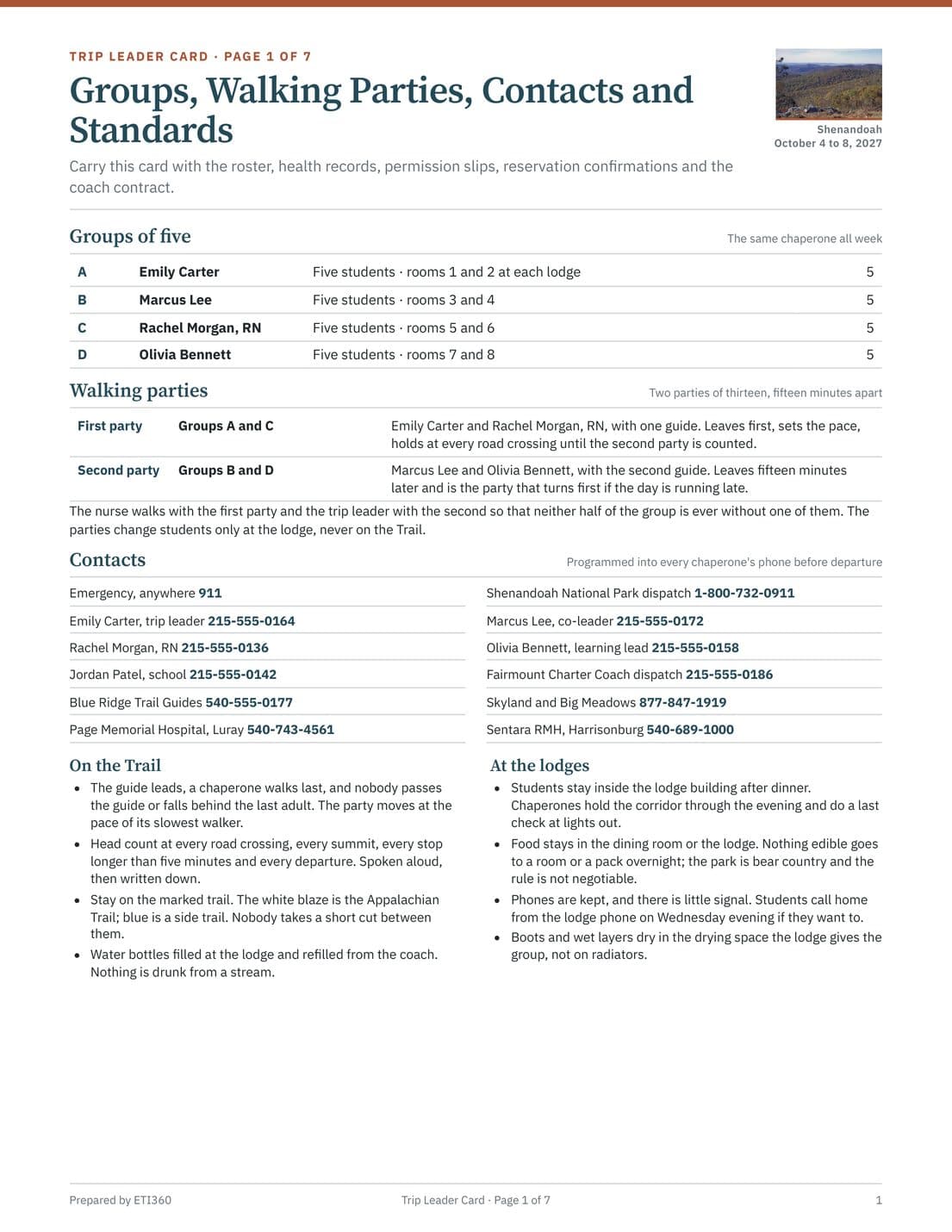
For the adults who each take five students: their group and walking party, the shape of a walking day, what they do on the Trail, at the lodge, and on the coach, and a card to print, cut, and fold that carries the emergency sequence and every working number.
Look inside
Deciding each day's route and turnaround
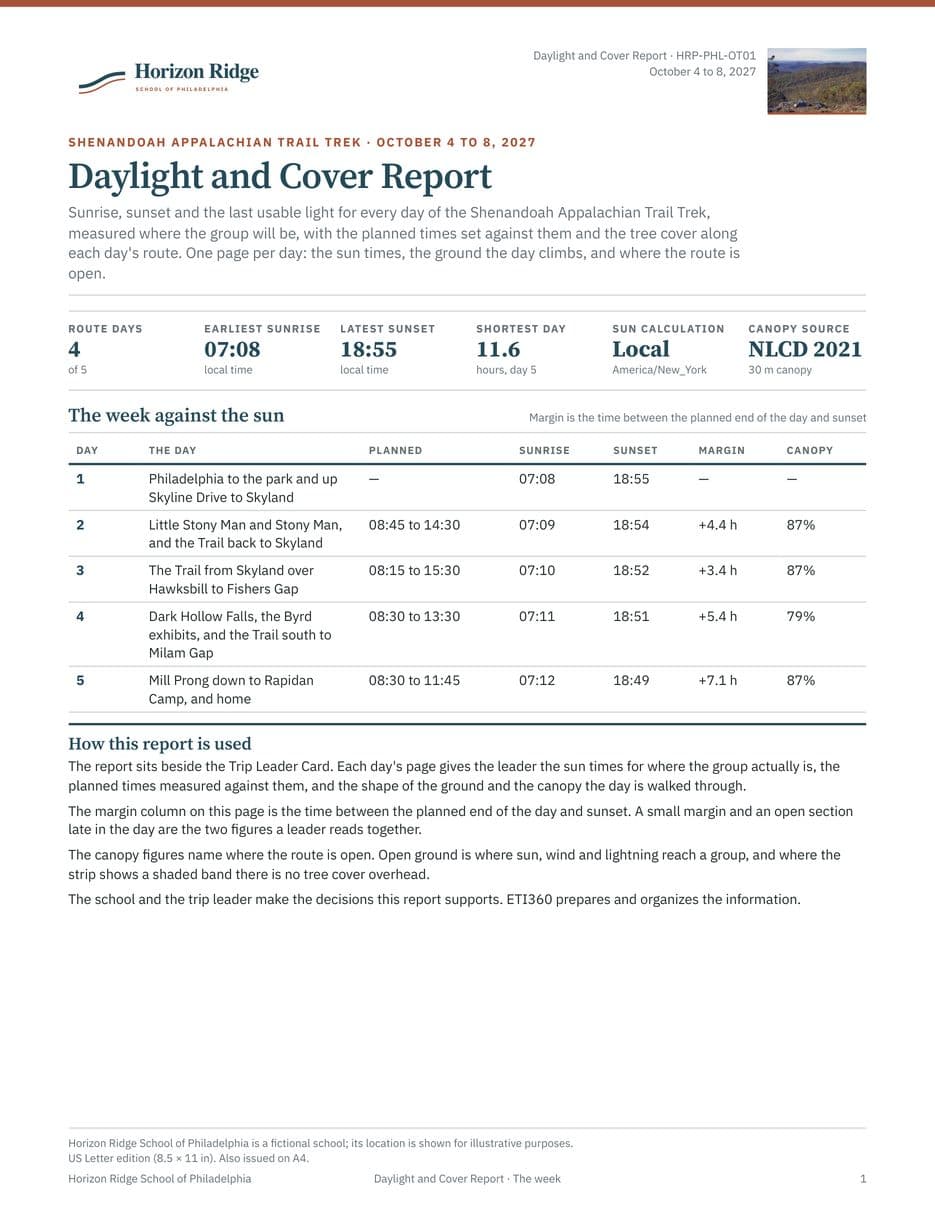
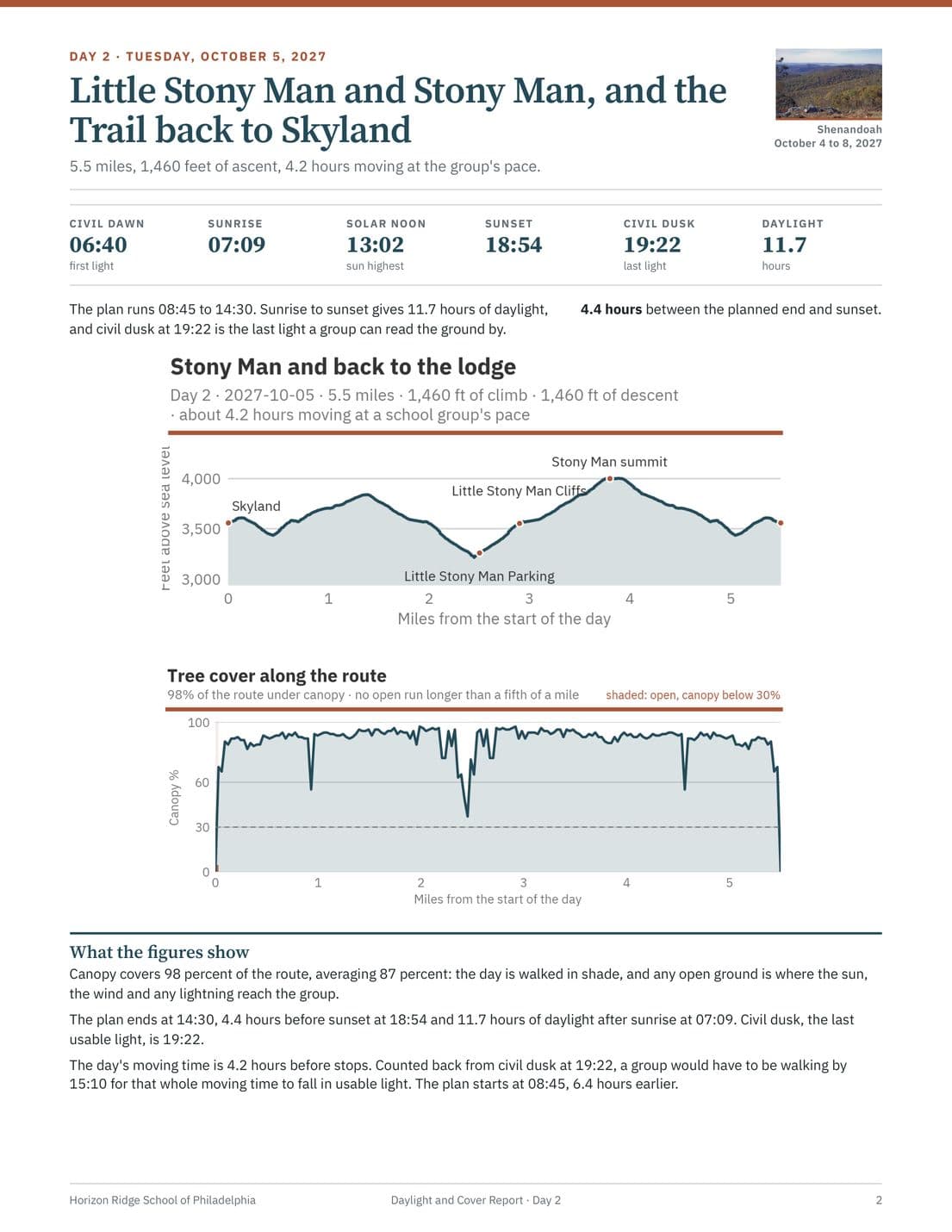
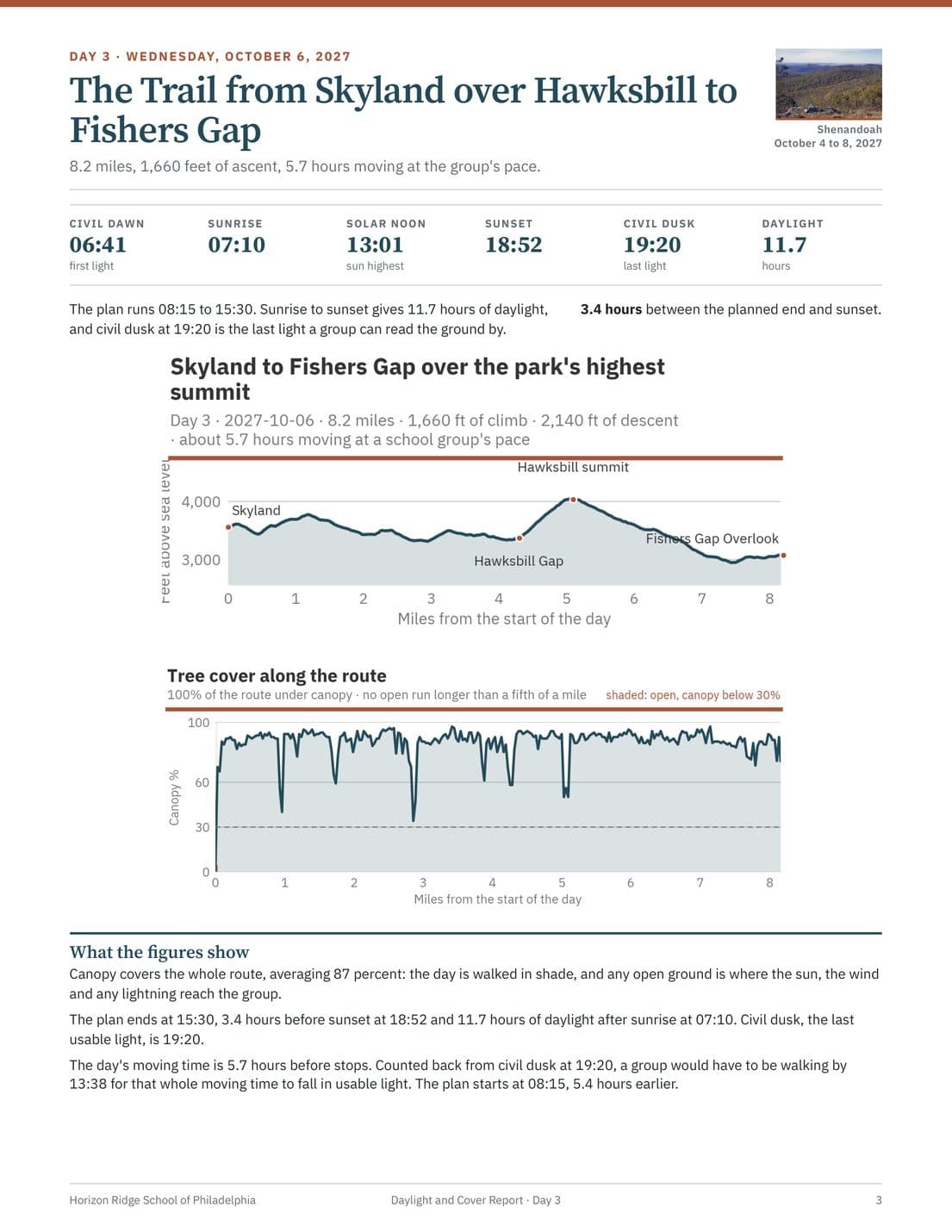
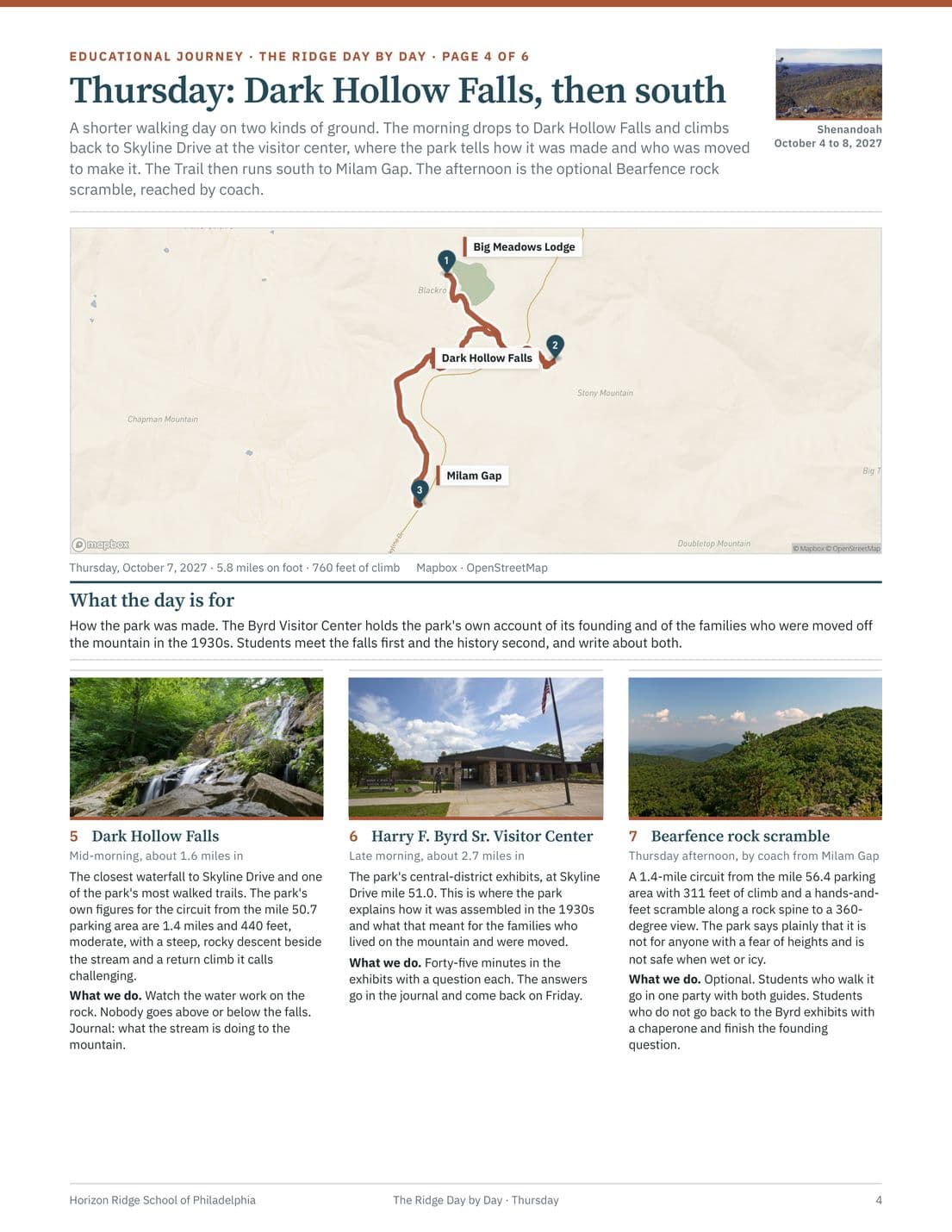
The Route Intelligence page for each walking day in the Trip Leader Card, with its turnaround times, and the sun times and tree cover for where the group will be. The trip leader makes the call on the day.
Trip leader
Daylight and Cover Report
Sunrise, sunset, and the last usable light for every day of the trip, computed for where the group will be, with the planned times set against them and the tree cover along each day's route.
Look inside

Connecting the trip to learning
One question about who decides what a place is for, carried from the classroom to the places on the ridge and back.
Teachers
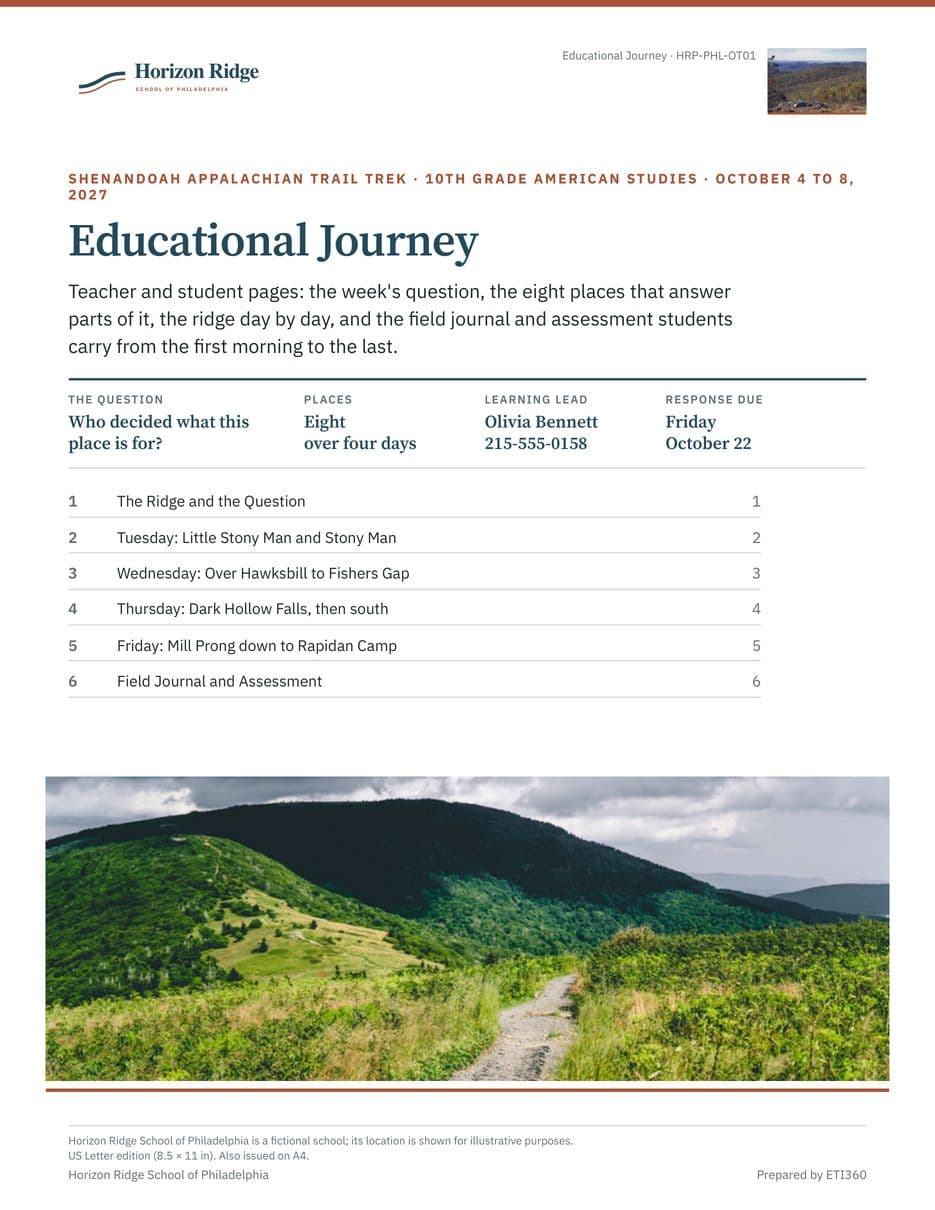
Educational Journey
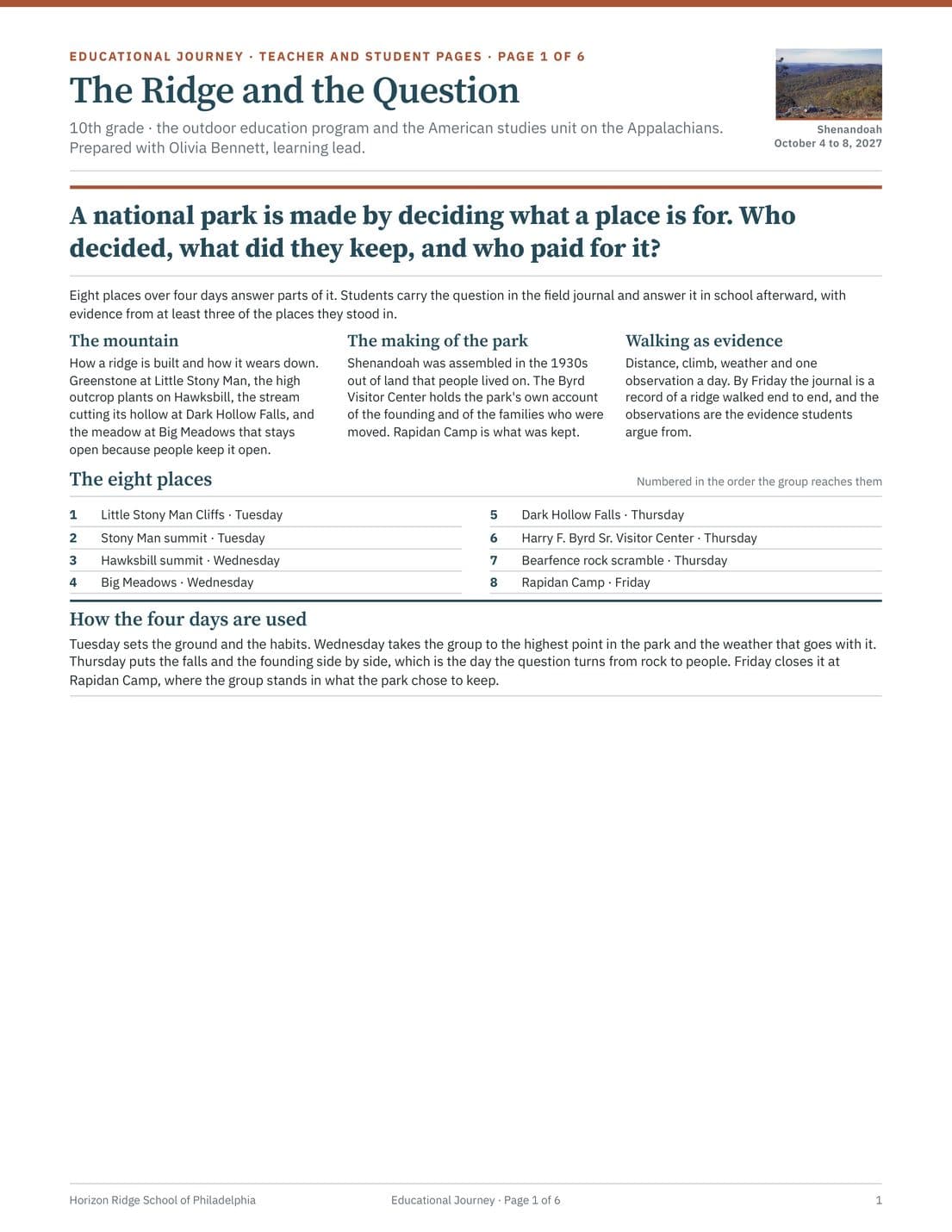
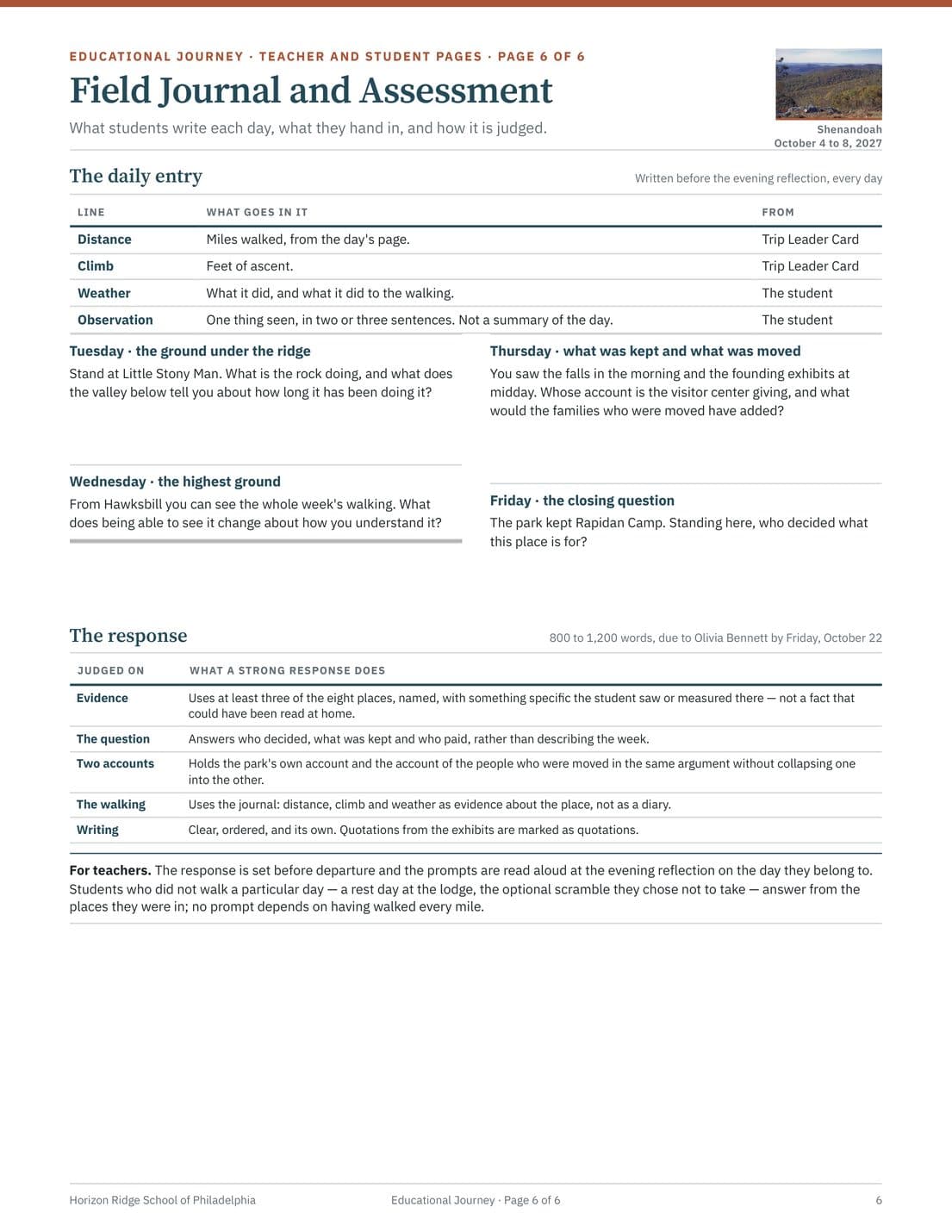
One question, the places on the ridge that answer parts of it, the walking days with a map for each, and the field journal and assessment guide.
Look inside
Students
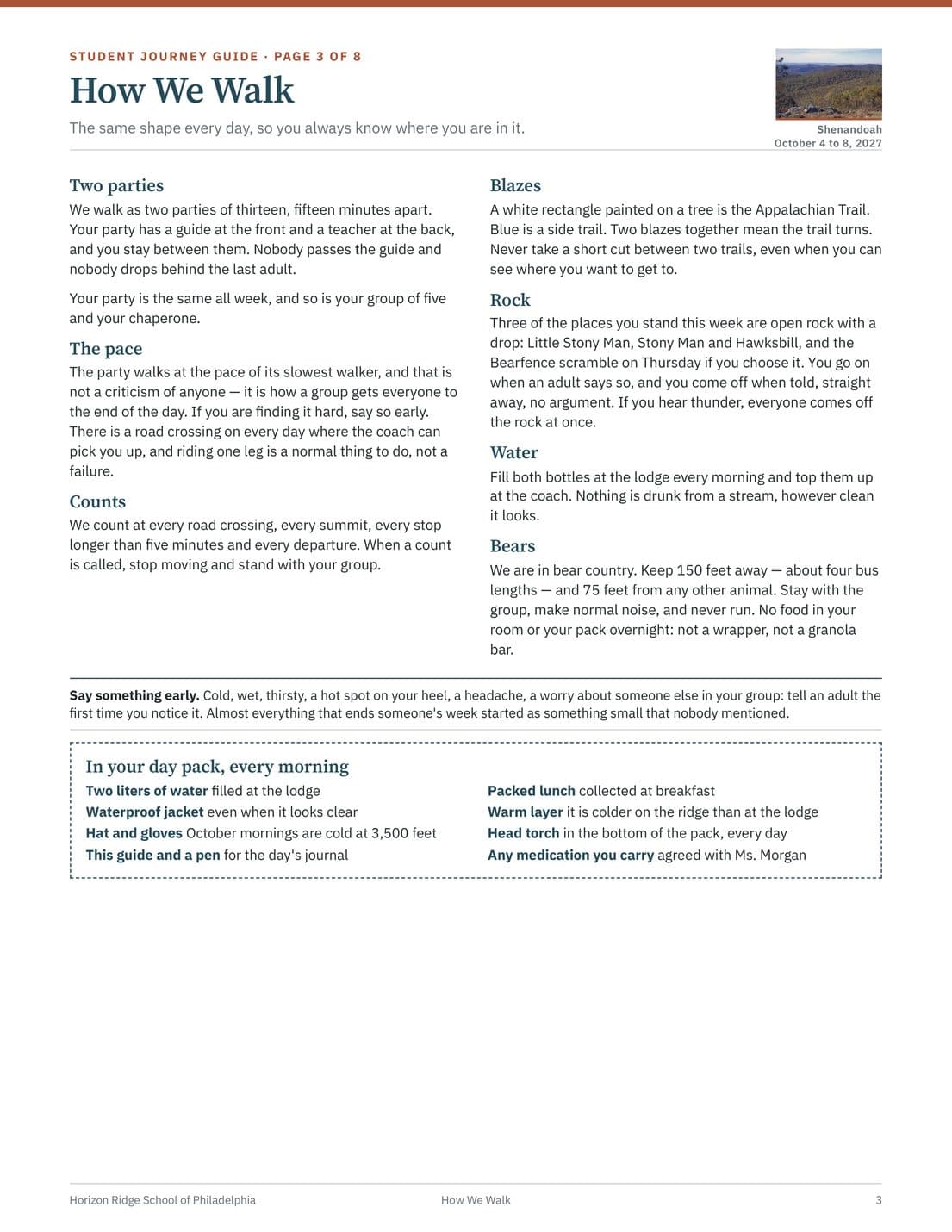
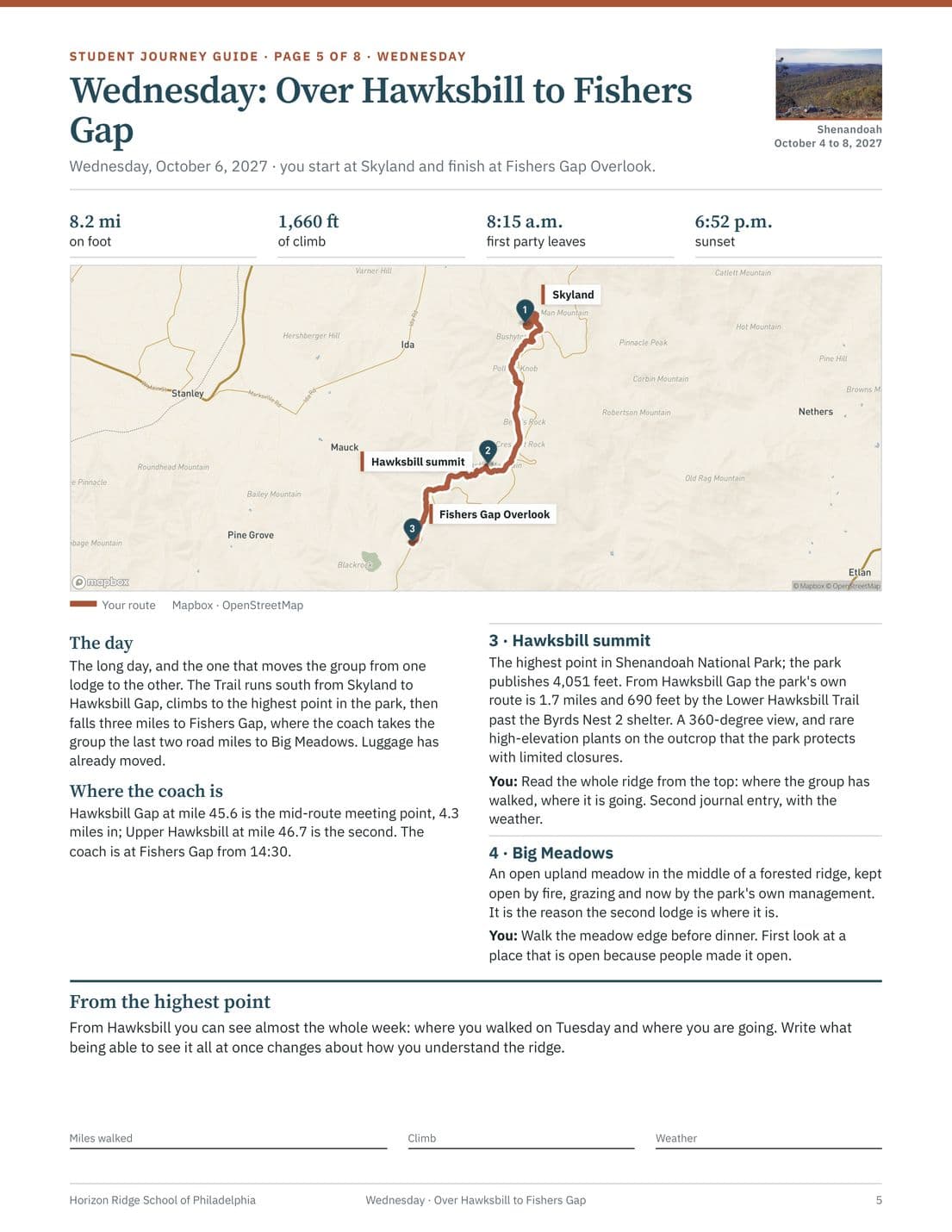
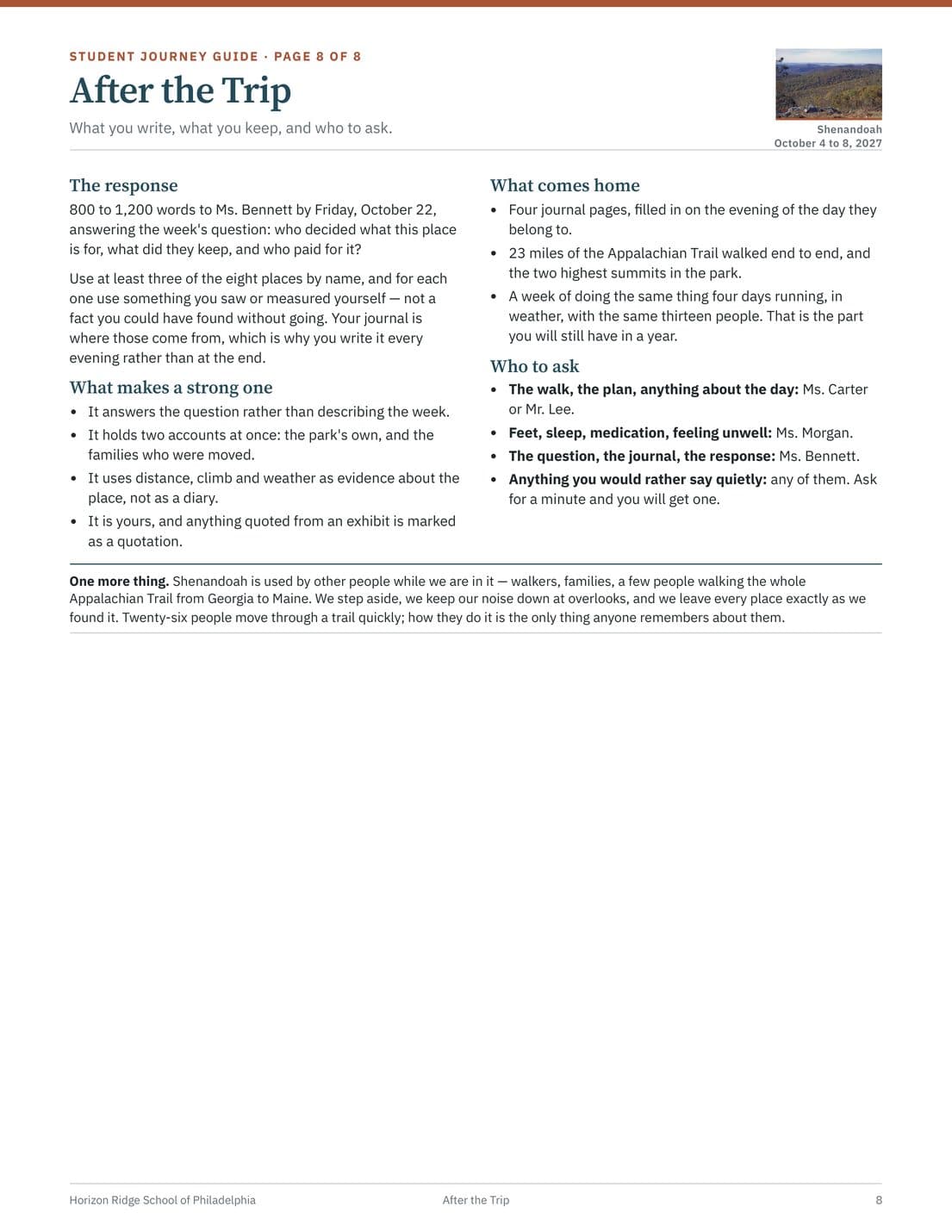
Student Journey Guide
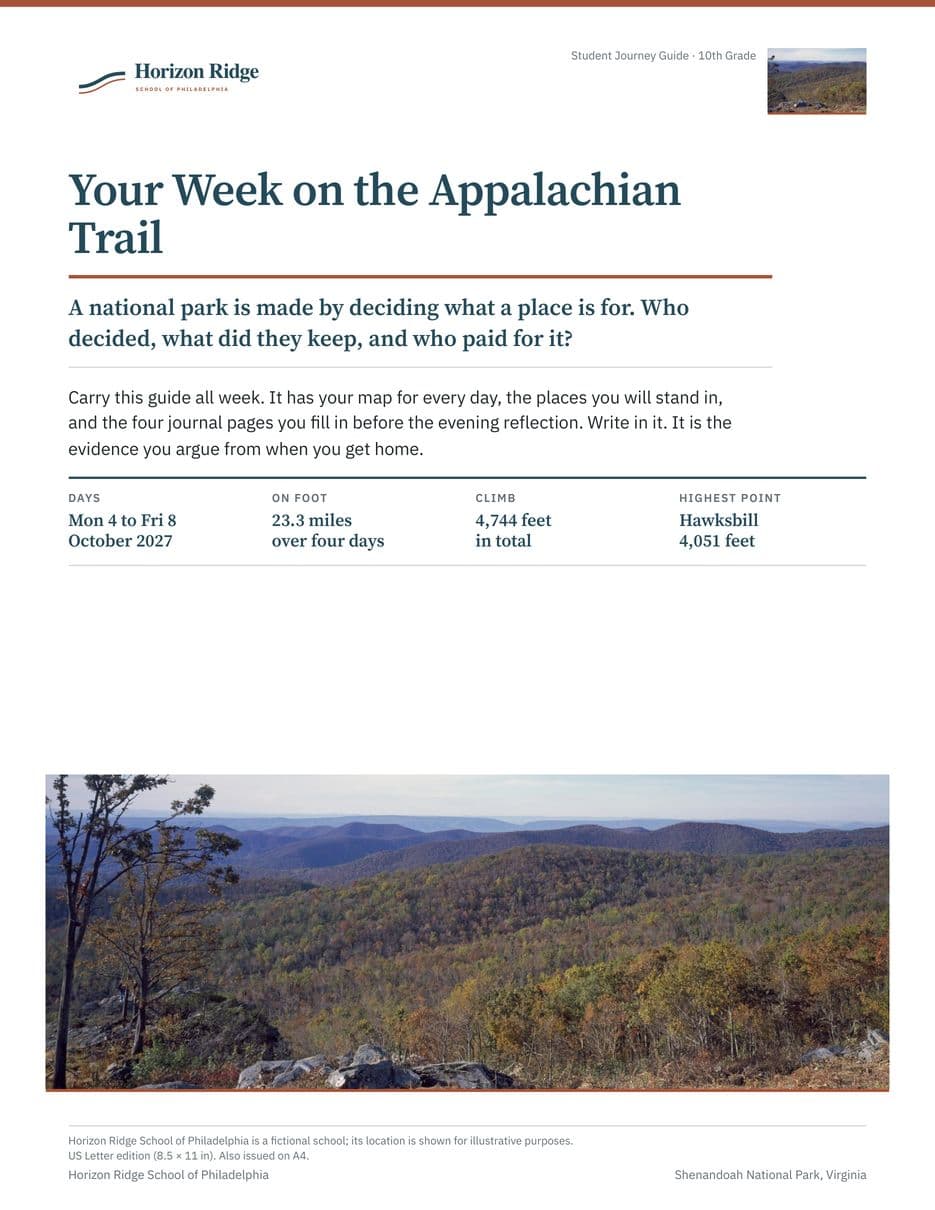
The guide students carry all week: the question, the week and the road, how the group walks, one page for each walking day with the map and journal prompts with room to write, and what happens afterward.
Look inside
Improving next year's trip
What students, families, the leaders, and the guides said, set out for the school's review.
After the trip
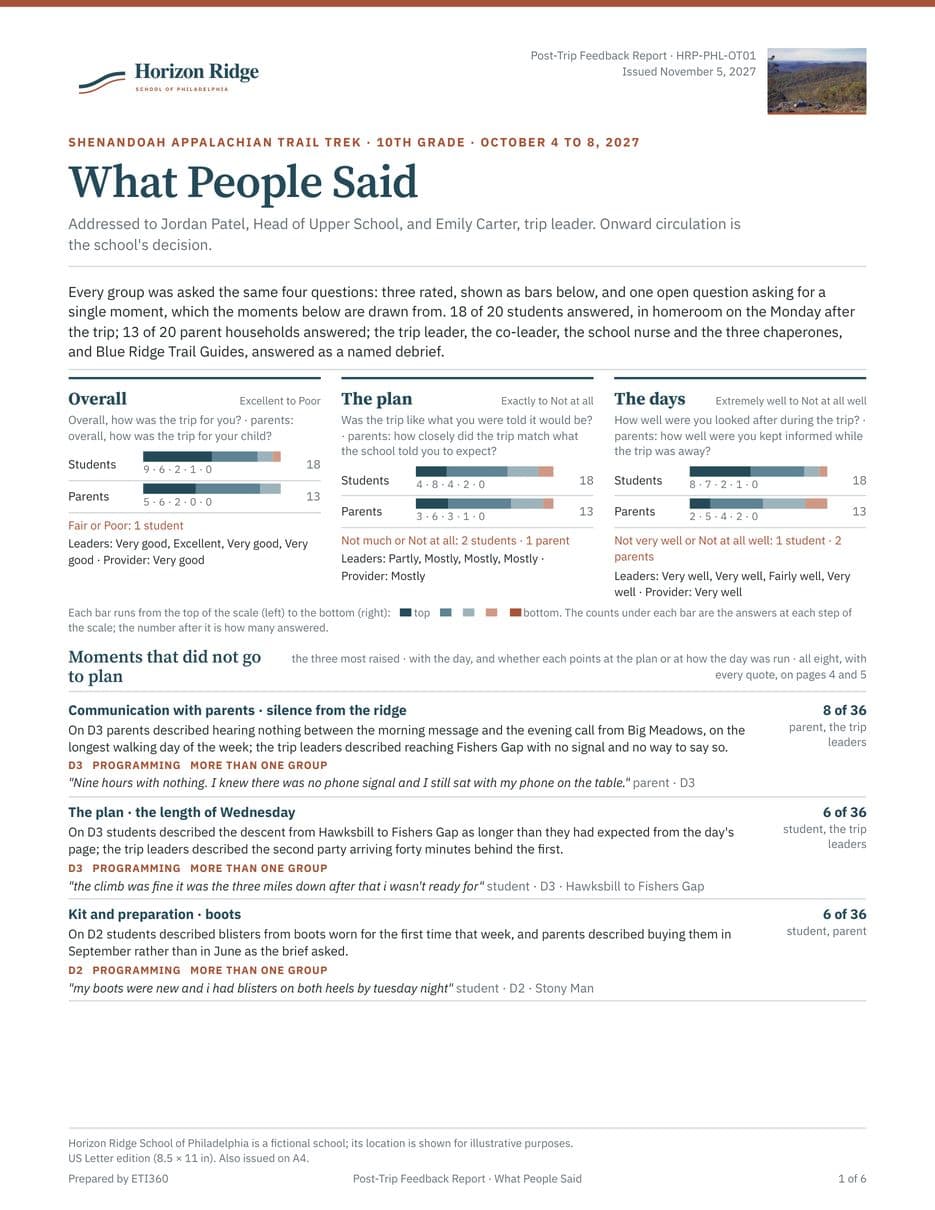
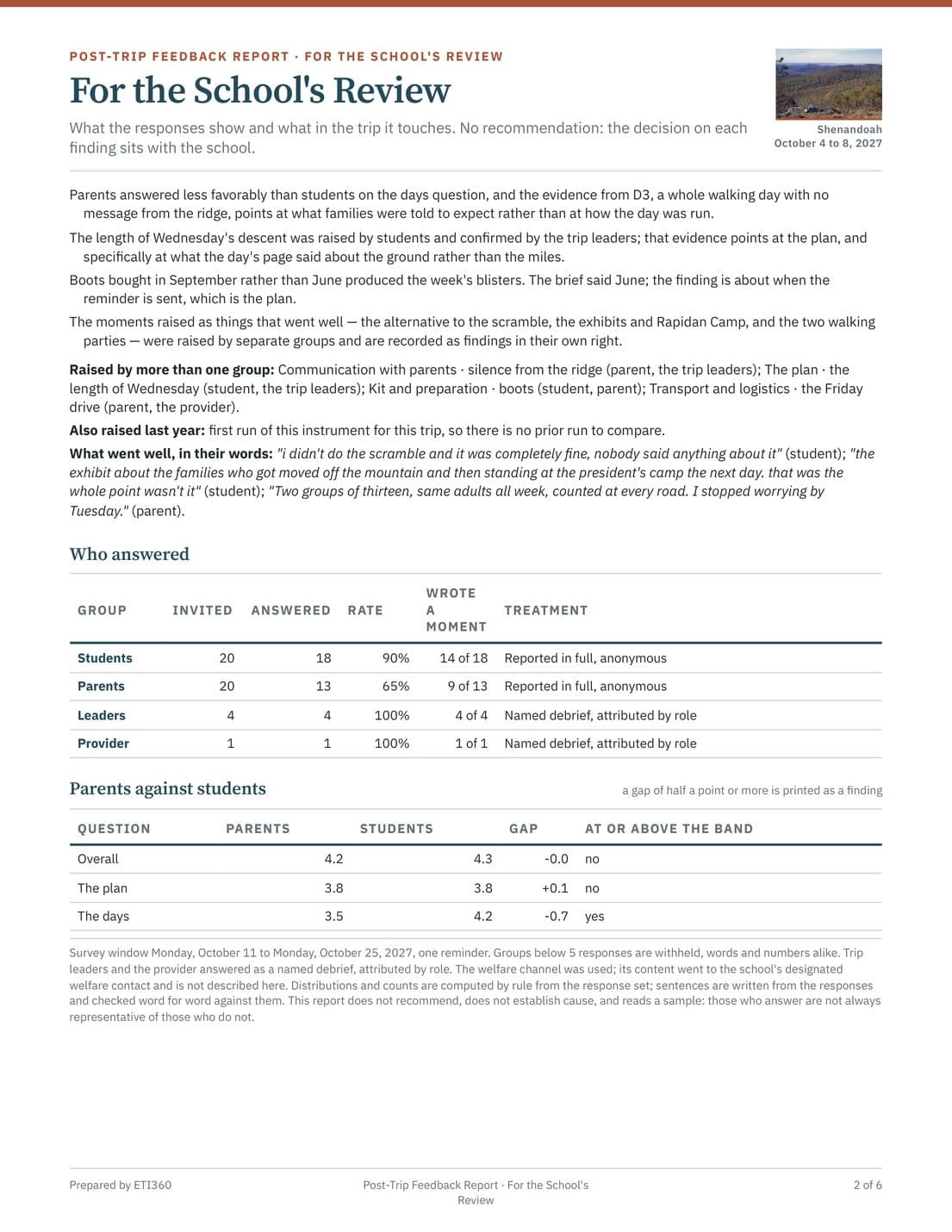
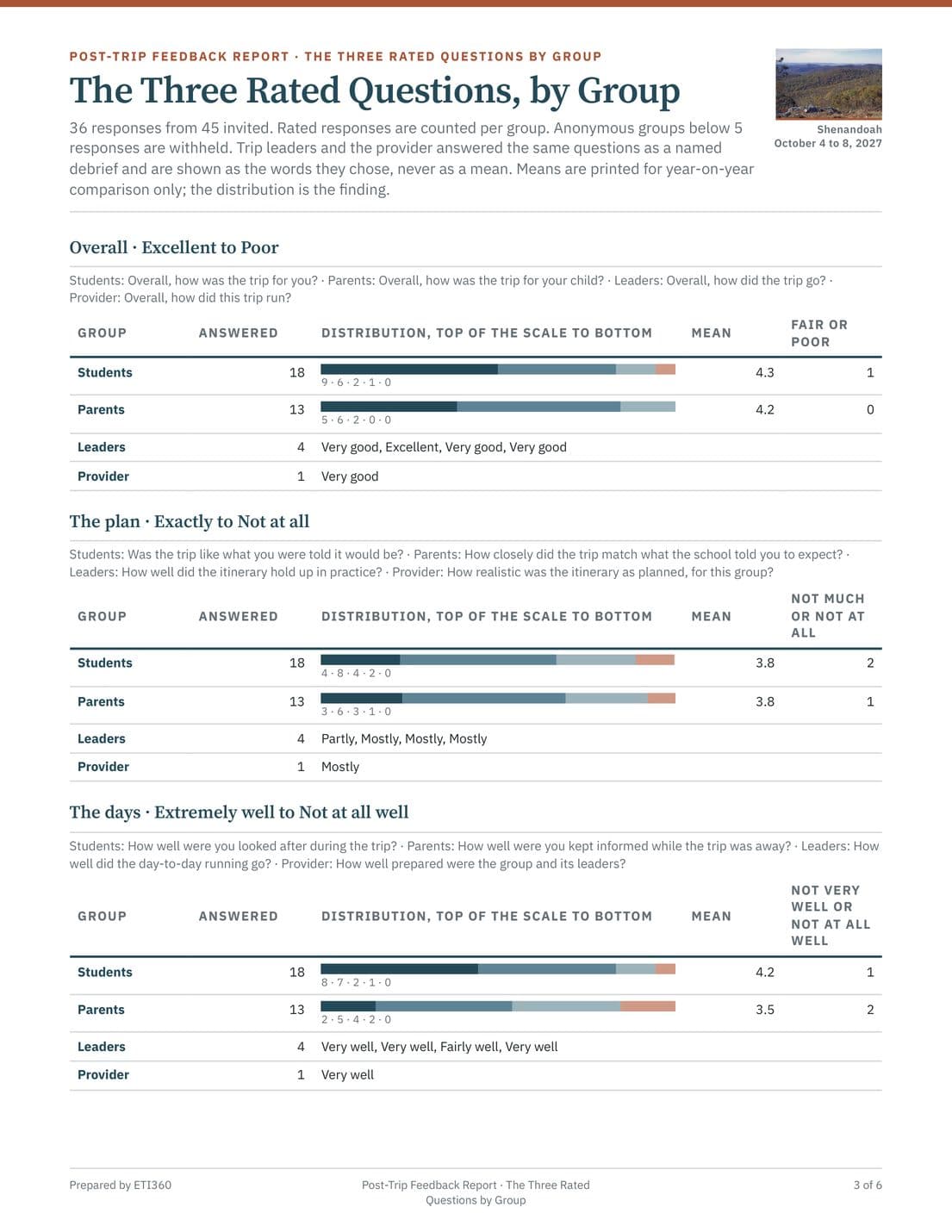
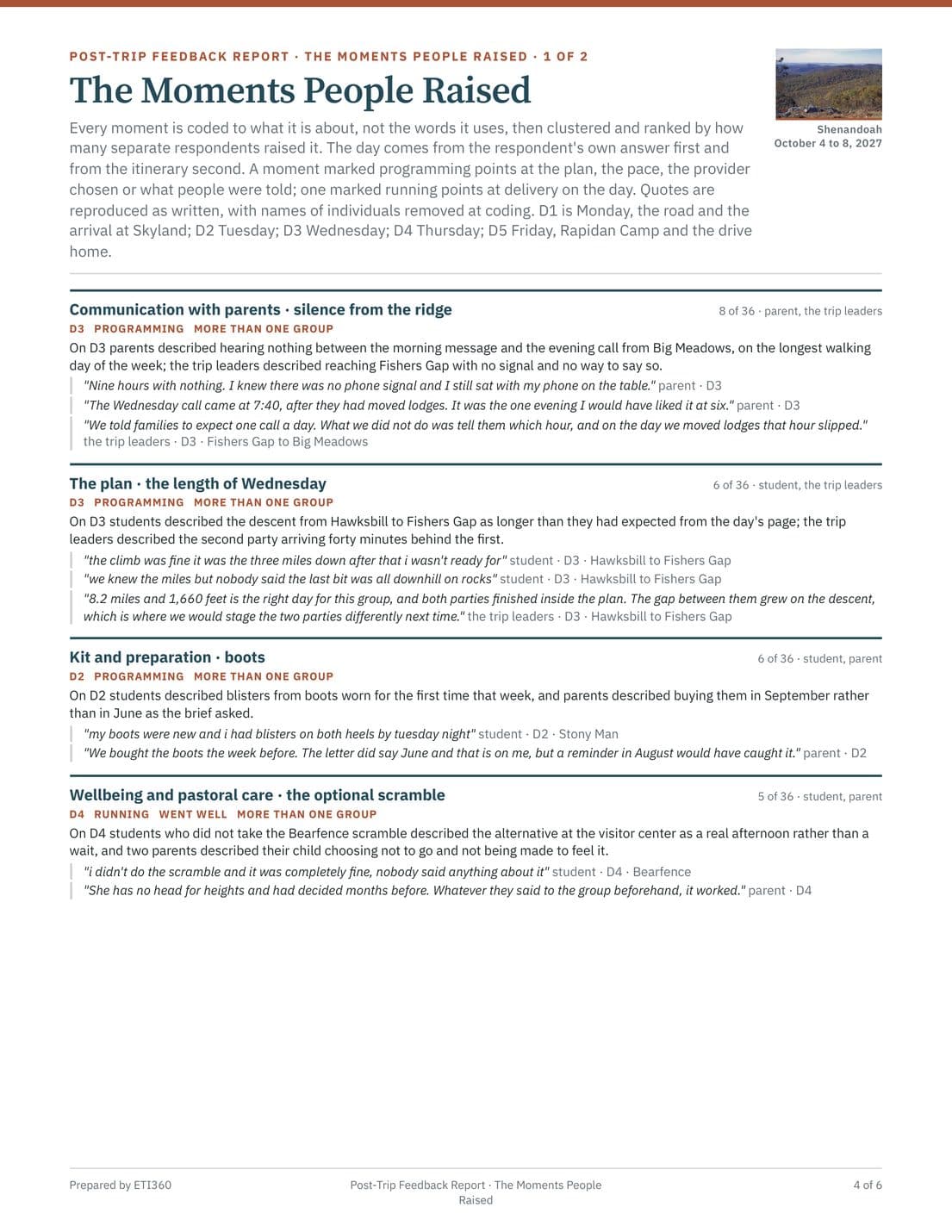
Post-Trip Feedback Report
Four questions asked of students, parents, the leaders, and the guides after the trip: what each group said, the moments that did not go to plan with the day they belong to, and what in the trip each one touches. It states; it does not recommend.
Look inside
Who decides
The school and any provider it works with retain responsibility for decisions, supervision, live assessments, and final approval.
The Trip Risk Working File is written for the school to review, complete, and approve. Its ratings are a starting point, its review lines are for the school’s own controls, and the trip leader makes the live assessment on the day.
Other worked trips
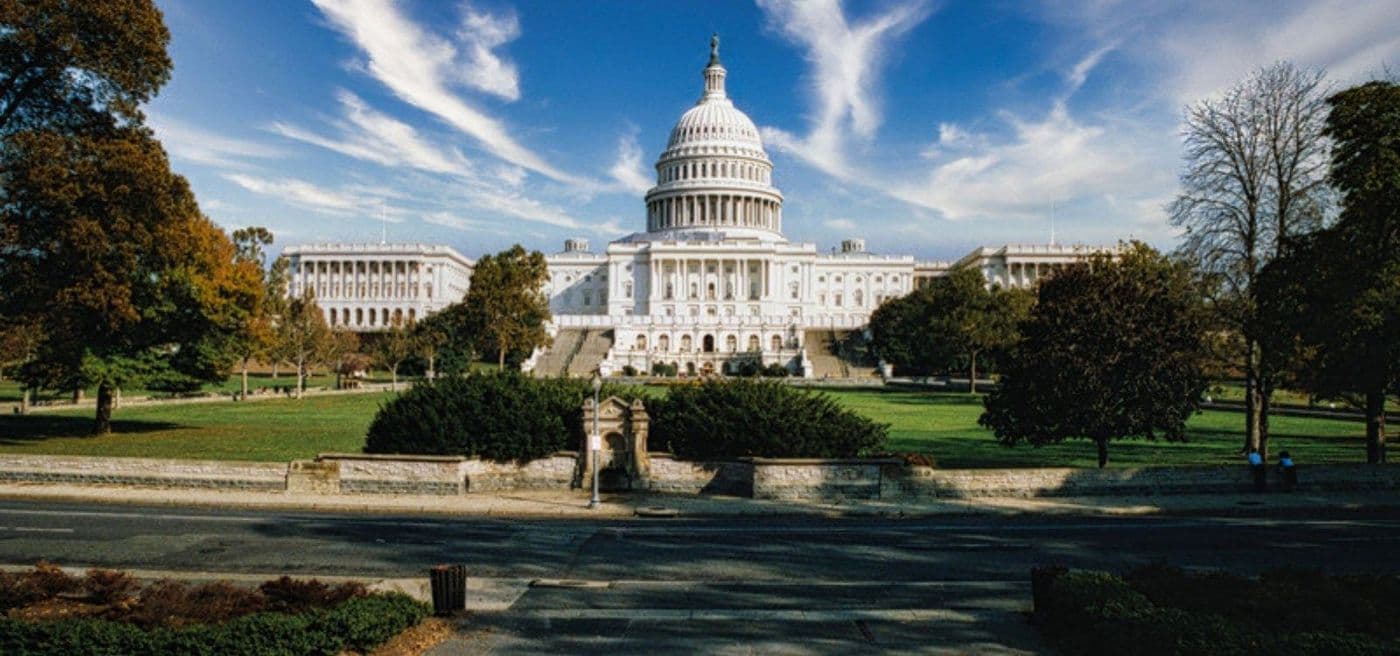 City · Washington, DCWashington, DCHorizon Ridge School of ClevelandSee the documents →
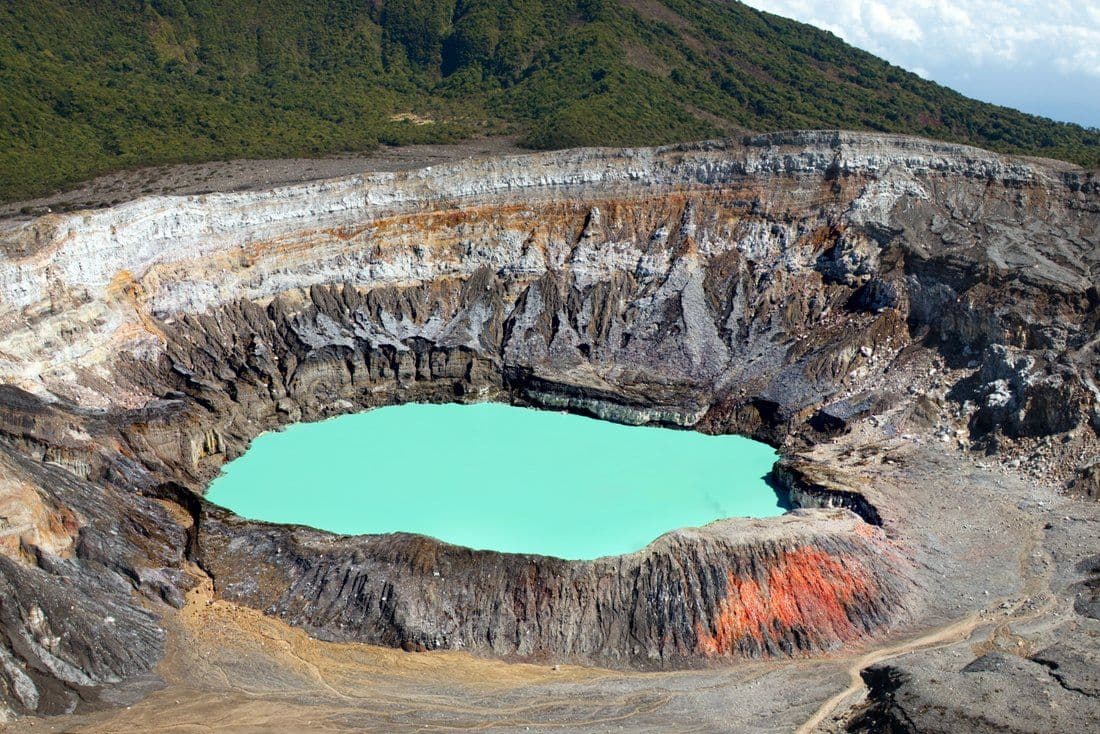 Service · Central AmericaCosta RicaHorizon Ridge School of ClevelandSee the documents →
 Culture · EuropeItalyHorizon Ridge School of ClevelandSee the documents →
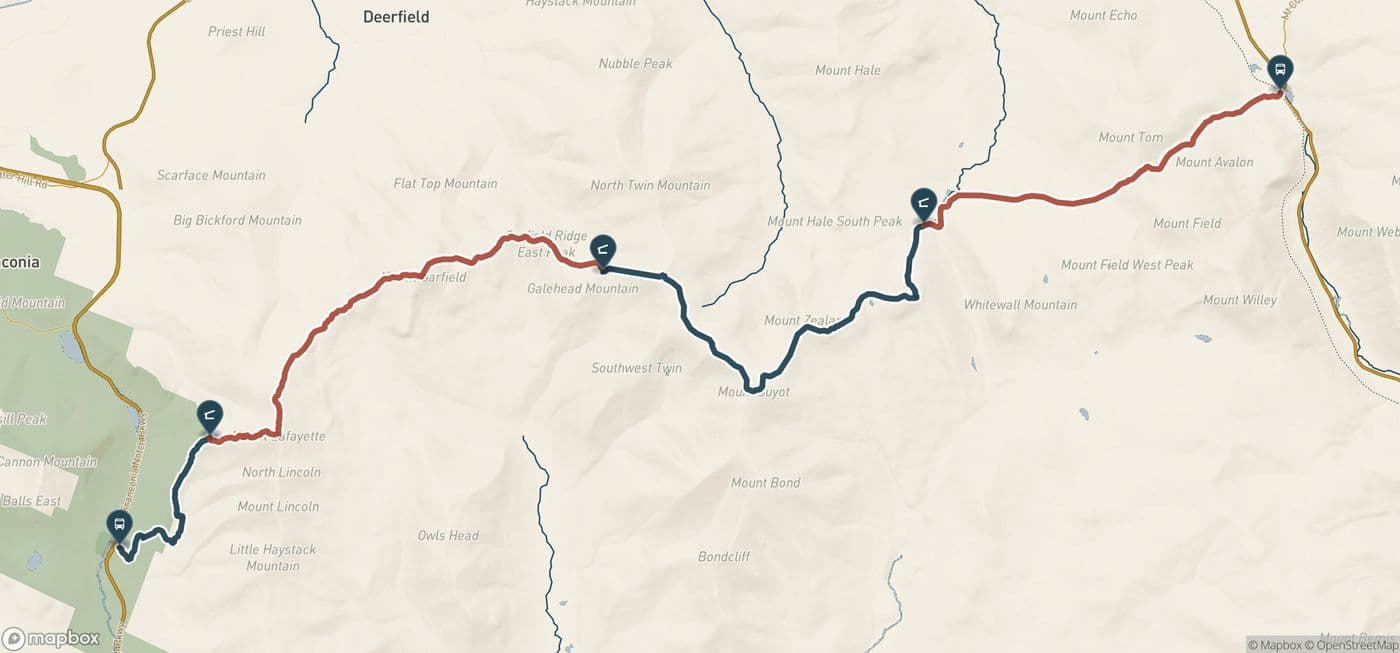 Outdoor · New HampshireWhite MountainsTideline SchoolSee the documents →
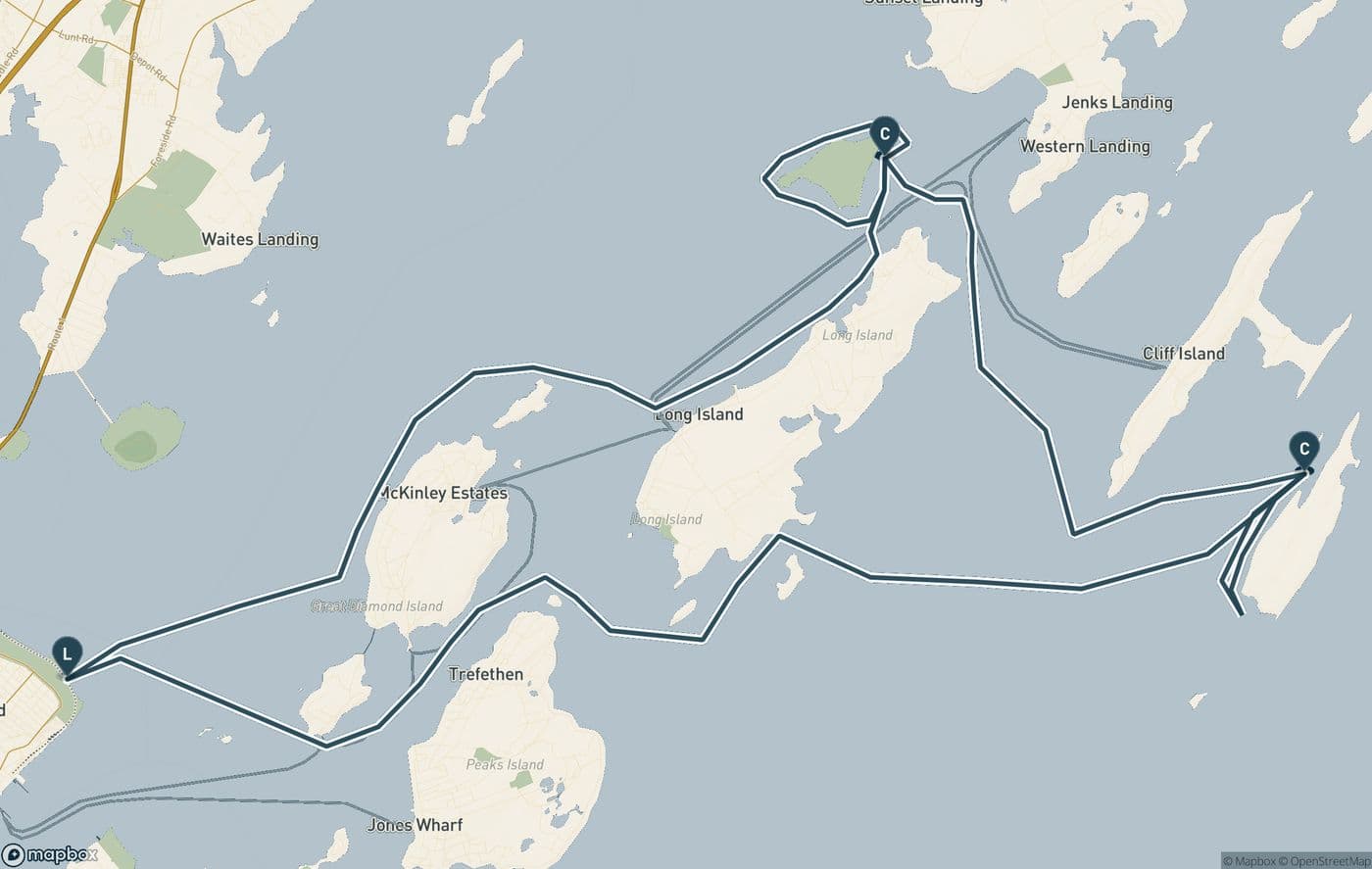 Outdoor · Maine coastCasco BayTideline SchoolSee the documents →The Trip Package →
Horizon Ridge School of Cleveland is a fictional school; its location is shown for illustrative purposes.
Tideline School is a fictional school; its location is shown for illustrative purposes.