Weather Brief
Are you able to anticipate the conditions your trips are likely to meet?
ETI360 turns the destination, dates and fifteen years of historical weather data into a concise planning brief—and makes the relevant risk information easier to adjust as the trip develops.
The planning question
Seasonal knowledge becomes useful when it is specific to the trip.
A destination label such as ‘Sydney in March’ is too broad for practical planning. The trip team needs the pattern for its dates: temperatures, rainfall, daylight and the range that history shows.
ETI360 prepares that context in the trip file, using a consistent source and format so likely conditions can be discussed alongside the itinerary and carried into the risk information prepared for the school’s review.
A date-specific worked example
Sydney in March, translated from climate history into planning context.
The brief combines typical ranges, rain frequency, daylight, daily historical averages and recorded extremes. Plain-language notes connect the data to the trip without claiming to predict the weather.
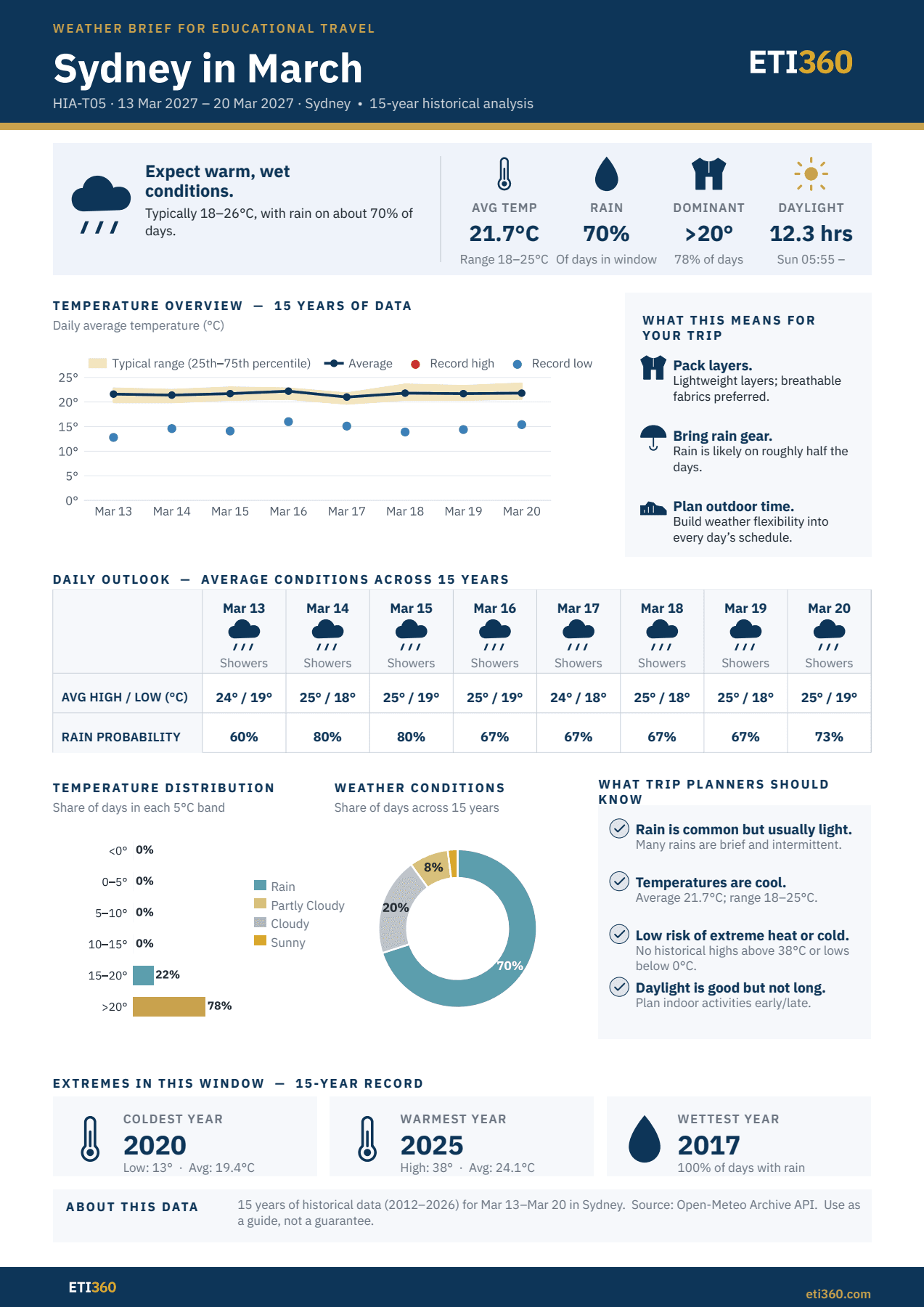
The data is selected for decisions a trip team can actually make.
The page avoids a data dump. It surfaces a small set of patterns and explains what they mean for preparation, scheduling and the risk information connected to the trip.
Temperature
Typical ranges and recorded variation show the conditions the window has historically produced.
Rain
Historical frequency shows whether wet conditions should be expected in the plan.
Daylight
Sunrise, sunset and available daylight add context to the daily program.
Risk information
Relevant seasonal context can be carried into the trip’s risk documentation and adjusted when dates or activities change.
How to read the page
A climate brief informs the plan; it does not replace a forecast.
Historical conditions are useful early, when the itinerary, preparation and risk information are still being shaped. Because the brief sits in the same trip record, a change of date, destination or activity can be reflected without starting the review again from scratch.
- History
- The brief uses a defined multi-year period for the same destination and date window.
- Pattern
- Averages and frequency describe what has been common, not what must occur.
- Extremes
- Recorded highs and lows keep normal conditions in context.
- Adjustment
- Relevant risk information can be refreshed as the itinerary or travel window changes.
Where this applies
For trips where destination conditions shape preparation.
The Weather Brief can support international travel, outdoor programs, field trips and seasonal departures. Each brief is matched to the destination and the dates held in the trip record.
Conditions become more useful when connected to the day.
The Weather Brief sits beside the Location Timeline and Route Intelligence, allowing likely conditions to be considered against the places, timings and activities in the same trip file.
A practical starting point
See the climate context for one upcoming trip.
Send the destination and dates for a trip already in planning. We will show how the historical conditions would be presented alongside the rest of the trip record.